
STB’s clarified two‑question framework and why it matters now
The Surface Transportation Board (STB) published a nonbinding policy statement that asks two concrete questions to decide whether state or local rules aimed at rail‑connected terminals fall under federal preemption under the Interstate Commerce Commission Termination Act (ICCTA). The statement uses active tests focused on how a facility operates and whether a regulation effectively controls rail service. That approach shifts analysis from the abstract identity of a target (railroads versus private customers) to the functional effects of a rule.
How the first question determines whether a facility is functionally a rail carrier customer
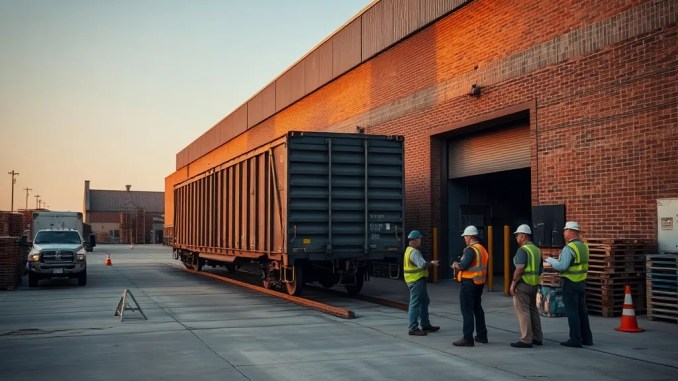
Ask whether the terminal or site was built or is used to receive or provide common‑carrier rail service. If a facility routinely accepts rail cars for unloading, loads rail cars for shipment, or otherwise transfers freight between rail and other conveyances, it meets this threshold. For example, a bulk transfer yard where inbound unit trains are routinely spotted and emptied is plainly within scope; a factory that once in a decade receives a single rail car for spare parts likely is not. The STB emphasizes facts such as: typical volumes of cars handled, whether railcars are regularly spotted or scheduled, and whether the physical layout is designed to accommodate rail operations.
How the second question gauges whether a local rule controls rail operations
Examine whether the ordinance or permit condition limits the rail service a facility can obtain by specifying car counts, train frequency, arrival/departure times, how trains must be assembled, or what commodities may be transported. If a rule changes the practical delivery of rail service (for example by capping cars per train or by barring certain cargo types), it functions as a regulation of rail transportation. The STB explicitly lists relevant variables: number of cars, frequency of moves, timing windows, train makeup, and permissible commodities. A local noise ordinance that sets a generic decibel limit and applies equally to all industrial activity is less likely to target rail service than a rule that forbids trains during specific hours when carriers operate.
When both answers are yes: federal preemption and review paths
If the facility is used to receive or provide rail service and the local rule in practice restricts that service, the STB says the regulation has the practical effect of regulating rail transportation. Such rules trigger ICCTA §49 USC 10501(b). The STB will then determine whether preemption review is categorical (a rule always preempted) or case‑specific (a fact‑intensive inquiry). Examples: (1) An ordinance that outright bans new rail sidings at all terminals could be treated categorically; (2) a conditional limit on cars per day might require a case‑by‑case balancing of impacts and justifications.
When either answer is no: state or local authority usually stands
If a facility is not primarily used to receive/provide rail service, or the regulation does not materially affect how rail service is provided, ICCTA federal preemption typically will not apply. The STB clarifies that ordinary land‑use rules, safety codes (electrical, fire), and environmental standards that do not single out rail service remain enforceable. For example, a zoning rule that applies broadly across industrial properties and does not change carrier operations will usually withstand a federal preemption challenge.
How prior STB decisions fit the new test (SEA‑3 and Valero)
The STB revisited SEA‑3 and the Valero decision to display how outcomes hinge on the two questions. In SEA‑3, municipal limits on expanding a transload site would have forced carriers to shift identical freight into smaller per‑move consignments, changing frequency and operations; that functional control supported preemption analysis. In Valero, denial of a transload facility foreclosed the planned unit counts and types of service the refinery would receive, similarly showing how operational constraints matter more than who the ordinance nominally targets.
Property takings, eminent domain, and stronger presumptions
The STB highlights a stronger federal interest where a state or local action would acquire railroad property or extinguish a valid easement used for rail transportation. In those cases, the Board signals that categorical preemption is more likely: taking physical rail property directly impairs interstate rail service. Routine municipal regulations that do not appropriate rail property remain subject to the two‑question, fact‑driven test.
Practical steps for rail carriers, shippers, and local governments
Rail carriers and shippers should document operational facts that satisfy the first question: historical car counts, scheduled spotting, train consist plans, and physical design for rail operations. When opposing local limits, quantify how a rule would change train frequency, car volumes, or cargo types. Local governments should draft requirements that achieve public objectives without prescribing operational aspects of rail service. Where safety, noise, or environmental goals require limits, craft standards tied to neutral performance metrics (eg, sound levels, emissions thresholds) rather than explicit train counts or timing restrictions.
Eleven recurring dispute types the STB highlighted
The policy statement maps common dispute categories—abandonments, grade crossing closures, locomotive idling, noise complaints, routing interventions, and takings among them—and explains how the two‑question test applies in each context. For instance, a grade crossing closure that forces rerouting of trains or changes in service frequency may implicate preemption, while a general traffic restriction that does not alter rail operations likely will not.
How to prepare a persuasive ICCTA preemption filing
Build filings around the two questions with clear empirical elements: timeline of rail usage, normal operating patterns, projected changes if the regulation stands, and measurable service impacts. Use carrier manifests, switching logs, time‑stamped spotting records, and engineering diagrams to show the facility’s rail function. For the second question, present modeled outcomes (cars/day, train moves/year) under the challenged rule and identify less‑restrictive alternatives local officials could adopt to meet their objectives without controlling rail operations.
Key examples and what they teach
Concrete examples clarify likely outcomes. A port that routinely receives unit trains of 100 cars and faces a local rule limiting train arrivals to one per day will likely pass both tests and trigger federal review. A distribution center that sporadically receives single cars for noncore inventory will likely fail the first test, leaving local rules intact. Use these hypothetical fact patterns when advising clients or drafting ordinance language.
Limits and open questions
The STB left unresolved whether certain hybrid rules—those that mix neutral performance requirements with operational restrictions—should be treated categorically or on a case‑by‑case basis; it emphasized that future adjudications will refine the line. Also, courts may weigh in where filings involve takings claims or unusual local factual patterns. Parties should anticipate litigated clarifications and structural evidence to address both tests simultaneously.
Bottom line for stakeholders
The two‑question test reframes preemption analysis around functional control of rail service. Stakeholders that document operational realities and craft narrowly tailored regulations or rebuttals will fare best. The STB’s approach encourages precise fact‑gathering and targeted remedies—either federal intervention where local rules actually regulate rail service, or room for state and local governance when rules do not affect carrier operations.




Be the first to comment