
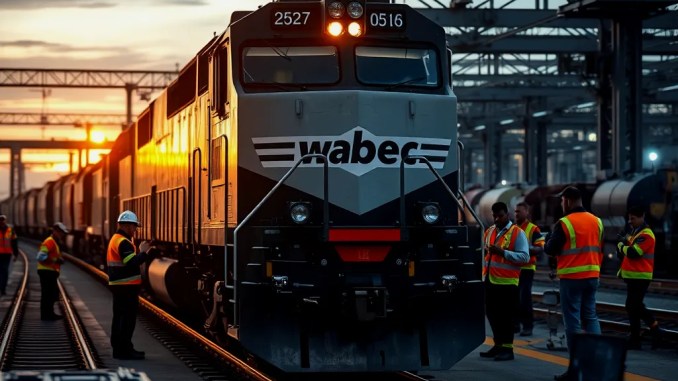
Wabtec signs long-term support agreement with Transnet
Wabtec finalized a long-term support agreement with state-owned Transnet to boost the operational reliability of its 43D (C30ACi) and 44D (ES40ACi) diesel locomotive fleets. The contract—announced by Transnet Engineering on 15 October and valued by Wabtec at roughly $390 million—covers spare parts supply, component overhauls, technical expertise, and the company’s Expert-on-Alert digital monitoring platform. Transnet reported the same deal as about 6.6 billion South African rand. Key signatories included Transnet Engineering CEO Bessie Mabunda, Wabtec South Africa director Tefo Mokaila and Transnet Group operations director Solly Letsoalo.
What the package delivers and how it improves fleet uptime
The agreement bundles parts provisioning, onsite technical support, predictive-diagnostics software and lifecycle management. Wabtec will deliver calibrated maintenance plans and condition-based interventions using Expert-on-Alert to spot anomalies such as rising engine temperatures, turbocharger performance drift, or traction engine electrical irregularities before they cause failures. By instituting monitored KPIs and regular firmware and calibration updates, the program aims to shorten Mean Time To Repair (MTTR) and extend Mean Time Between Failures (MTBF).
Concrete elements included in the service package:
– Spares and components: interchangeably stocked critical modules (fuel pumps, injectors, traction motors, inverters), consumables, and rebuild kits.
– Predictive maintenance: remote telemetry, scheduled analytics, and threshold-based alerts to trigger targeted field interventions.
– Technical expertise: on-site troubleshooting teams, remote engineering support, and OEM repair procedures.
– Lifecycle management: end-to-end asset records, repair histories, and refurbishment roadmaps to optimize total cost of ownership.
How predictive monitoring changes maintenance workflows
Deploying Expert-on-Alert changes maintenance from calendar-driven to condition-driven operations. Step-by-step typical workflow:
1. Data capture: telemetry streams from sensors (engine speed, coolant temp, vibration, DC link voltage) feed the platform.
2. Automated analysis: algorithms compare live signals to baseline signatures and detect deviations beyond defined thresholds.
3. Diagnosis and prioritization: the system classifies events by severity and recommends immediate actions for red alerts while queuing yellow alerts for scheduled checks.
4. Field response: mobile technicians receive task packs with required parts, diagnostic scripts and torque values for repairs.
5. Closed-loop verification: after repair, telemetry confirms the anomaly cleared; records update the asset history.
Workforce, local industry and supplier development commitments
Both parties emphasized the deal’s industrial and social impact. Transnet’s CEO of engineering, Bessie Mabunda, highlighted a commitment to create at least 100 new jobs and to run a graduate development program that enrolls about 20 students every two years. The agreement includes supplier development measures that ramp subcontracting from an initial baseline—described as sequentially increasing from 7% up to 30%—to boost black industrial participation and grow local content.
Operational measures to enable local content and skills transfer include joint training curricula for technicians, shadowing on complex rebuilds for Transnet staff, and supplier capability audits tied to staged contract awards. These actions are intended to ensure that, over the contract life, a larger share of component refurbishment, assembly and logistics will occur within South African suppliers.
Commercial and governance controls embedded in the contract
The contract specifies benchmarking, performance measurement, and governance mechanisms that allow Transnet to monitor pricing, delivery and quality across the program. Typical controls described by the parties include:
– Quarterly performance reviews with mutually agreed KPIs (availability, MTBF, on-time delivery).
– Price and quality audits tied to defined tolerances and remediation paths.
– Governance forums for escalation and to arbitrate supply-chain pinch points.
Context: Wabtec and Transnet’s prior locomotive relationship
Wabtec’s working relationship with Transnet traces back to its heritage with GE Transportation. Between 2010 and 2018, more than 436 locomotives were produced under programs involving GE and Transnet Engineering, while GE announced a 2014 order for 233 Evolution-series locomotives intended to supplement a prior 143-unit order. Legal challenges later affected that 2014 procurement: on 14 April 2025, the South African High Court set aside the 233-unit contract, and an approved settlement left Transnet holding the locomotives while providing Wabtec (then GE South Africa Technologies) with prior payments plus a supplier-development credit and payment to Transnet.
Key dates and practical implications for operators
Relevant timeline points:
– 17 March 2014: GE announced a 233-unit Evolution-series order for Transnet.
– 14 April 2025: South African High Court annulled the 2014 233-unit contract; settlement preserved certain payments and development commitments.
– 15 October 2026: Transnet Engineering and Wabtec signed the long-term material and technical support agreement for 43D and 44D fleets.
– 2 November 2026: Wabtec publicly stated the agreement’s value at approximately $390 million.
For freight operators and depot managers, the immediate implications are clearer supply lines for critical spares, a shift to condition-based maintenance that reduces unscheduled downtime, and increased predictability of life-cycle costs. For policy-makers and local industry, the contract’s supplier development targets and job commitments represent a measurable channel for retention and manufacturing localisation.
What to watch next
Follow-up items that will determine the program’s success include the contract’s detailed duration and fleet coverage (the parties have not declared the total number of locomotives covered), the cadence and depth of knowledge transfer activities, and measurable progress against the 7% to 30% skills subcontracting ramp Observers should also watch early KPI reports—availability and MTBF—over the first 12 months of implementation to verify whether predictive monitoring and local repairs deliver the expected operational improvements.








Be the first to comment