
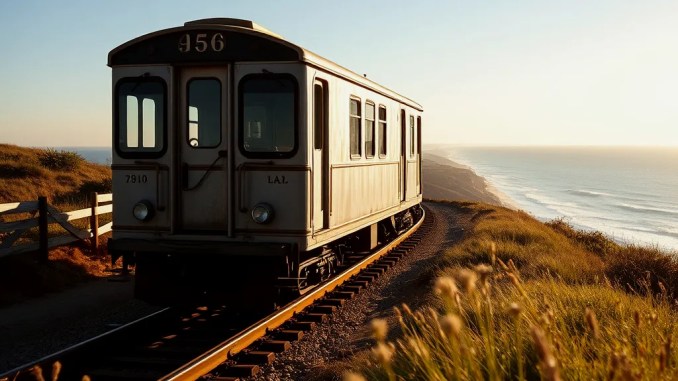
California Coastal Commission Approves 10-Year San Clemente Rail Protection Plan
The California Coastal Commission voted unanimously on November 5 to authorize a 10-year coastal protection program for the rail line through San Clemente. The approved plan allocates roughly 690,000 cubic meters of sand, targeted rock placements and construction of a new seawall to stabilize tracks that have suffered repeated outages since 2021 due to coastal erosion, wave attack and landslides. Orange County Transportation Authority (OCTA) and the Southern California Regional Rail Authority (SCRRA) will implement the measures along a vital corridor used by Metrolink, Amtrak Pacific Surfliner, freight operators and national defense movements.
What the Project Actually Does: Six Concrete Workstreams
The staff report for application 5-21-0866 lists six primary components that together address immediate hazards and scheduled maintenance over the permit period:
1) Rock investment protection and localized additions. OCTA and SCRRA will preserve approximately 48,463 tons of previously placed rock investment on the seaward side between mileposts (MP) 203.80 and 207.20. Two short reaches near MP 206 will receive roughly 2,100 tons of supplemental rock to buttress exposed segments.
2) New seawall at a critical segment. A 1,223-foot-long seawall will be built seaward of the tracks between MP 206.42 and 206.65 to protect an erosion-prone section where bluff retreat made the corridor vulnerable.
3) Anchor preservation for bluff-facing infrastructure. Operators will maintain 220 preexisting anchors located along a 700-foot cliff near MP 206.80 to hold engineered structural elements in place while stabilization works proceed.
4) Sand nourishment executed in two one-time placements. The plan calls for a combined 690,000 cubic meters of sand placed in two discrete areas: 240,000 m3 immediately north of the San Clemente Pier, and 450,000 m3 at the city’s southern end in front of San Clemente State Beach and Cyprus Shore. Sources may include offshore borrow areas, Prado Dam stockpiles or both. Material may be barged and pumped via submerged pipeline, while Prado Dam deliveries will be limited to truck haul to northern placement only.
5) Maintenance program with limits tied to permitted rock zones. Routine maintenance will allow additional rock placement under new, updated staff conditions that confine those works to previously permitted rock zones between MP 203.80–204.40 and MP 206.42–207.20. The commission tightened where maintenance rock may be added to reduce unchecked shoreline armoring.
6) Operational constraints, monitoring and adaptive triggers. The permit introduces monitoring, five-year audits and additional conditions — including a requirement for a Long-Term Rail Adaptation Study due by November 5, 2030 — to assess relocation feasibility and long-term resilience options.
How Sand Nourishment Will Work: Sources, Methods, Timing
The sand program aims to rebuild recreational beaches and provide a buffer to wave-driven bluff erosion. Key logistics:
Sources: offshore borrow areas, Prado Dam stockpiles, or a combination. Choosing both allows planners to match grain-size needs and meet placement schedules.
Transport methods: barges plus submerged pipeline (preferred for large volumes and minimal truck traffic), and truck haul strictly from Prado Dam to the north placement to limit community impacts.
Timing: Staff noted in an addendum that placement may not begin until early 2027, pending final environmental compliance and construction sequencing tied to permitting windows and nesting seasons.
Funding and Scale: $305 Million Mobilized for Coastal Protections
OCTA secured about $305 million from state and federal sources to implement priority protection tasks across the corridor. Approximately $100 million targets sand replenishment and public access protections. Funds cover rock repairs, engineered shoreline structures, beach nourishment and associated access and restoration work — integrating recently completed projects such as the Mariposa Point seawall and public pathway repairs.
Operational Impacts: Why Service Has Repeatedly Stopped
Sea-level rise and intensified coastal storms increased vulnerability along the San Clemente corridor. Since 2021 the line has experienced multiple closures caused by bluff and beach loss; closures lasted from intermittent weekend suspensions to multi-month outages. Notable impacts include:
– Sept 2021: Northern Beach repairs (MP 203.85–203.90) and a 220-foot rock buttress produced weekend closures.
– Sept 2021 (Cyprus Shore): Extension of a coastal wall and roughly 11,000 m3 of rock led to ~3 weeks without passenger service and reduced-speed freight operations.
– Sept 2022–Feb 2023: Emergency rock (≈8,000 m3), 220 anchors and foundation beam work at Cyprus Shore caused about four months of passenger service suspension and reduced freight capacity.
– Apr & Jun 2023: Slope anchoring and a temporary 250-foot wall produced two roughly one-month closures.
– Jan 2024 and subsequent months: Short closures associated with rock replenishment, temporary barriers, and the Mariposa Point emergency stabilization (Jan–Mar 2024) that paused regular passenger service for about two months.
These operational disruptions illustrate a pattern: progressive beach narrowing reduces wave energy dissipation, which accelerates bluff retreat and forces increasingly frequent emergency interventions.
Detailed Timeline of Closures and Work (2021–2026)
A concise chronology helps operators, planners and the public track intervention types and durations:
– Sept 2021 (MP) 203.85–203.90): Nourishment and rock repair; weekend closures.
– Sept 2021 (MP 206.8 Cyprus Shore): Coastal wall extension and ~11,000 m3 rock placement; ~3 weeks passenger suspension.
– Sept 2022–Feb 2023 (MP 206.8): Internal slope repair, anchors and foundation works; ~4 months passenger suspension.
– Apr & Jun 2023 (MP 204.6): Slope anchoring (90 anchors) and temporary wall (250 ft); two ~1-month closures.
– Jan 2024 (MP 206.6–207.1): ~420 tons of rock added; ~1 month closure.
– Jan 24–Mar 25, 2024 (MP 204.2 Mariposa Point): 250 m temporary barrier and drainage wall after landslide; ~2 months suspension of regular passenger service.
– Apr 2025 (Regions 1–3): Rock placement in first two regions, removal of damaged Mariposa pedestrian bridge; planned sand placement did not occur; ~6 week closure.
– Jun 2026 (MP 206.75–207.14): ~65 tons rock and 95 tons ballast under an exemption; night closures.
– Jul–Sep 2026 (MP 206.56–207.25): Previously placed rock that lacked prior permit was folded into the 5-21-0866 application and approved on Nov 5; night closures.
– Sept 2026 (Region 4 & Cyprus Shore): Emergency authorization reconfigured rock and provided up to 15,000 tons additional material; night closures.
Permit Conditions, Limits and Adaptive Measures
The commission attached new conditions intended to limit cumulative shoreline armoring while allowing railroad protection. Key points include:
– Permit Duration and Reviews: A 10-year permit with five-year monitoring reviews to ensure triggers for additional action are transparent and scientifically justified.
– Long-Term Study Requirement: A Long-Term Rail Adaptation Study must be completed by November 5, 2030 to evaluate feasibility and cost of relocating rail landward or implementing alternative durable solutions.
– Sand Minimum and Remediation Funds: The staff-required minimum is 690,000 m3 of sand placement. Staff also recommended either placement of 85,000 m3 of additional sand or equivalent funding to remediate past Coastal Act violations.
– Rock Use Caps Replaced with Per-Unit Limits: The earlier proposed 15,000-ton annual maintenance cap was removed. Instead, the permit now limits maintenance rock to a maximum of 500 tons per 100 linear feet for each maintenance episode; an overall program-level cap remains to be clarified by OCTA.
Long-Term Options Under OCTA Review
OCTA published a draft Coastal Rail Resilience Study that reviewed options to protect the rail corridor in-place for 10–30 years versus pursuing relocation or major structural redesigns. The agency finalized that study and announced completion on September 28. The study matrix compared:
– In-place protection (seawalls, revetments, periodic nourishment): lower near-term cost and quicker implementation but risks higher future maintenance and potential loss of beach amenity.
– Managed realignment or partial relocation (shore-parallel shift, vertical raise or inland bypass): higher capital cost, greater environmental permitting complexity, but more durable solution in most sea-level rise scenarios.
– Hybrid approaches combining strategic nourishment with limited armoring and targeted relocation for the most vulnerable reaches.
OCTA’s CEO Darrell E. Johnson stated the agency will coordinate with the Commission and project partners to integrate the revised conditions into construction and finance plans while continuing to protect public access and rail service.
What Residents, Commuters and Planners Should Expect Next
Actions to anticipate and how stakeholders can prepare:
– Construction windows: Major sand placement is likely in permitted seasonal windows to reduce ecological impacts and public disruption; preliminary work including anchor and rock placement will stage ahead of nourishment.
– Monitoring and public reporting: Five-year audits and monitoring data should be publicly available and used to trigger adaptive management actions.
– Travel impacts: Night and weekend closures will continue during discrete maintenance works; longers will be planned with advance public notice, shuttle services and coordinated freight schedules to reduce economic impacts.
– Funding and prioritization: With $305 million committed, OCTA will sequence work to protect the most at-risk stretches first while advancing the Long-Term Rail Adaptation Study to guide future capital investments.
Key Takeaways
The Commission’s unanimous approval gives OCTA and SCRRA a regulatory pathway to protect the San Clemente rail corridor for the next decade using a mix of engineered structures, large-scale sand nourishment and constrained maintenance rock placement. The permit balances immediate operational needs with longer-term planning by requiring a detailed adaptation study, mandatory monitoring and specific material-use limits designed to reduce unchecked shoreline armoring while enabling rail service continuity.
Source: California Coastal Commission staff report, application 5-21-0866, staff addendum dated November 4 and table data as of October 23, 2026.







Be the first to comment