
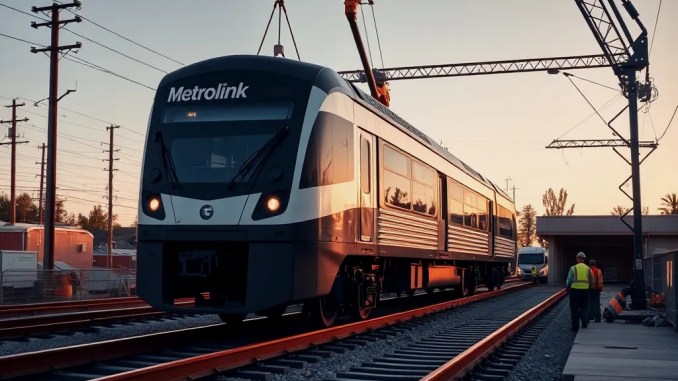
Granite Construction wins $51.5M contract and sets a clear delivery window
Granite Construction secured a $51.5 million contract to extend the Marengo and Rancho Cucamonga sidings on Metrolink’s San Bernardino Line. Work is scheduled to begin in January 2027 and to finish in July 2028, aligning completion with the LA28 Opening Ceremony month. The contract consolidates two separate siding extensions into a single construction package under the SCORE (Southern California Optimized Rail Expansion) program.
How far will each siding be extended and why those lengths matter
The Marengo siding, located just west of Cal State LA station, will be lengthened approximately 3,300 feet (about 1,000 meters) to reach a total of roughly 10,288 feet (3,100 meters). That extension places the new tail north of the mainline near the Fowler Avenue curve and will allow trains to meet and pass without entering the main single-track segment, directly increasing operational capacity on the corridor.
The Rancho Cucamonga siding will extend about 4,600 feet westward, increasing total length to approximately 15,600 feet. The extension includes relocating a control point at the west end, upgrading signaling, and lengthening culverts. Together, these works reduce pinch points and create more robust passing opportunities for peak and event-related service.
Specific grade crossing and safety upgrades included in the work
Contract plans call for reconfiguring two at-grade crossings: Hellman Avenue’s crossing will convert from single-track to double-track, and Archibald Avenue’s crossing will expand from double-track to three-track configuration. Metrolink recommends safety enhancements to bring both crossings up to Quiet Zone standards (ie, elimination of routine train horn use through physical and signaling improvements), which will involve upgraded gates, circuitry, and where needed, supplemental barriers.
Project elements that affect construction sequencing and risks
Beyond ballast, track and turnout installation, critical path items include signal system cutovers, control-point relocation at Rancho Cucamonga, culvert and drainage extensions, and phasing at the two grade crossings. Each of these tasks can introduce constraints: signal cutovers require short pre-planned outages; culvert work depends on weather windows; and constructing through active corridors requires staged track possessions to preserve service. Anticipated risks cited by funding documents include volatile material prices, local labor market tightness, and supply-chain delays for specialized track components.
Timeline changes: what shifted between Metrolink’s April plan and Granite’s schedule
In April 2026 Metrolink expected contractors to be selected by mid-2026 with early construction actions by late 2026 and completion in early 2028. Granite Construction’s schedule shifts major construction to January 2027 with final completion in July 2028. That change pushes the in-service date later than the April expectation but still targets the LA28 Games window in July 2028.
Funding sources, recent allocations, and the state funding debate
Funding for the two projects combines federal Olympic allocations, Caltrans program funds, and Metrolink capital budget resources. The July LA Metro recommendation proposed $89.47 million in first Olympic-related federal funds, of which $17.74 million was directed to Metrolink projects that support increased service on the San Bernardino Line during LA28. Separately, Metrolink’s April capital report identified Caltrans construction allocations of $30.34 million for Marengo and $35.66 million for Rancho Cucamonga.
In August, Caltrans recommended an additional $7.099 million for Marengo’s construction phase, citing contractor bids that exceeded engineering estimates and upward pressure on costs from fuel, tariffs, supply-chain constraints, and labor shortages. Later meeting minutes show that the additional request was withdrawn, illustrating the fluidity of final state-level allocations.
Operational impacts during and after construction: schedules, contingencies, and expected capacity gains
During construction Metrolink will need carefully staged possessions to both preserve scheduled service and to allow segments to be taken out of service for track work. Expect temporary schedule alterations, bus bridging on short segments if needed, and nighttime/weekend windows for signal cutovers. After completion, the longer sidings will permit more frequent bi-directional slotting on the San Bernardino Line. Metrolink projects that paired completion of Marengo with the El Monte siding (if funding and demand allow) could enable trains every 30 minutes in both directions on the corridor during peak windows.
Design and technical considerations that determine long-term reliability
Key design choices that drive reliability include turnout geometry (higher-speed turnouts reduce delay for diverging moves), signaling strategies (CCTV and interlocking logic to speed clearances), drainage and culvert sizing (to prevent track settlement), and grade crossing geometry for multi-track movements. Proper sequencing of control-point relocation with signaling cutover will reduce risk of service-impacting incidents. The contract leverages Granite’s prior regional rail experience, which Metrolink and county transportation agencies expect will shorten the learning curve on complex cutovers.
What stakeholders and travelers should expect during the LA28 Games
If completed on Granite’s timeline, the sidings will provide operational room to run additional Metrolink trains for LA28 demand surges. The federal Olympic fund portion explicitly targets both capital completion and the marginal operating and maintenance costs of any temporary extra trains put into service for the Games. Travelers can expect more reliable, higher-capacity service on event days and a quieter corridor where Quiet Zone upgrades are implemented.
Sources, verification points, and what to watch next
Primary sources for the details above include Caltrans’ August 2026 financing note and Metrolink project pages for Marengo and Rancho Cucamonga. Watch for the following documents and events to track changes: contract notices and change orders from Granite Construction, Metrolink board capital reports, California Transportation Commission meeting minutes where state allocations are finalized, and LA Metro Olympic funding resolutions. Significant shifts to watch are additional funding approvals or withdrawals, formal signal cutover schedules, and any published temporary service plans during construction.






Be the first to comment