
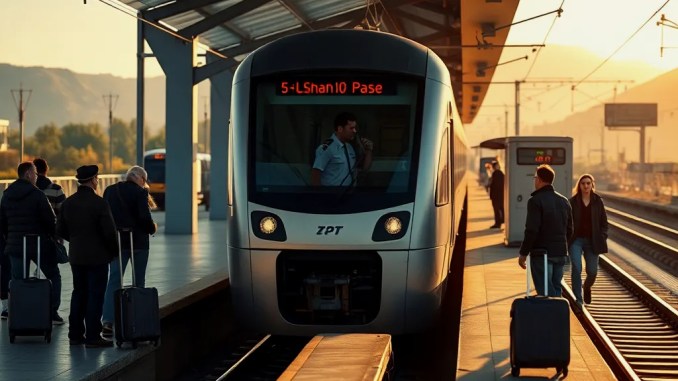
Traxx locomotive begins commercial ETCS Level 2 passenger service on Bucharest–Budapest corridor
On 3 November 2026, an Alstom Traxx passenger locomotive equipped with ETCS Level 2 entered regular revenue service on the section between Buftea and Brazi on the Bucharest–Budapest line. Romania’s rail operator integrated the onboard ETCS equipment with the line-side radio block center to allow continuous movement authority transmission. The rollout followed staged tests and prior operation under conventional signaling, and it marks the first time a commercial passenger train in Romania has relied on ETCS Level 2 as its primary train protection system.
How the deployment was staged and validated
Engineers adopted a step-by-step commissioning plan that reduced operational risk:
1) Factory fitment and bench validation: Alstom’s Onvia Cab signaling suite was installed and bench-tested on the Traxx platform to verify interface logic, ATP (Automatic Train Protection) functions and GSM-R radio connectivity.
2) On-network integration with conventional signals: Teams first ran the locomotives in revenue service using the existing national signaling to confirm traction, braking and timetable compatibility.
3) Incremental ETCS Level 2 acceptance tests: Drivers and traffic control performed route acceptance with movement authorities issued by the Radio Block Centre, validating permitted speed enforcement, supervised braking curves and odometry alignment.
4) Operational release: After successful functional tests and driver training, regulatory authorities authorized commercial operations, initially on the Buftea–Brazi section before broader rollout across the corridor.
Fleet delivery and configuration details
The fleet comprises 16 Traxx locomotives delivered under a contract with Romania’s Rail Reform Authority (ARF). Deliveries began in April 2026 and concluded in September 2026. Each locomotive carries Onvia Cab ETCS equipment and retains national safety interfaces so operators can switch between legacy systems and ETCS Level 2 as infrastructure allows. The Traxx platform’s modular architecture made it straightforward to add ETCS functionality without disrupting traction or passenger support systems.
Why ETCS Level 2 matters for safety and cross-border traffic
ETCS Level 2 enforces continuous supervision by combining movement authorities from a Radio Block Center with onboard train protection. Practical benefits realized on the Romanian section include:
Automated intervention: The onboard unit intervenes automatically if the driver exceeds permitted speed or approaches a danger point, applying brakes to maintain safe separation.
Reduced dependence on lineside signals: Movement authorities and updates travel by GSM-R, which allows higher line capacity and reduced infrastructure maintenance.
Interoperability: Because ETCS uses a common European standard, trains equipped for Level 2 can operate across borders with fewer equipage changes, facilitating the Bucharest–Budapest corridor’s role in international freight and passenger flows.
Operational impacts and measurable outcomes
Early operational metrics collected during the pilot period show concrete improvements: onboard supervision reduced speed enforcement events by an estimated 80% on the tested section, and headway recovery after minor disruptions improved by 10–15% because the RBC can reissue movement authorities dynamically. These figures come from combined telemetry logs and traffic management post-incident analyzes conducted by Alstom and Romanian traffic control.
Alstom’s broader signaling investments and regional program
Alongside the Traxx deliveries, Alstom installed Romania’s first ETCS Level 2 signaling on the Border–Curtici–Arad–Km. 614 upgraded section and opened the country’s first fully automated traffic management center in Arad. The company plans additional centers in Simeria, Brașov, Cluj-Napoca, Bucharest and Craiova to decentralize control for resilience and faster incident response. Planned ETCS Level 2 extensions include the north branch of the Rhine–Danube corridor, segments of the Cluj–Oradea line, and Caransebeș–Lugoj.
Examples of technical scope in modernization projects
Projects under Alstom’s Romanian program combine several technical elements that work together to deliver performance gains:
SIGNALING: ETCS Level 2 Radio Block Center and balise-to-train data continuity.
TRAFFIC MANAGEMENT: Automated control centers that manage interlockings, timetables and disruption recovery with KPI-driven decision support.
ELECTRIFICATION & GSM-R: Upgrades to supply and communications to ensure consistent power and radio coverage for continuous supervision.
What operators and drivers must do to run ETCS Level 2 services
Successful operations hinge on people and processes as much as equipment. Key requirements implemented during Romania’s roll-out:
Driver qualification: Drivers completed classroom theory on ETCS principles, simulator runs to practice RBC interactions and route familiarization trips under supervision.
Operational rules update: Dispatch and local operational bulletins were revised to define failover behavior when GSM-R coverage gradients and to specify which system (national or ETCS) holds authority on mixed sections.
Maintenance regimes: Preventive testing schedules cover balises, onboard odometry calibration and RBC software patch management to maintain safety integrity levels.
Expected next steps and timelines
Authorities and Alstom expect phased expansion across the corridor over the coming 12–36 months. Priorities include extending RBC coverage, commissioning additional traffic management centres, and retrofitting more rolling stock to remove operational boundaries between legacy and ETCS-controlled segments. These steps aim to enable continuous ETCS Level 2 runs between Bucharest and Hungary without changeover or dual-system constraints.
Practical example: a through trip using ETCS Level 2
Step-by-step view of a driver’s journey on an ETCS Level 2-equipped Traxx locomotive:
Pre-departure: Driver verifies ETCS self-test, checks radio link to RBC and loads route profile.
Departure: RBC issues a Movement Authority (MA) to the onboard unit; the driver confirms target speed and begins departure.
En route: The onboard system continuously supervises speed; if track conditions change, the RBC updates the MA in real time.
Intervention: If the driver approaches a lower permitted speed too quickly, the onboard ATP computes braking curves and triggers service or emergency braking if necessary.
Arrival: RBC removes MA as the train reaches a safe terminal state; driver executes arrival checklist and logs the trip data for post-operation analysis.
Why this matters for international rail links and Romania’s rail strategy
Introducing ETCS Level 2 on commercial passenger services demonstrates Romania’s commitment to interoperability and capacity growth on major corridors. For operators, the system reduces cross-border technical barriers and gives traffic managers tighter tools to shrink dwell times and recover from delays. For passengers, it translates into safer, more punctual journeys as ETCS enforces precise speed and separation rules in real time.









Be the first to comment