
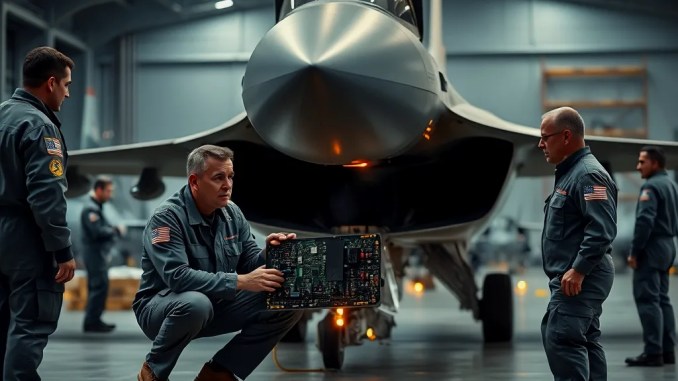
Northrop Grumman’s AN/ALQ-257 IVEWS System
Overview: Northrop Grumman designed the AN/ALQ-257 Integrated Viper Electronic Warfare Suite (IVEWS) to bring fifth-generation-equivalent electronic warfare (EW) capabilities to F-16 fleets. The system emphasizes survivability in dense electromagnetic threat environments by detecting, classifying, and countering advanced radio-frequency (RF) and millimeter-wave threats.
How it works in practice: IVEWS uses an ultra-wideband architecture that senses across a broad RF spectrum, identifies threat emitters, and applies real-time electronic attack or protection measures. In flight trials during the Northern Lightning exercise, IVEWS demonstrated pulse-to-pulse coordination with an F-16’s AN/APG-83 SABR AESA radar, allowing the radar to continue operating without performance loss while EW actions occurred. That integration prevents temporary radar outages, reduces filtering needs, and preserves targeting and electronic protection functions during contested operations.
Operational benefits and examples: – In contested airspace, IVEWS increases aircraft survivability by enabling rapid identification and suppression of ground-based and airborne radar threats.
– Example: During test flights, pilots maintained radar tracking while IVEWS injected countermeasures against simulated millimeter-wave air-defense radars, providing continuous situational awareness and target engagement capability.
Export and program status: IVEWS is the only EW system formally adopted in the US Air Force F-16 procurement stream and remains exportable. It has appeared in multiple procurement discussions internationally, including third-party defense packages where modern EW is required to match adversaries fielding advanced sensors and integrated air defenses.
L3Harris’ AN/ALQ-254(V)1 Viper Shield
Overview: L3Harris developed the AN/ALQ-254(V)1 Viper Shield as a fully digital EW suite tailored primarily for Block 70/72 F-16s but adaptable to several other F-16 configurations. The system focuses on combining digital detection with DRFM (Digital Radio Frequency Memory) jamming and radar warning functions to defeat sophisticated radar threats.
Core capabilities: Viper Shield integrates a Digital Radar Warning Receiver (DRWR) designed to work in concert with the AN/APG-83 SABR AESA radar, offering coordinated warning and countermeasure employment. The DRFM-based electronic attack capability enables synthesized, coherent jamming waveforms that closely mimic threat returns, degrading adversary radar performance rather than simply adding noise.
Operational improvements and use cases: – The DRWR provides timely, precise threat alerts to pilots, while DRFM jamming produces deceptive returns that can mislead or saturate advanced radars.
– Example use case: In a suppression-of-enemy-air-defenses (SEAD) mission, Viper Shield can present false targets or distorted radar tracking so that surface-to-air missile (SAM) systems lose lock or track erroneous returns, increasing strike package survivability.
Integration flexibility: L3Harris engineers designed Viper Shield to operate as an internal installation on Block 70/72 and to adapt for Block 40 and 50 aircraft. For two-seat F-16D variants it integrates internally; on older blocks the system can be fielded as an external pod, enabling capability upgrades without major structural modification. L3Harris continues collaborative development with Lockheed Martin and US Air Force stakeholders on AN/ALQ-254(V)1 and (V)2 variants to broaden performance and compatibility.
Why Greece Is Engaging Both Suppliers
Strategic drivers: Greece’s F-16 force operations in a high-threat regional environment with layered air defenses and growing use of advanced sensors. Greek decision-makers evaluate both IVEWS and Viper Shield to determine which solution best balances detection fidelity, RF offense/defense options, integration complexity, and interoperability with existing avionics and mission profiles.
Timeline of interactions: – Northrop Grumman presented IVEWS features online on 13 September 2022 and briefed Greek Air Force stakeholders again on 5 March 2026.
– L3Harris briefed Greek authorities on Viper Shield on 2 October 2023, maintained contact with demonstrations on 2 October 2024 and 1 July 2025, and provided an update on 20 October 2026 about recent system developments.
Decision factors Greece will weigh: – Compatibility with AN/APG-83 SABR AESA radars and other avionics.
– Performance against millimeter-wave and advanced RF threats in realistic threat libraries.
– Installation cost and downtime (internal retrofit vs. podded options).
– Interoperability with allied forces and export licensing or transfer timelines.
– Long-term sustainment, training, and allied logistics support.
Comparative Assessment: IVEWS vs. Viper Shield
Sensing and detection: Both systems prioritize broad-spectrum RF sensing, but IVEWS highlights ultra-wideband coverage and demonstrated pulse-to-pulse AESA coordination. Viper Shield emphasizes integrated DRWR tuned for cooperative operation with SABR AESA radars.
Electronic attack: Viper Shield’s DRFM-based jamming focuses on deceptive waveform generation and coherent countermeasures. IVEWS offers comprehensive electronic attack suites tuned for both RF and millimeter-wave threats with architecture proven in joint flight tests.
Integration approaches: Viper Shield: internal install for modern Blocks and podded option for legacy fleets. IVEWS: designed for deep avionics integration but also marketed for export retrofit programs. Greece must decide whether to prioritize a seamless internal fitment or accept podded flexibility to upgrade older airframes quickly.
How Greece Can Evaluate and Test These Systems
Step-by-step evaluation plan: 1) Establish mission profiles and threat libraries that reflect likely operational scenarios (eg, A2/AD corridors, naval strike, interceptor escort). 2) Require lab demonstrations of detection thresholds, DRFM fidelity, and false-alarm rates against recorded threat signatures. 3) Conduct integrated ground-vehicle and emitter-in-the-loop tests to validate response timing and pilot cueing. 4) Schedule flight test sorties with representative sensors (SABR AESA) to validate pulse-to-pulse coordination and continuous radar operation under EW duress. 5) Run combined-arms exercises with allied platforms to test interoperability and tactics. 6) Evaluate logistics, training packages, and total lifecycle cost models.
Metrics to quantify: – Probability of detection and classification time at varying ranges.
– Time-to-mitigate (latency from detection to countermeasure employment).
– Impact on host radar performance (eg, tracking continuity losses, false targets introduced).
– Electromagnetic compatibility data for multi-aircraft formations.
Operational Recommendations for Rapid Capability Gain
Short-term: Field an externally-mounted Viper Shield pod on legacy F-16s to quickly raise EW performance across the fleet while conducting parallel certification for internal installations on Block 70/72 aircraft.
Medium-term: Prioritize flight trials that demonstrate AESA-EW pulse-to-pulse coordination (as IVEWS has done) to minimize capability trade-offs between radar functions and EW activities.
Long-term: Adopt sustainment contracts with supplier-led training, threat library updates, and allied interoperability exercises to preserve relevance against evolving RF and millimeter-wave threats.
Implications for Regional Air Operations
Tactical effects: Fielding either advanced EW suite will change adversary targeting calculus by increasing the difficulty of acquiring and tracking Greek F-16s with ground and airborne radars. Improved EW capability supports deeper strike options, more survivable SEAD missions, and enhanced escort operations.
Strategic signaling: Demonstrated investment in modern EW technologies signals intent to deter escalation and complicate adversary planning. Exportability of the systems also means Greece could align procurement timelines with partner nations to enhance coalition interoperability.








Be the first to comment