
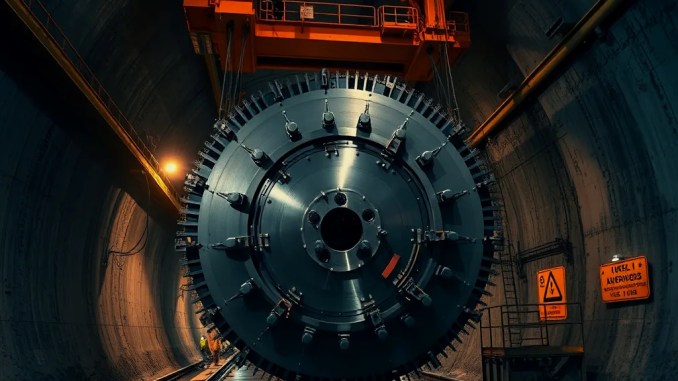
TBM cutterhead lowered into Rektinia shaft with millimeter precision
Workers positioned the 430-metric-ton cutterhead of a 130-meter variable-density tunnel boring machine (TBM) into the Rektinia launch shaft using a 450‑ton portal crane. The crew aligned the head to within approximately ±5 millimeters before locking it to the machine’s shield. This single operation required staged lifts, synchronized load checks, and temporary supports to protect bearings and hydraulic connections while the rest of the TBM awaits final assembly underground.
Why this matters: the cutterhead is the heaviest single component of the TBM; successful placement clears the path for integrating the main drive, conveyor systems and shield segments that together constitute the roughly 4,000‑ton assembled machine.
Proven TBM previously excavated Hampton Roads tunnels in Virginia
The TBM deployed in Łódź previously completed two long drives in the United States. During the Hampton Roads bridge‑tunnel expansion it two tunnels of 7,940 and 7,960 feet and operated under the name “Mary.” Herrenknecht manufactured the machine and, after finishing US works, it was shipped to Germany for refurbishment and then transported to Poland in sections due to its size.
In Łódź the TBM will form a single two-track rail tunnel approximately 14 meters in diameter and 4.6 kilometers long. Its prior record demonstrates continuous operation over multi-kilometer bores, giving the project team data on cutter wear rates, segment erection cadence, and spoil handling that they can adapt to local geology and logistics.
Assembly sequence and testing plan at Retkinia site
Assembly followed a staged plan: deliver shield rings and segment erector, set up primary, secondary and tertiary cranes, install the main hydraulic and electric drive components, then mount the cutterhead After mechanical integration the TBM’s systems undergo functional checks—hydraulic load tests, noise and vibration baselines, torque and thrust calibration, and emergency stop verification. Commissioning includes a short trial advance (700–800 meters), retrieval to a service alcove for inspection, and resolution of any abnormal wear before full-length excavation.
PORR’s project management schedules a roughly 18‑month excavation campaign once full commissioning completes: initial advance, periodic maintenance stops, mid‑drive inspections, then final break‑through at Łódź Fabryczna. The contractor sequences work to minimize risk to nearby structures and maintain predictable progress rates based on local soil conditions.
Tunnel route, dimensions and operational speed limits
The tunnel will run from Rektinia to Łódź Fabryczna station and accommodate two tracks for bidirectional traffic inside a single-bore 14‑meter diameter lining. Designers included five refugee rooms spaced along the alignment for evacuation and maintenance access.
Speed design: the wider Y‑shaped high‑speed network foreseen in the Port Polska/CPK program targets line speeds up to 350 km/h, with fastest commercial services around 320 km/h on open sections. The internal tunnel operational limit will be 160 km/h, reflecting emergency response, aerodynamics and track design within a confined single-bore environment.
Spoil management via pressurized pipeline reduces truck traffic
Project planners chose a sealed pipeline system to pump excavated spoil from the TBM to a remote separation plant. The material-laden slurry travels through pressurized pipes, where solids are separated, water is recycled, and processed spoil is removed for reuse or disposal. CPK estimates this method replaces roughly 80,000 truck trips compared with conventional haulage across the program’s construction life, reducing surface congestion, dust and vibration impacts in the urban corridor.
Operational details: the pipeline requires staged booster pumps, solids traps at the TBM throat, and a continuous monitoring regime for abrasive particle concentration to limit wear. Contingency plans include bypass pumping and temporary stockpiles at the shaft if the separator plant needs maintenance.
Protecting historic Łódź Fabric House and nearby buildings
The TBM alignment passes beneath the historic Łódź Culture House next to Łódź Fabryczna station. Engineers installed about 1,400 micro‑piles and jet‑injection columns beneath and around the structure to improve bearing capacity and reduce settlement risk. The construction also includes a reception chamber and transition room adjacent to the historic building to receive and service the TBM.
Monitoring regime: a geodetic instrumentation network covers the corridor with real-time measurement of settlement, tilt and vibration. Each building on the path receives a tailored protection plan that may include underpinning, load redistribution, or temporary shoring depending on recorded movement thresholds.
Schedule, milestones and expected handover
Key dates and forecasted milestones:
Installed cutterhead: November (current milestone).
Full TBM commissioning and short trial drive: staged after remaining system integration and testing.
Start of continuous excavation: planned spring 2027 (slipped from late 2026).
TBM breakthrough and tunnel structure completion: excavation expected to finish in the second half of 2028.
Main civil works completion: target 2029, followed by systems, tests and certification.
Integration into the 85 line service: phased introduction of traffic; program-level goals foresee passenger service connections to Warsaw and the new airport around 2032 and extensions to Wrocław and Poznań by 2035.
Practical risks, mitigation and lessons from prior TBM projects
Primary risks include unexpected ground conditions, cutterhead wear, pipeline blockages in spoil removal, and settlement affecting adjacent structures. Mitigations being applied:
Geotechnical: advance probing, grout curtains near sensitive foundations, and staged assembly to permit immediate intervention during initial thrusting.
Mechanical: on-site spare cutter tools and a planned service alcove about 700–800 meters into the drive for mid-run inspections.
Logistics: modular deliveries, off-site assembly capability, and a centralized monitoring hub to coordinate cranes, lifting windows and spoil pumping.
Community protection: continuous noise and vibration monitoring, defined working windows, and transparent reporting to local stakeholders.
Experience from the TBM’s US service indicates that preemptive cutter replacement schedules and rigorous slurry management reduce unplanned stoppages; Łódź teams have incorporated these lessons into their commissioning and maintenance plans.







Be the first to comment