
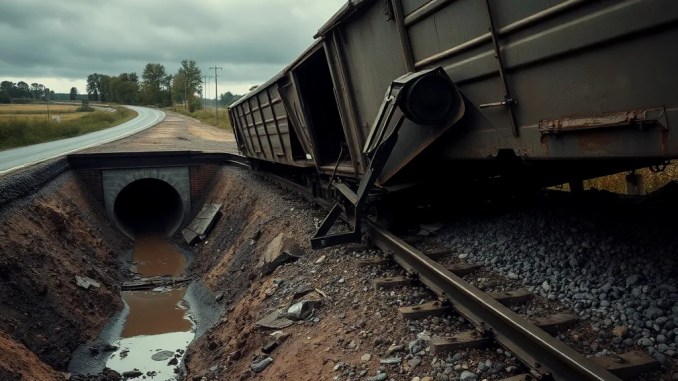
Inquiry finds drainage works deviated from approved design and directly contributed to derailment
Investigation outcome: The Carmont derailment in August 2020 followed heavy rain that washed construction spoil from a poorly built drainage system onto the Aberdeen–Glasgow line. The sheriff’s 199‑page determination concluded that if the drainage had been built to the approved Ove Arup design, the landslip that struck the 1T08 High Speed Train at about 117 km/h would likely not have occurred.
Concrete failings identified: The inquiry documents multiple technical departures from the approved scheme installed by Carillion Construction Limited in 2011–2012: the No.18 catchpit placed incorrectly, the No.17 catchpit omitted entirely, locally sourced fill used instead of specified engineered gravel near the No.19 catchpit, a stretch of pipe between catchpits No.18 and No.19 incorrectly located with holes not where designed, a carrier pipe used where a filter pipe was required, and missing geotextile lining in portions of the channel. Each defect reduced the drainage system’s capacity to control storm-driven debris movement toward the track.
Inspection and oversight gaps: Network Rail failed to detect or correct those defects. The inquiry highlights that routine inspection records show no checks on the upslope section feeding catchpit No.18 between March 2013 and the accident date, years leaving of uncorrected non-conforming work exposed to extreme weather.
Weather-warning and operational systems did not mitigate the risk
Real-time warnings and training shortfalls: The inquiry found that route control centers in Scotland were not configured to receive tailored, real-time hazard warnings from the National Rail Weather Service, and staff lacked the targeted training to interpret and act on available meteorological alerts. That gap meant operations staff did not have or could not apply timely situational intelligence about exceptional precipitation running toward the track.
Authority and rules at the time: Under the rules in force then, the control center could not unilaterally impose speed restrictions for heavy rain; controllers followed signaler instructions and operating rules. The sheriff explicitly cleared driver Brett McCullough of any fault, finding no driver error or causal contribution.
Legal and enforcement outcomes: penalty and criminal findings
Criminal conviction and fine: Following the crash, Network Rail Infrastructure Limited pleaded guilty at Aberdeen High Court on 7 September 2023 to breaching the Health and Safety at Work etc. Act 1974 and was fined £6.7 million. The fatal accident investigation ran in January–February 2026 and produced the sheriff’s formal findings in late October 2026.
Evidence timeline: Documentary, witness, and expert evidence were heard at Aberdeen Sheriff Court between 26 January and 4 February 2026, with party submissions delivered on 30–31 March. The sheriff’s findings knit forensic engineering detail with governance and operational analysis to identify where reasonable measures were not taken.
What the report recommends and what has changed since RAIB advice
RAIB recommendations and implementation progress: The judgment references the Rail Accident Investigation Branch’s March 2022 report, which issued 20 recommendations addressing drainage design verification, inspection regimes, weather‑related operational responses and staff competence. Many measures from the updated January 2024 RAIB package are already in place; remaining actions continue under Office of Rail and Road (ORR) oversight.
Sheriff’s conclusion on additional measures: After considering practicality and proportionality, the sheriff concluded no further reasonable measures beyond existing and ongoing programs would materially reduce recurrence risk, and therefore made no fresh recommendations. The ruling nevertheless stresses the centrality of constructing drainage exactly to its approved design and the necessity of consistent, documented inspection to ensure compliance.
How the HST fleet will be replaced and the timetable
Rolling stock replacement plan: ScotRail is preparing to replace the current High Speed Train (HST) fleet with 22 Class 222 units. Beacon announced a lease agreement in March 2026; Alstom will run the refurbishment and heavy maintenance program with a £67 million contribution from the Scottish Government to accelerate readiness.
Delivery schedule and service transition: Refurbished Class 222 sets are expected into service from late 2027, with the full fleet delivered by the end of 2028. ScotRail anticipates that the last HST will exit service before the end of 2028 and that existing HST leasing arrangements will terminate in 2030.
Practical lessons for infrastructure owners and operators
Design verification and construction control: Operators should require third‑party independent verification that drainage and earthworks have been built to approved designs before accepting them into asset registers. Example steps: 1) lock down a construction quality assurance plan tied to specific geotechnical acceptance criteria; 2) use targeted post‑installation CCTV or CCTV‑linked dye tests in buried pipe runs; 3) sample and laboratory‑test fill materials against specified gradation and permeability.
Inspection regimes and data-driven monitoring: Implement time-bound inspection cycles for upslope and catchpit elements, with digital records and exception reporting. Equip routes with automated level, flow and turbidity sensors at key catchpits so rapid increases trigger control-center alerts and an immediate operational checklist (speed reduction, enhanced patrols, temporary closure if required).
Training and real‑time weather integration: Configure control‑room systems to ingest bespoke RAWS (real‑time automated weather station) products and set scenario‑based standard operating procedures so staff can enact preapproved mitigations (temporary speed limits, line blockages) under delegated authority during extreme events. Train staff with simulation exercises using historical heavy‑rain events and the specific track drainage topology to test decision-making under pressure.
Key facts at a glance (concise summary for quick reference)
Date and location: 12 August 2020, near Carmont, Aberdeenshire. Train: ScotRail HST 1T08, Aberdeen–Glasgow. Speed: ~117 km/h. Fatalities: 3 (driver Brett McCullough, conductor Donald Dinnie, passenger Christopher Stuchbury). Injuries: 6 passengers.
Principal causal factors: Non-conforming drainage construction, absence of required geotextile and filter pipework, missing catchpit, local material substitution, inadequate inspection and oversight, limited real-time weather warning integration and constrained control-room authorities under then-current rules.









Be the first to comment