
Public Comments Open Through December 7, 2026
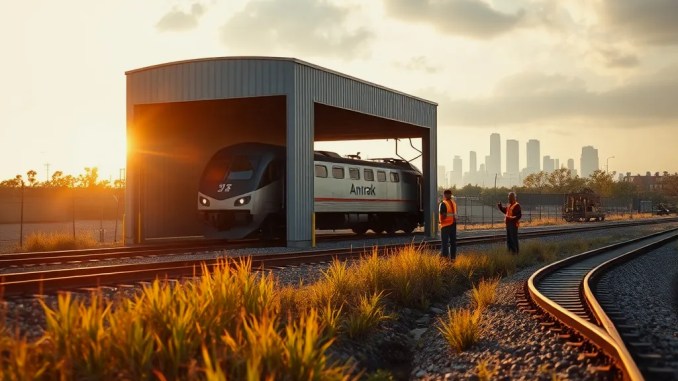
The Federal Railroad Administration (FRA) published an environmental assessment on November 6 that evaluates Amtrak’s proposed Midwest Maintenance Facility at the Canal Street Yard, roughly 1.8 miles south of Chicago Union Station. The FRA initiated a 30-day public comment period; Stakeholders can submit comments on Regulations.gov under docket FRA-2026-2938 through December 7, 2026. Amtrak will host an in-person meeting at Illinois Institute of Technology’s Hermann Hall on December 2 and online sessions on December 3 to present findings and gather input.
What the Assessment Found About Noise and Vibration
The FRA modeled noise and vibration for the project during construction and operation. Predicted day-night average noise levels (Ldn) near affected neighborhoods range from 46 to 65 dBA. Four residential clusters are expected to experience moderate noise impacts. The report identifies specific cluster codes (for example R-23 in the north yard and R-31, R-32, R-33 in the south yard) and isolates rail-joint and turnout noise as the primary sources—roughly a 5 dB increase at transition locations. FRA’s threshold for “significant” impacts was not crossed, so no mandatory mitigation is triggered under federal criteria; However, FRA recommends feasible measures to reduce moderate impacts, such as constructing a continuous noise barrier along the western site boundary or using moveable-frog/tie treatments to reduce wheel-rail discontinuity noise. Amtrak plans to evaluate barriers, turnout repairs, or both in final design.
Vibration Analysis and Human Comfort
Measured ground-borne vibration at the residences closest is projected between 43 and 70 VdB, below the Federal Transit Administration’s 80 VdB screening criterion for adverse human response. Temporary vibration increases could occur at transition zones and during viaduct repairs, but long-term levels remain within federal limits. The assessment therefore treats vibration as non-significant while recommending monitoring during construction and sensitive-period scheduling where feasible.
Soil and Groundwater Contaminants Identified in Phase II Field Work
A Phase II investigation in February–March 2026 collected 45 soil borings and analyzed 235 soil samples down to approximately 20 feet in historic fill. Results show petroleum hydrocarbons, polycyclic aromatic hydrocarbons (PAHs), and metals—particularly lead and cadmium—exceeding Illinois cleanup targets in pockets of fill. Shallow, non-potable groundwater samples contained PFOA and PFOS at concentrations of 6.6–11 ng/L, exceeding Illinois’ 4 ng/L guideline. The EA outlines best-management controls for construction: testing and segregating excavated soils, disposing or remediating in permitted facilities, storing groundwater samples prior to analysis, and prohibiting untreated dewatering discharge to storm or sanitary systems. Fugitive dust controls (wetting, covering stockpiles, and tarping trucks) are also required to limit exposure and off-site transport.
Projected Emissions During Construction and Operation
Air quality modeling shows construction emissions peaking in 2027, with estimated emissions of approximately 10.2 tons of NOx and 1.1 tons of VOCs for that year. Operating emissions for the completed facility are estimated at about 5.5 tons/year of NOx from mobile sources and 10.8 tons/year when stationary sources are included—well under the typical 50-ton significance threshold used in many federal reviews. The EA concludes the project is unlikely to cause significant air-quality deterioration with the planned controls and phasing.
Viaducts and Bridges Included: Condition, Repair Plans, and Historic Fabric
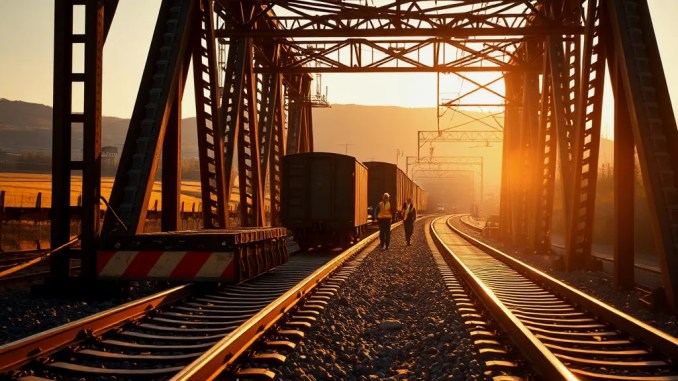
FRA expanded the review to include 17 viaducts and bridges between Cermak Road and West 38th Street after earlier categorical exclusions did not cover structural repairs. Historic structures—built originally between 1905 and 1907 and widened in later decades—showed substantial wear: inspectors reported up to 90% deck deterioration in areas and localized section loss up to 100% in steel members. Repair strategies emphasize in-kind replacement of damaged members rather than full replacement for each structure. Where lead-based paint is presumed, the EA recommends controlled abatement methods to protect workers and the public. FRA identified up to $572 million for the maintenance facility and up to $87 million for viaduct repairs, each with a required 20% non-federal match as part of federal funding conditions.
Construction Schedule, Capacity, and Operations Assumptions
Design envisions a roughly 168,000 m2 maintenance and inspection building with five indoor service tracks, a wheel truing facility, a train wash, and an off-site cafeteria. Construction is targeted to begin in January 2027 and finish by August 2028, a roughly 20-month schedule that would keep the existing 14th Street Yard in service during work. Noise modeling assumed about 29 daily train movements between the facility and the network; staffing assumptions estimate ~400 workers across three shifts. FRA’s rail operations simulation indicates the new yard can route trains to Union Station without exceeding capacity at the 21st Street control point.
Why Amtrak Is Moving the Facility
Amtrak currently performs maintenance at the century-old 14th Street Yard directly south of Union Station. That rail complex has shorter track lengths, which forces trainsets to be split and reassembled for servicing, and lacks sufficiently sized heated indoor spaces for winter work. Amtrak considered rebuilding 14th Street and using the Union Pacific Global One Yard but rejected both: rebuilding would disrupt active operations for years and Global One access would require routing equipment over the busy BNSF Chicago Subdivision and could not be secured through Union Pacific. Canal Street Yard offers longer laydown tracks and room for a modern, enclosed facility that reduces off-site staging and speeds servicing operations.
Mitigation and Next Steps: How FRA Will Proceed
After the comment period, FRA will review public input and either issue a Finding of No Significant Impact (FONSI) if the final documentation supports no substantial adverse effects, or require a full Environmental Impact Statement if significant impacts remain. The EA already recommends practicable mitigation where impacts are moderate—continuous noise barriers, turnout treatments, lead-paint abatement protocols, soil segregation and disposal procedures, groundwater monitoring, and dust and dewatering controls. Construction-phase monitoring, community notification about work schedules, and vibration monitoring at sensitive receptors are among operational commitments that the EA identifies as feasible and enforceable elements of final project conditions.
What Residents and Decision-Makers Should Know Now
Residents near Canal Street Yard should use the Regulations.gov docket number FRA-2026-2938 to submit specific, evidence-based comments by December 7, 2026—cite locations, property uses, times of day, or health concerns to inform mitigation choices. Local officials should track the December meetings and request site-specific monitoring commitments if they seek additional protections. If the FRA issues a FONSI, mitigation commitments from the EA can still be enforced through funding conditions and permit requirements; if an EIS is required, the community gains a longer, more detailed procedural pathway for alternatives and mitigation design.







Be the first to comment