
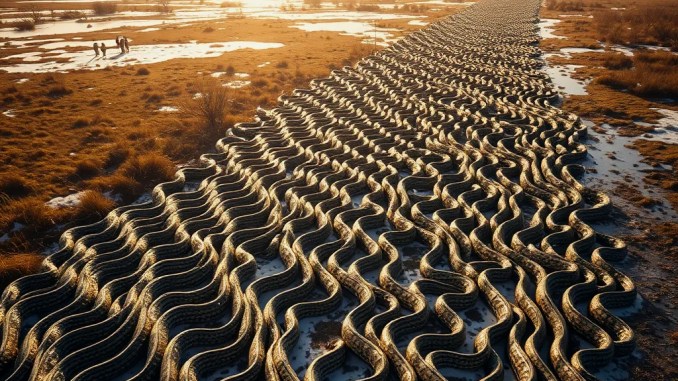
Why tens of thousands of red-bellied gartersnakes surface in Narcisse each spring
The Narcisse sinkhole network sits on fractured limestone that forms a stable, unfrozen refuge through Manitoba winters. When ground temperatures rise in late March–May, the snakes detect thermal cues and chemical signals and exit collectively through dozens of fissures and sinkholes. The synchronized emergence concentrates animals in predictable places because the underground voids connect to limited surface openings; snakes funnel through the same egress points rather than dispersing randomly.
How mating balls form and what they reveal about snake behavior
Male gartersnakes use pheromone trails and tactile signaling to locate females. Once a female emits reproductive cues, dozens to hundreds of males aggregate into a dense, coiling mass called a mating ball. Inside these balls, males compete physically and persistently for mating opportunities. These structures provide direct observational evidence of mate-choice pressure, male endurance, and the role of thermal microhabitats: the cluster conserves heat and shortens the female’s time to optimal body temperature for ovulation.
Detailed timeline: daily and seasonal movements during the spring surge
Day 0–3: Initial surfacing occurs at first warm days, often after several consecutive temperatures above freezing. Snakes appear near sinkholes and move toward sun-warmed patches.
Week 1–3: Peak mating activity. Mating balls are frequent during warm afternoons; Males remain clustered around females day and night for short bouts. Observers report the highest density across weeks 2–4 of emergence.
Week 4–8: Post-mating dispersal. Gravid females seek out upland nesting or hibernation-edge refugia; Males disperse slowly. By late spring and early summer, surface densities decline as animals return to surrounding forests, wetlands, and rocky cover.
Conservation measures that reduce road mortality and maintain population connectivity
Local agencies installed under-road tunnels sized for small reptiles and oriented to align with natural movement corridors. Wildlife guide-fencing funnels individuals to these culverts, reducing run-over incidents. A step-by-step overview of implementation:
1) Mapping Movement: Track emergences to identify crossing hotspots using mark-recapture and trail cameras.
2) Installing Fences: Erect low, flexible barrier fences that prevent snakes from climbing and direct them along the fence to tunnel entrances.
3) Building Culverts: Use small-diameter, darkened passages with natural substrate and gradual slopes to encourage use.
4) Monitoring: Continue camera and tag studies to confirm tunnel effectiveness and adjust fence placement.
Scientific and visitor interest: managing access while protecting an exceptional natural event
Researchers use the site to study pheromone communication, mating system dynamics, disease screening, and thermal ecology. Tourists and naturalists travel to Narcisse for a unique wildlife spectacle; management balances access with protection by installing boardwalks and designated viewing platforms. Recommended visitor practices that reduce disturbance:
• Stay on platforms and trails to avoid trampling microhabitat.
• Keep distance so snakes can continue normal mating behavior.
• Limit handling to trained personnel to avoid stress and potential pathogen transfer.
Examples and data points from monitoring programs
Long-term mark-recapture studies show strong site fidelity: a high proportion of adults return to the same sinkhole complexes each spring Road mortality counts dropped significantly—often by over 70%—within two seasons after tunnels and fences were installed in comparable reptile-crossing projects. Camera arrays document peak daily activity in mid-afternoon temperatures between 10–20°C, with activity declining below 5°C or above 25°C.
Frequently asked practical questions visitors and researchers ask
How close can I safely get? Maintain at least several meters; Move quietly and avoid sudden shadows over snakes. Can the tunnels become blocked? Regular maintenance clears debris; The design includes grated entrances set above flood levels. Are the snakes dangerous? Red-bellied gartersnakes are nonvenomous; they can bite defensively but bites are rare and medically minor.
What to expect after the mating season and long-term outlook
After mating, the visible density in Narcisse drops as females disperse to gestation sites and males return to broader foraging ranges. Populations remain stable when connectivity corridors and culverts are maintained. Continued monitoring for emerging threats—habitat loss, invasive predators, or disease—ensures managers can intervene early and preserve this globally notable spring event.
Key takeaways for conservation planners and curious visitors
Design crossings aligned with natural movement routes, use low-profile fencing that snakes cannot bypass, and provide observation infrastructure that keeps people off sensitive ground. For visitors, a short list: arrive during peak spring temperature, stay on platforms, bring a long lens, and follow posted signage. The Narcisse emergence combines concentrated animal behavior, straightforward mitigation solutions, and rich opportunities for public education—if managers and visitors act deliberately to protect the site.









Be the first to comment