
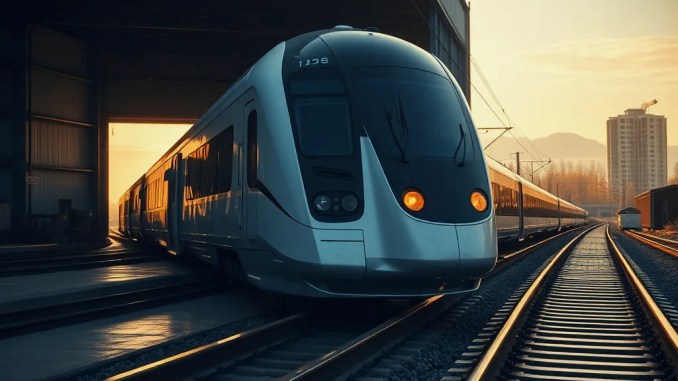
Russia Completes Assembly of First Domestic Hydrogen Fuel‑Cell Passenger Train
Transmashholding (TMH) finished assembly Russia’s first domestically developed hydrogen fuel‑cell passenger train at the Demikhovo plant near Moscow. The train targets non‑electrified routes as a direct diesel replacement and aims to reduce fossil fuel use on regional lines. TMH developed the project in partnership with Russian Railways, Rosatom and the Sakhalin regional government; initial development began after a 2019 agreement and early units were built at Demikhovo and the Tver Carriage Plant.
Two Configurations Tailored for Different Ranges and Capacities
The train will be produced in two distinct configurations to match route length and passenger demand. A two‑car passenger configuration uses only hydrogen fuel cells to achieve over 700 km range; integrated battery support extends that reach to roughly 740 km. A three-car version delivers about 480 km from the hydrogen system alone and gains an additional ~80 km from its battery pack. Both configurations include a dedicated technical wagon housing the hydrogen power system, sensors for hydrogen concentration and fire detection, and modular interfaces for refueling and maintenance.
How the Hydrogen Propulsion System Works
The propulsion system pairs PEM (proton exchange membrane) fuel cells with high-capacity lithium battery packs. Fuel cells convert stored hydrogen into electricity; Batteries capture regenerative braking energy and supply peak power during acceleration. The technical wagon contains pressurized storage tanks, pressure regulation, safety shutoffs and active ventilation. Sensor networks continuously monitor hydrogen concentration and thermal conditions; In the event of abnormal readings, the control system isolates the hydrogen circuit and triggers ventilation and fire suppression protocols. This layered approach reduces operational risk and facilitates certification under rail safety standards.
Testing Timeline and Certification Plan
Sakhalin’s governor announced assembly completion and the start of testing. Initial static and system integration tests are scheduled to begin in November 2026, with dynamic trials around Moscow planned during 2027. Project partners intend to complete certification tests in 2027 and begin commercial service on Sakhalin by late 2027. The program includes development of a hydrogen test center on the island to validate refueling procedures, cold‑weather performance and maintenance workflows under real operational conditions.
Why Sakhalin Is the First Deployment Site
Sakhalin offers a practical testbed: many lines remain non-electrified, the island’s climate provides a rigorous cold-start environment, and the regional government prioritizes modernization. Operators will be able to trial refueling logistics, station infrastructure layout and crew training without disrupting high-frequency mainline services. Lessons learned on Sakhalin will inform operations for suburban and intercity services elsewhere.
Infrastructure and Operational Considerations
Deploying hydrogen trains requires coordinated upgrades across infrastructure and operations. Key elements include:
Onsite refueling stations: modular stations with liquid or gaseous hydrogen storage, dispensers sized for quick turnarounds and integrated safety zones.
Maintenance facilities: dedicated workshops for hydrogen system checks, high-voltage and battery servicing, and certified personnel for fuel-cell module replacement.
Operational procedures: cold‑weather start protocols, emergency isolation steps, regular leak and sensor verification, and revised timetables accounting for refueling intervals.
Energy and Emissions Benefits with Realistic Tradeoffs
Hydrogen fuel‑cell trains emit only water at the point of use, offering clear local air quality benefits compared with diesel locomotion. However, lifecycle emissions depend entirely on how hydrogen is produced: green hydrogen from electrolysis powered by renewables yields the largest carbon reductions, while hydrogen derived from fossil sources can offset those gains. Energy density of hydrogen and the added mass of tanks influence axle loads and track wear; Mitigate these effects by optimizing tank placement and using lightweight composite materials where possible.
Design Examples and Data Points
Design choices in the Russian program reflect practical tradeoffs. Example data from project documents and comparable programs:
Two‑car set: hydrogen‑only range >700 km; with battery support ~740 km. Two passenger cars plus a technical wagon minimize platform length impact while maximizing range.
Three‑car set: hydrogen range ~480 km; battery adds ~80 km, enabling medium‑distance regional runs with fewer refueling stops.
Sensors and safety: distributed H2 sensors, redundant pressure relief valves, and automatic ventilation reduce incident escalation times to seconds in simulations.
Scaling: From Regional Trials to Wider Fleet Use
Project stakeholders plan to evolve the hydrogen power system into a common platform for city, suburban and intercity rolling stock. A stepwise scaling path includes:
1) Operation on Sakhalin to validate refueling strategies, crew training and maintenance cycles.
2) Retrofit pilot units for busy non-electrified suburban corridors to reduce diesel operation during peak periods.
3) Manufacturer standardization of modular hydrogen powerpacks for economies of scale, enabling rapid installation across multiple vehicle types.
Practical Steps for Operators Considering Hydrogen Trains
Operators preparing to introduce hydrogen trains should follow a clear checklist:
1. Route analysis: map non-electrified routes, distance between terminals and existing fueling logistics to determine ideal deployment sites.
2. Refueling design: size dispensers based on turnaround time targets and select either compressed gaseous or liquid hydrogen, balancing cost and refueling speed.
3. Facility upgrades: train staff in hydrogen safety, install ventilation, sensor networks and isolation systems in depots.
4. Maintenance planning: schedule fuel‑cell stack servicing, battery cycling protocols and create spare‑parts pools.
5. Certification and community engagement: work with regulators on safety cases and inform local communities about hydrogen handling and emergency responses.
What to Expect Next
Look for the following near-term milestones: completion of static integration and cold-weather trials starting November 2026, dynamic testing in the Moscow region in 2027, certification by the end of 2027 and initial commercial service on Sakhalin shortly thereafter. If test results validate durability and refueling workflows, the technology could expand into suburban and intercity fleets using a shared hydrogen power platform.
Related Searches and Questions People Also Ask
How far can hydrogen trains run compared to diesel and electric trains? Typical hydrogen train ranges vary by configuration; the Russian examples target 480–740 km depending on battery support, which approaches regional diesel ranges and closes the gap with electric trains on non-electrified lines.
How safe is hydrogen on trains? Modern systems employ multilayered safety: robust tank designs, distributed leak detection, automatic isolation, ventilation and certified emergency procedures, which together reduce operational risk to levels comparable with other rail energy systems.
Can hydrogen trains work in cold climates? Yes—designs include cold‑start procedures, insulated tanks and thermal management for fuel cells and batteries; Sakhalin will provide a practical cold‑weather validation.






Be the first to comment