
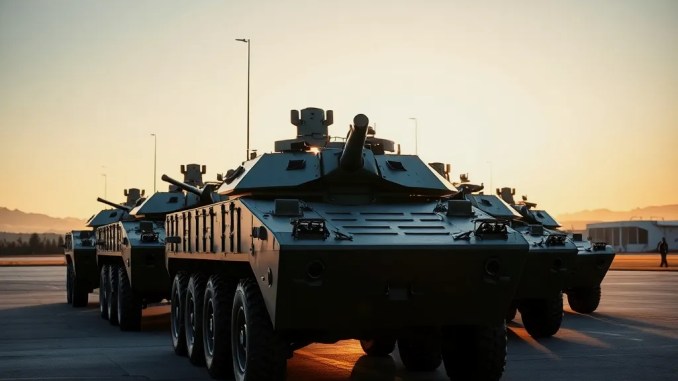
Five Stryker 8×8 Vehicles Delivered to Bulgaria, Modernization Begins
Bulgaria received the first five Stryker 8×8 armored vehicles under a $1.414 billion procurement program when the vehicles were formally handed over at TEREM-Ivaylo in Veliko Tarnovo on 3 November 2026. Officials from Bulgaria, the United States and Canada attended the ceremony, signaling allied support for the Bulgarian Army’s mechanized modernization. The delivered vehicles are in the M1126 armored personnel carrier configuration and will begin equipping the 61st Stryamska Mechanized Brigade based in Karlovo.
What the Program Orders and Current Delivery Status Are
The procurement covers 183 Stryker 8×8 vehicles across six configurations plus 15 HEMTT logistics trucks. Bulgaria’s program phases the work through shipment, final assembly, communications integration and testing at TEREM-Ivaylo. Timeline and status highlights:
Key dates and progress
– 14 February 2026: First group of Strykers arrived at Burgas port.
– 3 November 2026: Formal delivery of five M1126 APCs following integration and acceptance steps.
– As of 3 November 2026: Eight Strykers have completed assembly; three await final acceptance; 25 are in assembly. The initial five were handed over 262 days after arrival, about one year behind the original schedule.
Which Stryker Variants Are Included and How They’ll Be Used
The 183-vehicle order contains variant types sized to specific mission roles. The distribution and intended operational roles are:
Fleet composition
– 90 M1296 Dragoon infantry fighting vehicles for direct fire and maneuver operations.
– 17 M1126 armored personnel carriers for troop transport and protected mobility.
– 33 M1130 command vehicles to host brigade and battalion C2 elements.
– 24 M1133 medical evacuation vehicles to provide protected casualty treatment and evacuation.
– 9 M1132 engineer/assault breacher variants for mobility and obstacle reduction tasks.
– 10 M1135 CBRN reconnaissance vehicles for nuclear, biological and chemical detection missions.
The 90 Dragoons and 17 APCs total 107 combat and transport platforms, representing roughly 58.5% of the fleet; the remaining 76 vehicles provide command, medical, engineer and CBRN capabilities to form balanced combined-arms squadrons.
Why Deliveries Fell Behind Schedule and What Slowed Integration
Prime causes of the delay center on supply-chain issues for imported subsystems, with communications and electronics showing the most impact. Practical constraints included long lead times for radios, datalinks and adapters, certification testing for NATO interoperability, and the integration workload at the TEREM-Ivaylo facility. Bulgaria requires complete communication system installation and verification at TEREM-Ivaylo before vehicles enter operational service; that integration step added measurable time after maritime receipt.
How Bulgaria Will Field and Sustain the New Stryker Fleet
Bulgaria plans a phased fielding and sustainment approach that minimizes operational gaps:
Fielding steps
1. Final assembly and systems integration at TEREM-Ivaylo, including radios, battlefield management systems and power systems.
2. Acceptance testing that covers mobility, communications interoperability, weapons and crew drills.
3. Training packages delivered to crew and maintenance cadres covering preventive maintenance, diagnostics and tactical employment.
4. Progressive unit introduction: initial platoons and companies will reach capability first, enabling a rolling conversion of the 61st Stryamska Mechanized Brigade.
Logistics and sustainment considerations
Bulgaria will require spares provisioning, local workshop upgrades for medium-weight tracked/wheeled platforms, and supplier-managed obsolescence plans for radios and electronic modules. The inclusion of 15 HEMTT logistics trucks supports forward sustainment by moving bulk supplies, fuel and recovery gear to mechanized units operating with Strykers.
Operational Impact: What Strykers Change for Bulgarian Forces
Stryker family vehicles change operational posture in measurable ways:
– Mobility and tempo: eight-wheeled Strykers provide higher road speed and shorter logistics footprint than legacy tracked IFVs in routine deployments, enabling faster brigade-level maneuver on paved networks.
– Protected transport and survivability: M1126 APCs improve troop protection against small-arms and shrapnel while being easier to sustain than heavier IFVs.
– Combined-arms balance: Mixing Dragoons, APCs, command and support variants creates self-contained squadrons able to operate with organic C2, MEDEVAC and engineer support for independent operations.
Examples and Data Points to Watch During Fielding
Trackable indicators that will show program momentum and operational readiness:
– Assembly throughput: number of vehicles completed per month at TEREM-Ivaylo.
– Acceptance cycle time: days between assembly completion and formal handover.
– Training throughput: number of crews and maintenance personnel fully qualified per quarter.
– Sustainment metrics: mean time to repair (MTTR) for critical subsystems and initial spare-part fill rates.
Next Steps and Timeline Expectations
Bulgaria and its industrial partners are likely to focus on accelerating communications procurement, increasing parallel assembly lines at TEREM-Ivaylo, and ramping up training to close the roughly one-year delay. Expect incremental deliveries through 2027 and into 2028 as integration bottlenecks clear and acceptance testing progresses. Monitoring the four indicators above will provide a clear view of whether the program returns to its original cadence.
Takeaway
The first five M1126 Strykers mark a tangible start to Bulgaria’s mechanized transformation. Completing communications integration, scaling assembly, and developing sustainment capacities will determine how quickly the 61st Stryamska Mechanized Brigade achieves full operational capability with the new Stryker family variants.








Be the first to comment