
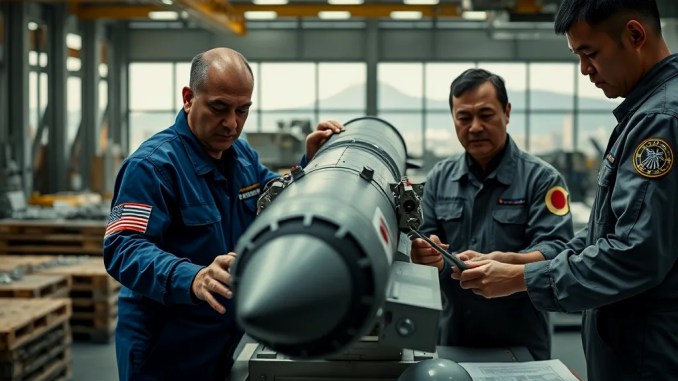
US and Japan Reach Agreement to Host AMRAAM Final Assembly and Checkout in Japan
The United States and Japan will establish a production facility in Japan to perform final assembly and checkout (FACO) of the AIM-120 AMRAAM air-to-air missile. Officials announced the deal during defense talks in Cebu at the ASEAN Defense Ministers’ Meeting-Plus. The move aims to expand allied missile production capacity to meet rising global ammunition demands and to deepen industrial cooperation under the Operation Supercharge initiative.
Why Japan Is Building an AMRAAM FACO Now
Japan’s decision followed more than two years of negotiations and a feasibility study involving Mitsubishi Electric and Raytheon. The country seeks to secure critical munitions access, strengthen domestic manufacturing capability, and reduce lead times for Japanese and regional air-defense platforms. The effort also aligns with broader allied plans to scale munitions output after supply shortages exposed by recent conflicts.
How the New Facility Will Integrate with Global AMRAAM Production
Raytheon currently leads AMRAAM production in the United States, with a multi-year contract targeting at least 1,900 missiles per year. The Japanese FACO will not replace US lines but will share the production burden: it will perform final assembly, functional testing, and checkout on missiles or missile components sourced from US and allied suppliers. Integrating FACO operations in Japan will:
• Shorten delivery timelines by completing final assembly closer to regional operators.
• Reduce logistic strain on transoceanic shipments of fully assembled missiles.
• Enable variant-specific tailoring for NASAMS and fighter aircraft users in the Indo-Pacific.
What Remains Unsettled About the Project
Key details remain pending: the facility’s exact location, construction schedule, targeted annual FACO throughput, and which Japanese firms will perform specific manufacturing tasks. Officials have also discussed expanding Japanese involvement beyond FACO to include printed circuit board assembly and other subassemblies, but no binding commitments on scope or technology transfer levels have been publicly released.
Production Capacity Targets and Budget Context
Raytheon’s announced five-year AMRAAM production contract, including optional extensions, has a total potential value above $20 billion and sets a baseline of at least 1,900 missiles per year as the US target. If the Japan FACO takes responsibility for even 10–20% of final assembly work, that would translate into roughly 190–380 missiles annually routed through the new facility. Unit cost for AMRAAM variants varies; advanced versions can exceed $1 million per round, so contribution percentages have direct budgetary implications for procurement and sustainment planning.
Operational Benefits Across Platforms
AMRAAM serves both fighter air-to-air roles and ground-based systems such as NASAMS. Locating FACO in Japan benefits multiple users:
• Fighters: Faster replenishment for F-35s and other air-superiority platforms operating in the Indo-Pacific.
• Ground-based air defense: Easier resupply for NASAMS batteries protecting bases and critical infrastructure.
• Allied interoperability: Local FACO enables quicker modification or configuration of missile lots to match platform-specific integration requirements.
Technical Steps the New FACO Will Perform
The FACO will follow a defined sequence of operations to convert imported modules into flight-ready missiles. Typical steps include:
1. Receipt and inspection of chassis, guidance sections, and propulsion modules.
2. Subassembly integration such as mounting the seeker, wiring harnesses, and control fins.
3. Circuit board installation and software loading (if included in scope).
4. Alignment and calibration of guidance and seeker units.
5. Environmental and functional testing including vibration, thermal cycling, and power-on checks.
6. Final checkout and shipment with traceable lot records for logistics and sustainment.
Industrial and Strategic Implications for Japan
Hosting FACO increases Japan’s defense-industrial base capability, creates skilled manufacturing jobs, and fosters joint supply-chain resilience with US partners. If Japan expands into printed circuit board assembly and other subcomponents, the facility could evolve into a regional hub for missile electronics, further insulating allied stocks from single-point failures.
Examples and Precedents
Allied FACO models exist already: NATO and partner nations have long hosted final assembly for certain weapon systems to improve logistics and sovereign sustainment. Japan’s FACO would follow that precedent but within a higher-technology supply chain and under stricter export-control and interoperability constraints unique to AMRAAM’s classified guidance and seeker elements.
Questions Likely to Appear in People Also Ask and Featured Snippets
What is AMRAAM FACO? A FACO (final assembly and checkout) facility performs the final integration, testing, and certification steps that convert missile subassemblies into flight-ready rounds.
Why is Japan building one? To speed deliveries, strengthen domestic defense capacity, and share production burdens with the US amid rising ammunition demand.
Will Japan make whole missiles? Initially, the facility will likely perform final assembly and testing rather than complete manufacturing of all major components; future expansion into subassemblies is under discussion.
How many missiles will it produce? Exact throughput is not declared; a plausible early share would be a fraction of the US 1,900-per-year production baseline (for example, tens to a few hundred missiles annually), depending on scope.
Next Steps and What to Watch
Watch for formal announcements that specify the facility location, construction timeline, Japanese industrial partners, and any technology-transfer terms. Procurement notices or invitations to tender from the Japanese Ministry of Defense or participating companies will clarify capacity targets and potential commercialization of circuit-board assembly or other subcomponent work.
Bottom Line
The US-Japan agreement to host AMRAAM FACO in Japan under Operation Supercharge represents a strategic, industrial, and logistical step to increase allied missile availability. It reduces supply-chain vulnerability, accelerates regional resupply for multiple platforms, and sets the stage for deeper Japanese participation in missile manufacturing if partners expand the facility’s technical scope.









Be the first to comment