
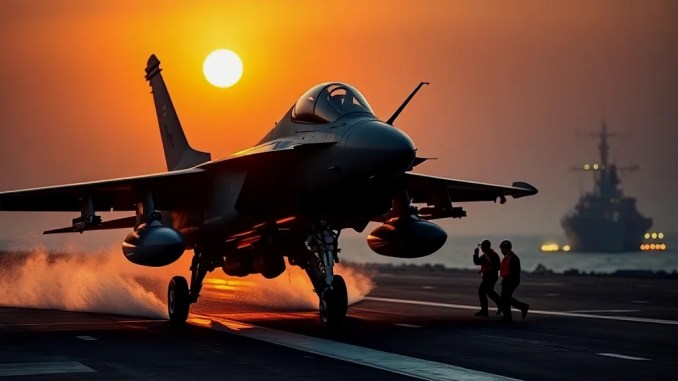
Rafale M completes first successful landing on INS Vikrant
France-built Rafale M made a confirmed arrested landing on India’s indigenous aircraft carrier INS Vikrant during sea trials on 29 October. The test demonstrated basic deck compatibility and recovery procedures for the Marine variant, marking the first shipboard trap landing of the type on Vikrant. Indian Navy observers, led by Vice Admiral Sanjay Vatsayan, monitored approach profiles, deck handling and arrestor engagement across multiple recovery cycles.
Why this landing matters now
This single event advances three operational priorities simultaneously: validating carrier deck interfaces for Rafale M, accelerating pilot and deck-hand proficiency for ski-jump operations with tail-hook recoveries, and providing empirical data to refine carrier operating procedures. The test moves the platform closer to formal induction ahead of the 26-aircraft procurement schedule signed between India and France.
Contract timeline and fleet planning
India’s inter-governmental agreement with France covers 26 Rafale M fighters for roughly $7.4 billion, with planned deliveries through 2030. The Indian Navy intends to operate the jets from INS Vikramaditya and INS Vikrant, giving each carrier a carrier air wing capable of strike, air superiority and maritime patrol suppression missions. The procurement package includes weapons integration, simulators, spares and logistical support to field a carrier-capable Rafale squadron.
How deck operations differ for ski-jump carriers and what was tested
Ski-jump carriers launch aircraft using a ramped bow rather than catapult assistance. For recoveries, aircraft use a tail hook to catch deck arrestor wires that bring jets to a full stop over a short distance. During the Vikrant trial teams evaluated approach glideslope stability over the ski-jump descent corridor, touchdown dispersion relative to arrestor wire placement, tail-hook engagement reliability and braking loads transferred to the arrestor gear. These parameters determine safe sortie rates and required maintenance intervals for deck hardware.
What integration work preceded the shipboard landing
Two weeks before the deck landing, Rafale M airframes underwent ground-based carrier trials at India’s Shore-Based Test Facility (SBTF). Engineers and pilots simulated takeoffs from a ski-jump and repeated arrested landings on a replica deck to tune landing gear, tail-hook geometry and flight-control settings under carrier-specific constraints. Ground trials identify required software or hardware tweaks before committing to the riskier at-sea environment.
Technology transfer, local production and systems integration
The procurement agreement includes provisions for technology transfer and local production. Dassault Aviation plans to establish manufacturing of select Rafale airframe components in India, while MRO facilities for engines and avionics will be developed locally. Integration work aims to marry India’s indigenous ordnance—such as the Astra beyond-visual-range air-to-air missile—with the Rafale M’s avionics and weapon-control systems. This will reduce lifecycle costs and broaden tactical flexibility by allowing carriers to employ home-grown munitions.
Operational implications: training, maintenance and sortie generation
Bringing a carrier fighter into service requires synchronized advances across personnel, logistics and infrastructure. The Navy needs deck-landing qualified pilots, landing signal officers, arrestor and catapult technicians, and calibrated simulators to shorten the training pipeline. Maintenance teams must absorb new repair protocols for composite airframes, engine modules and advanced sensors. Saab-style sortie-generation planning indicates that a fully staffed carrier air wing can sustain higher daily sortie rates once arrestor reliability and deck-hand turnaround procedures clear defined thresholds derived from these tests.
Potential risks and mitigation steps observed
Carrier-based operations pose landing dispersion, deck-wear and foreign-object-damage risks. Mitigation steps during trials included repeated hook-engagement verification under varying approach speeds, real-time telemetry to detect hook stresses, and incremental increases in landing tempo while monitoring arrestor wire integrity. These stepwise tests minimize surprise failure modes and allow incremental tuning of both aircraft flight-control laws and deck equipment settings.
What to expect next in the test and induction program
Expect a phased schedule: expanded at-sea trials covering day/night and rough-weather recoveries, weapons-load flight trials from the ski-jump, interoperability exercises with carrier-capable support aircraft, and progressive increases in landing tempo. Each phase will provide pass/fail data points that must be cleared before formal squadron induction. Parallel simulator and SBTF cycles will shorten the calendar by addressing configuration issues on the ground.
How this shapes regional naval balance
Deploying Rafale M squadrons aboard India’s carriers strengthens maritime air power, extending reach for air superiority, strike and anti-surface roles. Combined with local weapon integration and growing MRO capacity, the capability rise will influence carrier-air operations across the Indian Ocean region by introducing higher-performance, multirole fixed-wing assets into regular carrier task groups.






Be the first to comment