
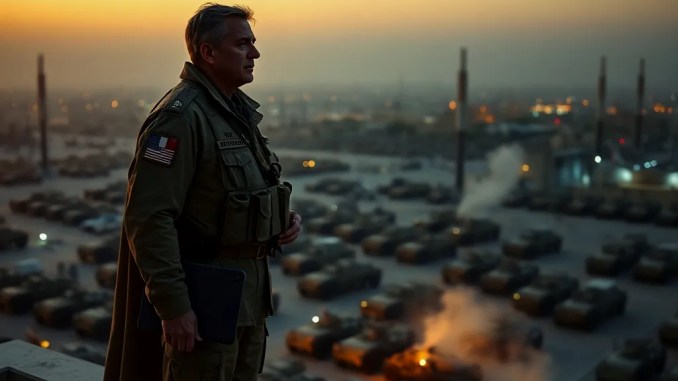
Supreme Leader Instructs Forces to Raise Readiness and Broaden Response Options
Ayatollah Mojtaba Khamenei directed Iran’s armed forces to elevate their preparedness in response to potential new attacks, emphasizing swift and decisive action. He instructed the Islamic Revolutionary Guard Corps (IRGC) to develop capabilities that allow responses not limited by geographic boundaries. This directive positions Iran to control both timing and scope of any retaliation, signaling a strategic shift from strictly territorial defense to a posture that includes offensive planning and flexible targeting.
Updated Targeting Orders: What Was Mandated and Why It Matters
Khamenei ordered an updated target list and military planning aimed at ensuring that both physical and non-physical assets are tied to the United States and Israel fall within reach of Iran’s armed forces. The instruction covers material infrastructure as well as intangible targets such as logistical networks and command-and-control nodes. Operationally, this requires integrated intelligence, long-range strike capabilities, and synchronized command structures to convert political intent into timely action.
How Iran Could Translate Orders into Capability
Converting the Supreme Leader’s directives into operational capability involves several concrete steps: 1) expanding surveillance and intelligence fusion to identify high-value targets beyond Iran’s borders; 2) enhancing stand-off strike options — including missiles, drones, and cyber tools — to project force without requiring immediate cross-border troop movements; 3) updating rules of engagement and command protocols so strategic leadership can rapidly authorize proportional responses; and 4) conducting joint drills that validate coordination between IRGC, regular military units, and intelligence services. Each step reduces decision latency and increases the credibility of deterrent threats.
Strategic Significance for Regional Deterrence
By framing retaliation timing and scope as decisions reserved for Iran’s leadership and armed forces, the directive aims to strengthen deterrence in three ways: first, by increasing uncertainty in adversaries’ targeting calculus; second, by signaling capability to retaliate beyond Iranian territory; and third, by demonstrating political will to escalate if attacked. This layered deterrence relies on both visible demonstrations (exercises, public statements) and concealed preparations (intelligence updates, forward positioning of assets).
Potential Operational Examples and Scenarios
Concrete scenarios that reflect this guidance include:
Short-range escalation: precision missile strikes against forward-deployed bases or logistical hubs linked to adversary operations.
Stand-off operations: long-range unmanned aerial vehicle strikes or cruise missile attacks on facilities outside Iran’s borders that support hostile actions.
Non-kinetic responses: coordinated cyber operations targeting command-and-control, satellite-assisted disruption of communications, or information operations to degrade adverse decision-making.
Implications for US-Iran and Israel-Iran Tensions
The instruction arrives amid sustained diplomatic activity between Washington and Tehran and intensified regional military tension. By broadening possible responses, Tehran raises the strategic costs for any actor contemplating strikes on Iranian assets. For policymakers and analysts, this increases the need to reassess force posture, convoy protection, and the dispersal of critical assets to reduce vulnerability to both kinetic and non-kinetic attacks.
Indicators to Watch: How to Tell If Iran Is Implementing These Orders
Key indicators that would signal active implementation include:
Increased joint training between IRGC and regular forces focused on long-range strike and rapid command approval.
Surge in ISR activity (intelligence, surveillance, reconnaissance) — greater satellite tasking, signals collection, and human intelligence operations focused on external targets.
Forward deployment or rehearsals of strike platforms — visible movement of missile units, aerial assets, or drone logistics to positions that enable extended reach.
Cyber and information campaigns calibrated to degrade adversary communications or readiness ahead of or alongside kinetic options.
Risks, Constraints, and Possible Countermeasures
Expanding response options does not eliminate limitations. Logistics, international political cost, alliance countermeasures, and precision targeting challenges constrain execution. Adversaries can mitigate risks by hardening critical infrastructure, dispersing assets, improving early warning systems, and elevating cyber defenses. Diplomatic engagement and de-escalation channels remain the most direct way to reduce the likelihood of miscalculation.
Takeaway: A Shift Toward Flexible, Credible Deterrence
The Supreme Leader’s orders reflect a deliberate shift toward flexible deterrence that integrates kinetic and non-kinetic tools, command agility, and targetable reach beyond Iran’s borders. Implementation will depend on intelligence integration, force modernization, and clear political thresholds for action. Observers should monitor military exercises, ISR patterns, and cyber activity for early signs of operationalization.






Be the first to comment