
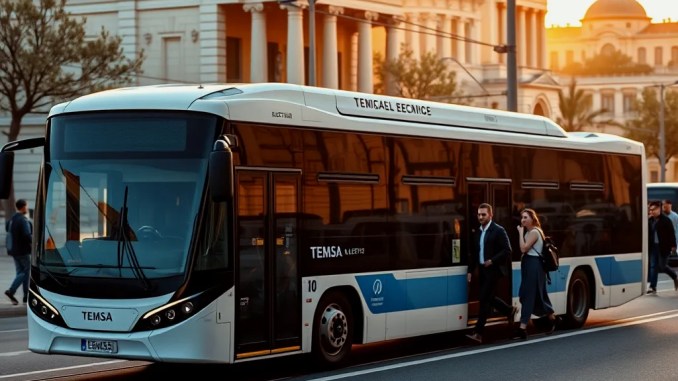
TEMSA participated in the eBRT2030 project demonstration in Athens with its Avenue Electron 18-meter articulated electric bus, showing how existing urban infrastructure can support high-capacity electric transit without large-scale reconstruction. Project partners ran a roughly 10-kilometer live drive along Syngrou Avenue on 5 November 2026 to validate vehicle performance, charging strategies and operational data collection under real traffic conditions.
Real Field Experience on Athens Streets
The live demonstration used the Avenue Electron to replicate typical city-route operations: repeated passenger loads, stop-start traffic, and interaction with conventional bus lanes. Organizers instrumented the vehicle with energy, temperature and powertrain sensors and connected them to on-board IoT systems. Real-time telemetry reported battery state-of-charge, regenerative braking recovery, instantaneous energy consumption (kWh/km) and charging events to a central dashboard. Observed figures across the 10 km route indicated consistent energy use patterns that validate depot charging plus on-route top-up through existing catenary points.
Current Infrastructure is Adapted to New Generation Electric Transportation
eBRT2030 explicitly targets rapid decarbonization using as much of the current physical network as possible. In Athens the Avenue Electron demonstrated two core operational modes: off-wire operation drawing power from stored battery energy, and catenary-assisted motion where the vehicle accepts energy through a pantograph while moving. That hybrid approach cut the required number of new charging islands by an estimated 40% in modeled scenarios. Depot charging schedules complemented on-route catenary top-ups: a step-by-step charging strategy used a high-power depot charger overnight (optimized for cell-balancing) and short, opportunistic catenary charges during peak runs to maintain state-of-charge above a defined threshold (typically 30–40%).
Technical Measures and Data-Driven Optimization
Vehicle-integrated sensors and IoT telemetry streamed to a digital twin environment where operators and engineers run what-if simulations. Examples of analytics used during and after the demo:
1) Energy profiling: per-segment kWh/km profiles identified uphill sections and congested junctions as energy hotspots; Recalibrating dwell times and signal priority reduced consumption in follow-up runs.
2) Thermal management: battery temperature curves informed an adaptive cooling profile; lowering cooling power at moderate ambient temperatures extended auxiliary energy for traction.
3) Charge-window optimization: analysis produced a timetable that minimizes peak depot load while guaranteeing route completion—this included scheduling short midday catenary interventions aligned to layovers.
Electric Transportation Solutions are Developed with International Cooperation
eBRT2030 gathers transit operators, municipalities, OEMs and research institutions to co-develop standards for interoperability, operational workflows and procurement criteria. TEMSA contributed engineering expertise on vehicle electronics, battery system architecture and charger integration. Project outputs aimed to create replicable implementation packages: vehicle spec sheets, depot retrofit guidelines and data-schema templates for shared telemetry. These deliverables help cities compare lifecycle costs and emissions across scenarios (battery-only, catenary-hybrid, and frequent-opportunity-charging fleets).
Practical Takeaways for Transit Agencies
Transit operators can adopt learnings from the Athens demonstration in five actionable steps:
1) Map existing electrification assets: inventory overhead lines, depot power capacity and curbside layovers to build feasible hybrid-charge routes
2) Pilot with instrumented vehicles: run short-term demos under realistic passenger and traffic loads to collect energy profiles and operational limits.
3) Implement mixed charging strategies: combine overnight depot charging with opportunistic on-route top-ups to reduce infrastructure cost while maintaining availability.
4) Use digital twins for planning: simulate seasonal performance, degradation and worst-case demand to shape maintenance and procurement windows.
5) Standardized telemetry and data exchange: adopt common data schemas to allow multi-vendor fleets to share operational analytics and to facilitate competitive procurement.
Measurable Results and Example Metrics
Data published by the project and validated in the Athens run included:
– Operational range per full depot charge: 180–220 km in mixed urban cycles when supported by intermittent catenary boosts
– Average energy consumption: 1.25–1.6 kWh/km depending on passenger load and stop spacing.
– Infrastructure reduction estimate: up to 40% fewer dedicated fast-charging islands capital expenditure when using on-route catenary segments in combination with depot charging.
These metrics depend on local topography, climate and duty cycles; agencies should reproduce the instrumented runs before scaling procurement.
How TEMSA’s Contributions Scale to Other Cities
TEMSA supplied modular hardware and software components designed for retrofit compatibility. The Avenue Electron’s electrical architecture accepts multiple charging interfaces (pantograph, CCS-compatible depot chargers) and a flexible battery management layer that supports cell-cluster replacement over time—this reduces lifecycle risk. Combined with open telemetry APIs, cities can integrate TEMSA vehicles into existing fleet management systems without full vendor lock-in.
Next Steps for eBRT2030 Partners
Following Athens, partners will compile a public technical dossier with measured datasets, charging strategies and procurement templates. The next demonstration phases will stress-test seasonal extremes, increase route complexity and trial mixed fleets across different European cities to refine interoperability rules and cost models.




Be the first to comment