
Rheinmetall signs contract to deliver 20 Skyranger 30 systems to Belgium
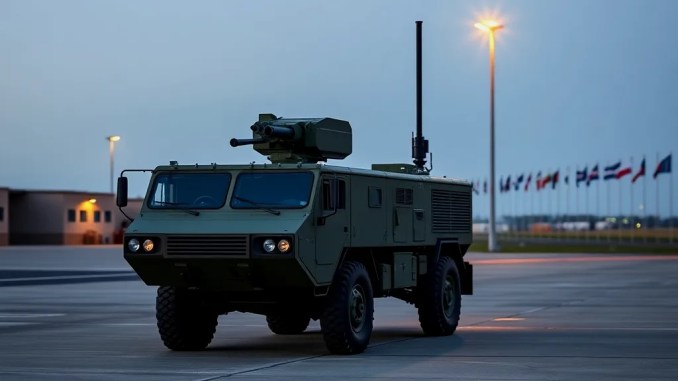
Rheinmetall will supply 20 Skyranger 30 short-range air-defense systems to the Belgian Armed Forces and provide logistics support under a contract finalized after negotiations began that in June 2025. The systems, slated for delivery starting at the end of 2028, will mount on hooklift-capable vehicle platforms and operate primarily in fixed emplacements to protect Belgian territory and critical infrastructure from air threats.
How the Skyranger 30 will be deployed and what it protects
The Skyranger 30 pairs a compact turret with a 30 mm automatic cannon, sensors and a combat management interface. Belgium will use these systems in fixed deployments across strategic nodes: airfields, energy and communications infrastructure, and priority urban approaches. Integrating the Skyranger 30 into static positions simplifies logistics and sustainment while enabling continuous, layered coverage against low-altitude threats such as cruise missiles, helicopters and small unmanned aerial systems (UAS).
Contract scope, timeline and value
The procurement package includes the 20 Skyranger 30 units plus full lifecycle logistics support. Deliveries will start at the end of 2028 and encompass training, spare parts, maintenance planning and integration engineering. Public reporting places the program value at several hundred million euros. The logistics element covers scheduled maintenance cycles and depot-level support to ensure high availability across the force.
Why Belgium chose Skyranger 30: capability match and operational fit
Belgium evaluated systems for rapid detect-and-engage performance against increasingly varied aerial threats. The Skyranger 30 offers a balance of rate of fire, precision and integration readiness for a national C2 architecture. It complements longer-range systems by filling the short-range engagement layer and provides a cost-effective means to harden key sites without the footprint or expense of larger surface-to-air missile systems.
50 years of cooperation: historical context and continuity
Rheinmetall traces its Belgian partnership back nearly five decades to the Oerlikon Contraves era, when the company and Krauss-Maffei supplied Belgium with 36 Gepard mobile air-defense systems. Executives characterize the new contract as the latest phase in a long-term industrial and operational relationship. That continuity provides Belgian planners with institutional memory on sustainment, upgrade pathways and interoperability lessons learned from earlier Gepard deployments.
Integrating Belgian industry into the supply chain
Rheinmetall will incorporate Belgian technology firms into the Skyranger 30 supply chain. The program specifies local-supplier participation for selected components, testing activities and systems integration tasks. This approach reduces delivery risk, creates local engineering and assembly jobs, and positions Belgian suppliers to compete for follow-on exports as sub-tier vendors on Rheinmetall-led projects.
Linking Skyranger 30 to Belgium’s Blue Dome C2 architecture
The Skyranger 30 units will interface with Belgium’s Blue Dome command-and-control (C2) framework. Integration includes data-linking sensors, sharing track data, and allowing centralized engagement authority when required. By joining the national C2 layer, Skyranger 30 systems will operate as part of a coordinated air-defense picture, improving reaction time through fused sensor inputs and reducing redundant sensor coverage.
Countering UAS threats: tactics, examples and employment concepts
The Skyranger 30 is well suited for counter-UAS missions. A typical employment concept places systems in overlapping coverage arcs around critical assets, with radars and electro-optical sensors providing cueing. Rules of engagement and escalation ladders tune responses to risk levels: detect, classify, track, and then interdict with graduated responses. Belgium can pair Skyranger 30 cannon engagements with soft-kill effects—jammers or directed-energy systems—where authorization and collateral-risk calculations favor non-kinetic defeat.
Logistics and sustainment: step-by-step readiness plan
Effective sustainment follows three steps: 1) Pre-deployment validation — perform system acceptance testing, operator training and export-conformity checks at Rheinmetall facilities; 2) In-country establishment — set up maintenance depots, stocking plans for spares and a training pipeline for technicians; 3) Long-term lifecycle management — implement scheduled overhauls, software update regimes and supply-chain diversification to avoid single-source bottlenecks. These steps will keep operational availability high while the fleet expands across sites.
Industrial benefits and export potential for Belgian firms
Local companies that enter the supply chain can gain experience in hardened electronics, turret subassemblies, and C2 software modules. Rheinmetall’s intent to involve Belgian firms creates a pathway to qualify vendors for strict defense standards, which in turn raises their competitiveness for international programs. Example opportunities include manufacturing sensor housings, developing integration middleware and providing field-level maintenance services for allied customer fleets.
Operational scenarios and force-multiplying effects
In high-tempo scenarios, Skyranger 30 batteries can free longer-range assets to engage high-value, standoff threats while handling saturation attacks at short ranges. In peacetime, fixed Skyranger emplacements deter low-cost incursions and provide reinsurance to critical-site operators. Their presence also shortens response timelines for local quick reaction forces tasked with follow-on interdiction or forensic recovery after an engagement.
What happens next and procurement oversight
Belgium will finalize integration schedules, nominate installation sites and begin supplier qualification activities with Rheinmetall. Parliamentary and defense-audit reviews will track program milestones and expenditure. The next visible steps are signing-off on site-preparation works, rolling out operator courses and completing the first system acceptance trials ahead of the 2028 delivery window.








Be the first to comment