
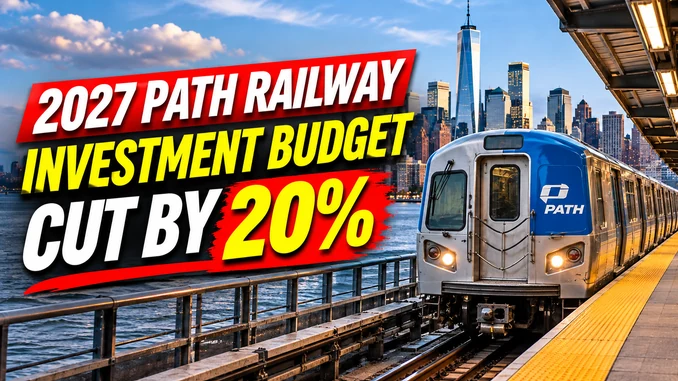
New 2027 Capital and Operating Proposal
The Port Authority of New York and New Jersey proposes a $232.9 million capital allocation for the PATH rail system in 2027, about 20% below the $292 million originally budgeted for 2026. Officials base the reduction largely on the completion of the $430 million PATH Forward modernization program in 2026, which eliminated a major multi-year spending driver. The full agency budget request totals $10.3 billion for 2027, with allocations of $4.5 billion for operations, $4.0 billion for capital, $1.7 billion for debt service and $100 million for deferred maintenance.
Why PATH Capital Falls in 2027
Capital spending for PATH peaked during intensive system upgrades. PATH spent roughly $379.8 million in 2025, while 2026 year-end spending is forecast near $257.2 million. The proposed $232.9 million for 2027 sits $146.9 million below 2025 actuals. The principal cause is the end of the PATH Forward program, a two‑year modernization effort completed in 2026 that upgraded systems, rolling stock interfaces and customer service elements. With those projects closed out, routine and targeted capital needs remain but large program-driven outlays decline.
Top Capital Priorities and Dollar Allocations
The 2027 capital plan prioritizes electrical reliability, critical station and track work, and resiliency. Notable allocations include:
• 2nd Transformer Station and Compressor Facility (Jersey City): $34.6 million — Replaces an end-of-life transformer station that supports operation of the entire PATH fleet. Upgrading power infrastructure reduces forced outages and enables consistent service levels.
• Journal Square–Harrison Track Work: $21.4 million — Replaces rails, ties (traverses) and ancillary components to reduce slow orders and increase service reliability along this corridor.
• Ticket Hall Upgrades: $12.9 million — New faregates and anti-fare-evasion technologies to lower revenue leakage and speed passenger flow at peak periods.
• Sandy Storm Repairs: $12.5 million — Restoration at Hoboken, Newport, Exchange Place and Grove Street to address lingering storm damage and improve station resilience against future flooding.
Other ongoing investments include tunnel infrastructure design work for PATH Tunnels A and B, and continued rail and car maintenance programs to extend life cycles and reduce mid-term replacement needs.
Which Previously Planned Projects Shifted or Paused?
The 2026 budget had larger sums for several projects — $53.3 million earmarked previously for the 2nd Transformer Station, $41.5 million for rolling stock and track maintenance programs, and $28.2 million for post-Sandy station restorations. The reduction in 2027’s line item amounts does not necessarily mean these projects are canceled; Rather, it reflects the phasing of expenditures, grant receipts timing, or completion of earlier scopes. Agencies often reprofile multi‑year projects so that peak spending years align with construction schedules and available state/federal funding.
Operating Budget and Ridership Targets
PATH’s proposed 2027 operating budget is $657 million, about $27 million (4%) higher than 2026. The increase coversary pressures, climate‑related maintenance needs, and investments in facility upkeep. Specific operating additions include $1 million to support on‑train mandatory camera systems and $4 million supporting Amtrak‑reimbursable work on the Dock and Sawtooth bridges where PATH contributes to joint infrastructure efforts.
PATH estimates carrying 67 million passengers in 2027 — roughly 3 million more than projected for 2026 and about 82% of 2019’s pre-pandemic ridership. Projected farebox receipts are $230 million, up $41 million (22%) from the prior budget, driven by both higher ridership and a scheduled fare increase.
Fare Increase Details and Passenger Impact
Single‑ride fares will increase from $3.25 to $3.50 effective January 3, 2027. This 25‑cent rise represents the second phase of a four‑year fare plan previously approved by the Port Authority board. The agency frames the increase as necessary to support more frequent weekday and weekend service, improve reliability and fund ongoing capital maintenance. Using PATH’s ridership and revenue projections, the fare change helps bridge part of the operating shortfall while keeping one‑way fares at a level comparable to other regional commuter options.
AirTrain Newark and Aviation Investments
The 2027 budget also supplies $717 million for aviation projects across Port Authority airports. Within that envelope, work continues to replace the aging AirTrain Newark system with a new guideway and vehicles. The authority expects a new entrance to Newark Liberty International Airport rail station to open in 2027, improving multimodal transfers among AirTrain, Amtrak and NJ Transit. These investments aim to reduce surface access constraints and improve the airport’s resilience to peak‑period demand.
Timeline for Budget Review and Public Input
The Port Authority will accept public comments on the 2027 budget through December 15. The board plans to consider and vote on the final budget at its December 17, 2026 meeting after reviewing feedback and making adjustments where appropriate. That schedule leaves a condensed window for stakeholders to submit technical comments, community concerns about station projects, or requests for reallocation tied to grant matches and local priorities.








Be the first to comment