
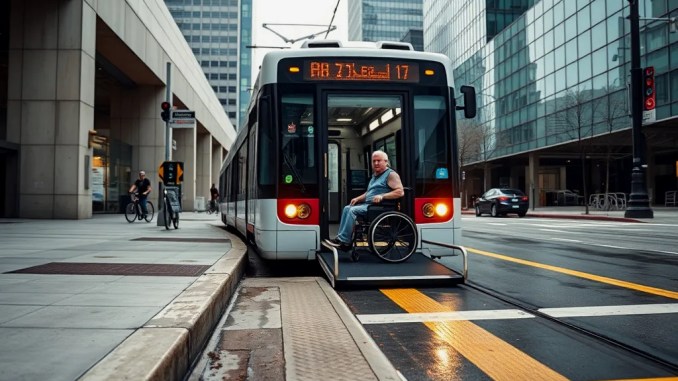
Metrolinx commissions independent accessibility audit for Eglinton and Finch West
Metrolinx will hire an independent accessibility consultant to audit the new Eglinton (Line 5) and Finch West (Line 6) light rail lines after sustained complaints from disability advocates. The agency’s CEO, Michael Lindsay, confirmed in a September 17 letter to David Lepofsky of the AODA Alliance that the audit will include stakeholder consultations and user-testing with people with disabilities, and that Toronto Transit Commission (TTC) staff will participate in the review.
Why advocates demanded audits and what they documented
Advocates flagged two recurring problems that motivated the audit: the long ramp transfer at Finch West station and tactile wayfinding shortfalls at multiple Eglinton stations. The AODA Alliance published videos in early June and late July demonstrating issues: tactile indicators that only route users to elevators instead of stairs or escalators, and a ramp at Finch West that spans roughly 80 meters and rises about 11 feet across two landings, creating a circulation and safety concern for people with mobility and vision impairments.
How Finch West’s ramp created accessibility debate
Finch West station connects Line 6 to the Yonge–University subway (Line 1) without an elevator between platforms. TTC passengers move between platforms via stairs and a sloped ramp. Metrolinx says the ramp arose from consultations with TTC and the Accessible Transit Advisory Committee (ACAT), and that consultative stakeholders preferred a grade-separated sloped walking route rather than an elevator connection. AODA Alliance counters that Metrolinx has not published the expert reports or consultation notes that supported choosing a ramp over elevators, and points to Cedarvale station—where elevators provide a transfer—as a counterexample.
What tactile wayfinding problems were reported on Eglinton
On Line 5, advocates recorded that detectable tactile indicators (raised bars and dots) often direct cane users only to elevator entrances and fail to provide clear routing to stairs and escalators. That limited routing can leave visually impaired riders uncertain how to navigate from platform to surface or to transfer connections. Metrolinx says tactile guidance was designed using expert input, stakeholder feedback and standards; the advocates argue that design intent did not match real-world usability.
Who will take part in the independent audit and what methods will be used
Lindsay invited the AODA Alliance, the Canadian National Institute for the Blind partners, and balance advocates for blind adults to participate in the audit process. The independent consultant will conduct structured user-testing, field observations, and document reviews. Metrolinx indicated it previously used external consultants for system-wide accessibility reviews (for example, the 2022 GO Transit facility accessibility review) and intends to follow similar evidence-based methods.
Timeline questions: when will the audit start and will results be public?
The September letter commits to an independent review and user-testing but provides no start date or publication timeline. Advocates had formally requested audits by letters sent June 23, July 21 and August 31; they also asked Metrolinx to promise to publish the audit report. The absence of a public schedule and clear disclosure commitments left stakeholders pressing for assurances that findings and recommendations will be shared publicly and acted on.
Chronology: key dates from openings to the audit commitment
Understanding the sequence clarifies the delay between openings and the audit pledge:
- 7 December 2025 — Finch West (Line 6) opened to passengers.
- 8 February 2026 — Eglinton (Line 5) began service.
- Early June 2026 — AODA Alliance published a video highlighting tactile wayfinding concerns on Line 5.
- 23 June 2026 — AODA Alliance and the National Blind Equality coalition met with Michael Lindsay.
- 20 July 2026 — AODA Alliance published a video about the Finch West ramp transfer.
- 21 July 2026 — AODA Alliance formally requested independent audits for both lines.
- 31 August 2026 — AODA Alliance sent another request reiterating the need for an audit.
- 17 September 2026 — Lindsay committed to an independent audit covering both lines and to structured user-testing.
- 12 November 2026 — AODA Alliance released Lindsay’s letter publicly.
What outcomes stakeholders expect from an effective audit
Disability advocates want the audit to deliver clear, specific outcomes: publication of findings, a prioritized remediation plan with deadlines, independent verification of design assumptions (for example, proving that a long ramp meets safety and usability standards for the population it aims to serve), and commitments to retrofit where needed (additional elevators, improved tactile guidance, revised signage and lighting). They also want the audit to test real-world rider journeys across transfer points, escalators, stairs and street access under different conditions (peak loads, reduced lighting, and when elevators are out of service).
How user testing should be structured to produce actionable results
Effective user testing typically follows these steps: 1) recruit diverse participants with mobility, vision, and sensory impairments who regularly use public transit; 2) define representative routes and transfer scenarios (eg, Line 6 platform to Line 1 platform during rush hour); 3) observe and record navigation behavior, travel time, and safety incidents; 4) run repeat trials under constrained conditions (elevator outage, low visibility); 5) collect qualitative feedback through structured interviews; and 6) synthesize findings into prioritized recommendations with cost and schedule estimates. Audits that adopt that rigor produce evidence that agencies can act on immediately and measure change against.
Potential technical and retrofit options Metrolinx might consider
Depending on audit findings, Metrolinx and TTC can consider a layered approach: short-term mitigations (enhanced signage, additional tactile strips to indicate routes to stairs and escalators, temporary monitored assistance), medium-term fixes (improved lighting, regraded ramp). landings where feasible, route markings and audible wayfinding), and long-term retrofits (installing elevators or escalators, constructing new transfer corridors). Cost, engineering feasibility, and service disruptions will determine sequencing; the audit should estimate costs and identify low-cost high-impact changes to implement first.
Why public reporting matters: transparency builds trust and improves outcomes
Publishing the audit report and an action plan lets riders, advocates, and municipal stakeholders verify that recommendations are reasonable and that Metrolinx/TTC follow through. A public timeline with milestone reporting (eg, design complete, procurement initiation, construction start) reduces repeated complaints and provides a basis for accountability. Independent verification after remediation confirms whether retrofits resolve the identified barriers.
Next steps for riders and advocates
Advocates will likely press Metrolinx for a public timeline and a commitment to publish the final audit. Riders who experience problems should document incidents (time, photos or descriptions, staff interactions) and submit them through Metrolinx and TTC customer-service channels and to advocacy groups; well-documented cases help auditors validate systemic issues. Advocate groups can also propose concrete test protocols and offer volunteers for structured user-testing to accelerate evidence collection.
Bottom line
Metrolinx’s commitment to an independent audit responds to concrete, documented accessibility concerns on the newly opened Eglinton and Finch West LRT lines. The audit’s value will depend on transparent methods, meaningful participation from disability organizations, a public report, and credible remediation timelines. Results that produce prioritized, funded fixes—starting with low-cost, high-impact changes—will best protect rider safety and mobility while guiding longer-term engineering decisions.







Be the first to comment