
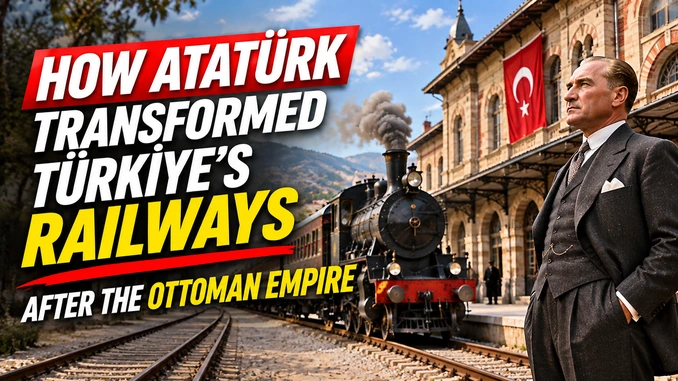
When Mustafa Kemal Atatürk founded the Republic of Türkiye in 1923, the country inherited an uneven railway network shaped largely by the commercial interests of the late Ottoman Empire. Over the next fifteen years, railways became a central instrument of economic development, state-building and national integration—and thousands of kilometres of new lines transformed the map of Anatolia.
In the final decades of the Ottoman Empire, the railway represented modern technology, foreign capital and new international trade connections. But the network that emerged was fragmented. Lines were frequently built and operated by concessionary companies, with routes serving important ports and commercial corridors rather than connecting every part of Anatolia.
Under Atatürk, that inherited system was gradually reshaped. The Republican government repaired war-damaged infrastructure, expanded railway construction into underserved inland regions and purchased many lines previously controlled by foreign companies. The transition was neither instant nor inexpensive, but it fundamentally changed the country’s transport priorities.
The Railway Network Türkiye Inherited from the Ottoman Empire
The origins of railway transport within the borders of present-day Türkiye go back to the İzmir–Aydın railway concession of 1856. Other major Ottoman-era undertakings included the Anatolian and Baghdad railway corridors and railway links in European territories.
By the time the Republic was founded in 1923, approximately 4,100 kilometres of railway lay within its new borders, according to the historical statistical series used by the Atatürk Encyclopedia and TCDD-related institutions. Different historical accounts report slightly different opening totals because of counting conventions and the treatment of inherited sections.
Some lines were foreign-owned or foreign-operated, and geographic coverage was highly uneven. Much of eastern and central Anatolia lacked efficient rail connections, while wartime damage had left bridges, tunnels and track sections in need of substantial repair.
The new Republic therefore faced a dual challenge: modernize the railways already in operation and extend the network into parts of the country that had remained isolated from the principal transport routes.
Atatürk’s Vision: Railways as a National Development Strategy
The Republican railway strategy reflected Atatürk’s conviction that reliable transport was essential to national unity, economic growth and security. New lines were planned to connect the political centre in Ankara to provincial cities, agricultural districts, mineral resources and strategic regions.
Railways could reduce transport costs, improve the movement of raw materials and manufactured products, and help farmers reach larger markets. They also supported administrative integration by connecting distant towns with the emerging national institutions of the Republic.
These objectives required a new approach to planning. Where many Ottoman concessionary routes had followed commercial interests linking productive hinterlands to ports, Republican policy emphasized the creation of a more nationally integrated network. Rail construction was not solely an economic activity: it became one of the most visible symbols of the state’s modernization programme.
New Lines Connected the Heart of Anatolia
The early Republican years initially concentrated on restoring damaged infrastructure and mobilizing limited domestic resources. As state capacity increased during the late 1920s and 1930s, major construction projects advanced across difficult terrain.
The railway reached Kayseri in 1927 and Sivas in 1930, strengthening the link between Ankara and central Anatolia. Expansion towards Malatya and the southeast supported a longer-term ambition to connect resource-producing districts and eastern provinces with the rest of the country.
The Fevzipaşa–Malatya–Diyarbakır corridor, associated with access to the Ergani copper deposits, was a particularly important undertaking. Its construction required substantial engineering work through difficult terrain, and the line reached Diyarbakır in 1935. Other projects developed connections to the Black Sea, the Mediterranean and central Anatolian industrial regions.

The expansion programme was not without obstacles. The mountainous landscape demanded bridges and tunnels, while shortages of capital, equipment and skilled labour complicated scheduling. Despite these constraints, the government continued to prioritize railway projects as long-term public investments.
Nationalization: Bringing Ottoman-Era Lines Under State Control
One of the most consequential changes was the progressive nationalization of privately owned and foreign-controlled railways. Although elements of state railway administration had roots in the period of the Turkish National Movement before 1923, the Republic established a more formal institutional framework.
A major step came with Law No. 506 in April 1924, which reorganized state railway administration. A subsequent law in May 1927 created the State Railways and Ports Administration, bringing railway and related port operations into a more integrated public-management structure.
Railway nationalization generally involved negotiated purchases rather than the immediate seizure of foreign-owned assets. The cost placed real demands on the national budget, and some acquisitions added to the Republic’s financial obligations. Still, the policy provided the state with greater control over investment priorities, operations and future network planning.
The process accelerated through the 1930s. The İzmir–Aydın line, the railway that had inaugurated rail transport in the territory of modern Türkiye, was transferred to state control in 1935. This represented a striking reversal of its original status as a British-financed Ottoman concession.
From 4,100 to Nearly 6,900 Kilometres
The scale of the railway programme illustrates how important it was to early Republican policy. According to historical information published by the TCDD Foundation, the railway network expanded from 4,112 kilometres in 1923 to 6,927 kilometres in 1938, an increase of 2,815 kilometres during the period.
The Atatürk Encyclopedia similarly documents the rapid growth of the system, while noting the changing institutional and ownership structure of railway operations. The figures are best understood as a measure of network expansion, rather than suggesting that every section was built directly by a single state entity or under identical conditions.
These investments were made amid major economic pressures, including the global Great Depression. Railway projects competed with other urgent public needs, and their financing required difficult choices. The scale of construction nevertheless demonstrates the high place railway infrastructure occupied in government policy.

Railways Helped Build a New Economic Geography
New rail links reduced the dependence of inland towns on slow road transport and helped connect agricultural and mineral-producing areas to wider markets. They also supported the movement of machinery, industrial inputs and construction materials needed for the Republic’s wider development programmes.
The impact varied by region. Communities near new lines could gain improved mobility and trading opportunities, while places beyond the railway corridors remained more difficult to reach. Railways alone could not resolve the country’s structural economic challenges, but they provided infrastructure on which later investment and industrial growth could build.
Railway stations also became distinctive public spaces. They brought railway employees, merchants, farmers, students and officials into contact, while timetables established more regular links between cities. Across Anatolia, the appearance of a station could change how a town related to the rest of the country.
A Legacy That Outlived Atatürk
Atatürk died in November 1938, but many of the railway projects and policies pursued during his leadership continued to shape the network in the following years. Some major lines initiated in his era were completed after his death, including important eastern connections.
The early Republican railway programme established the principle that rail transport was a public instrument of national development rather than simply a collection of separate commercial concessions. Its legacy can be seen in the development of state railway institutions and in the network of routes linking Anatolian cities.
Modern Türkiye’s railways have since undergone further transformations, including electrification, modernization and the introduction of high-speed services. Those developments belong to later eras, but they form part of a longer story in which the first fifteen years of the Republic remain a decisive chapter.
Atatürk did not introduce railways to Anatolia. His transformation was different—and arguably more far-reaching: he helped turn an inherited, uneven network into the backbone of a national transport strategy.








Be the first to comment