
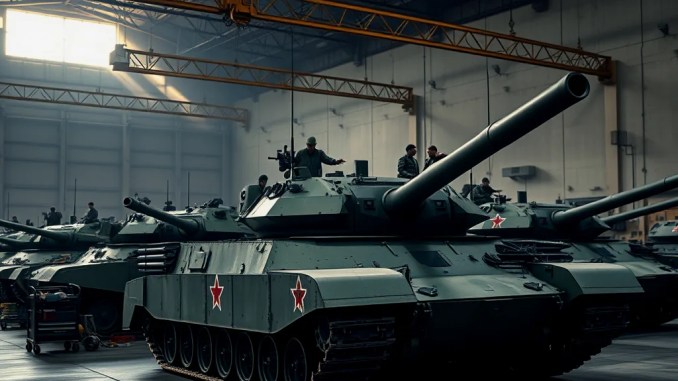
Engine Failures Reported in Polish K2 Fleet
Polish military workshops in Braniewo and elsewhere currently hold about 30 K2 main battle tanks undergoing repair, according to local reporting. Technicians report repeated symptoms of engine overheating and occasional engine seizure on a subset of vehicles delivered from South Korea. These failures present as high-temperature alarms, loss of propulsion under load, and, in some cases, abrupt engine stops that require on-site recovery.
Diagnosis teams apply a step-by-step troubleshooting sequence: (1) verify fault codes from the vehicle’s engine control unit, (2) inspect coolant and oil circuits for leaks or blockages, (3) run dynamometer tests where possible to reproduce thermal load, and (4) swap suspect components under warranty for controlled validation. Where warranty has expired, Polish maintainers perform component-level repairs or full engine replacement using domestic logistics chains.
Warranty Handling and In-House Maintenance Capacity
The Ministry of Defense states that defects discovered during warranty periods are handled by the manufacturer, while routine maintenance and post-warranty repairs fall to Polish Armed Forces units. Poland is actively developing the capability to perform higher-complexity repairs locally: personnel retraining, specialized tooling, and test stands are being installed at national facilities to reduce dependency on overseas warehouse-level maintenance.
Concrete steps are ongoing include creating standard operating procedures for K2PL-specific systems, training cohorts of mechanics on K2 powerpacks and transmissions, and establishing a local spares pipeline to cut turnaround time. These measures aim to decrease mean time to repair (MTTR) from current multi-week cycles to shorter, predictable intervals aligned with operational tempo.
Building K2PL Final Assembly and Technology Transfer
Bumar-Łabędy is scheduled to host assembly lines for the K2PL variant, enabling Poland to perform final assembly and integrate national modifications such as additional armor packages and local electronics. The planned technology transfer covers production jigs, quality assurance protocols, and intellectual-property arrangements for selected subsystems.
As an example of phased capability transfer: initial deliveries use the South Korean K2GF “Gap Filler” configuration to meet urgent needs. Subsequent K2PL units will receive Polish-tailored upgrades—improved mine protection, communication suites compatible with NATO standards, and locally sourced subsystems—to reflect operational feedback and logistics commonality.
Procurement Oversight: Legal Review Concluded
Prosecutors in the Warsaw regional court closed an investigation into alleged irregularities in consultancy services tied to the K2 procurement. Authorities examined invoices from two Polish consulting firms sent to a South Korean company, totaling 34 million zloty (approximately $8.65 million). The probe found insufficient evidence that billed services were not provided or that public funds were defrauded, and the court upheld the closure on 8 May 2026.
Operational implication: with the legal uncertainty removed, procurement schedules and technology-transfer milestones can proceed without that specific legal constraint. Nevertheless, transparency advocates and acquisition auditors may continue reviewing contract records and oversight practices to ensure compliance with state procurement rules.
How Poland’s K2 Fleet Readiness Can Improve — Practical Measures
Immediate actions to improve fleet readiness include:
1. Data-driven maintenance prioritization: implement predictive maintenance analytics on vehicle telematics to forecast engine faults and schedule preemptive interventions.
2. Local spares stockpiling: identify high-failure-rate components (cooling pumps, turbochargers, seals) and hold safety stock to avoid repair delays.
3. Modular repair capability: train teams in modular removal and replacement to shorten downtime, supported by specialized hoists and test benches at regional depots.
4. Continuous feedback loop: formalize channels between front-line units, depot maintenance, and the manufacturer to track failure modes and prioritize design or procedural fixes.
What This Means for NATO and Regional Defense
Poland’s effort to domestically sustain and adapt the K2 platform strengthens NATO’s regional armored capability by shortening logistic lines and tailoring systems to local threats. Successful technology transfer and local assembly will also boost the Polish defense industrial base, create skilled jobs, and improve operational independence for scheduling upgrades and repairs.
However, until local repair capacity matures, units will face intermittent availability impacts whenever several vehicles enter depot workflows simultaneously. Prioritizing rapid-repair kits and predictive diagnostics will be essential to maintain deployed force readiness.





Be the first to comment