
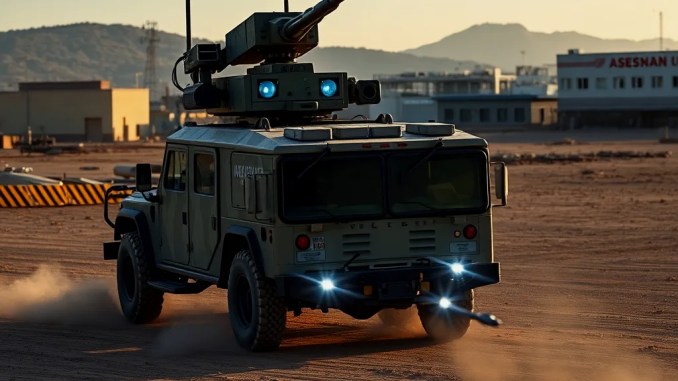
Overview of the EJDERHA High-Power Electromagnetic (HPEM) System
EJDERHA produces focused, high-power electromagnetic pulses using vacuum-electronics technology to neutralize unmanned aerial vehicle (UAV) threats at standoff distances. In a recent demonstration at ASELSAN’s Gölbek Test Center, EJDERHA disabled 51 simultaneously launched drones within seconds, and also neutralized tethered (wired) drones from roughly 1,000 meters. The system integrates radar detection, electro‑optical tracking, and a directed-energy emitter to deliver effects on the electronics of target platforms.
How DRAGON Detects, Tracks, and Engages Targets
The engagement chain follows three active steps: detect, track, and deliver directed electromagnetic energy. First, a medium-range radar performs active detection and situational classification. Next, electro‑optical sensors provide continuous track and targeting coordinates for precision aiming. Finally, the HPEM emitter fires tightly controlled pulses that couple into target electronics, causing functional interruption. This active sequence enables rapid response to both single and swarm scenarios without kinetic munitions.
Why HPEM Works Against Both Wired and Wireless Drones
HPEM defeats UAVs by inducing disruptive voltages and currents and by upsetting microprocessor logic states. Wired (tethered) drones remain vulnerable because their control and power lines provide conductive paths for electromagnetic coupling; DRAGON’s pulses exploit those paths to reach critical electronics even when radio links are absent. Wireless FPV and autonomous drones present radiative coupling paths EJDERHA also targets. The net result: loss of control, sensor blackout, reboot loops, or permanent component damage depending on pulse amplitude and waveform.
Test Details: Single- and Multi-Platform Results
During the test sequence ASELSAN ran two distinct scenarios. In the first, DRAGON engaged two tethered drones at ~1,000 meters and achieved mission kill within seconds. In the second, 51 drones were launched simultaneously to emulate a swarm saturation attack; DRAGON’s emitter produced coordinated irradiation that neutralized every platform in the air nearly simultaneously. These outcomes show both reach and parallel-engagement capability—key metrics for layered air-defense roles.
Technical Capabilities and Tunable Effects
EJDERHA’s effects range from non-permanent disruption to destructive interference depending on emission parameters. Operators can tune pulse amplitude, repetition rate, and waveform shaping to create these effects:
Soft effects: temporary sensor blackout, processor resets, loss of telemetry. These allow recovered platforms to resume operation after a cool-down or software restart.
Persistent effects: component stress that requires maintenance or replacement (for example, burned power regulation circuits).
Hard damage: irreversible failure of critical subsystems when pulses exceed damage thresholds.
Choosing the effect balances mission rules of engagement, collateral-risk assessment, and desired persistence of mitigation.
Integration into Layered Defense: The ÇELİKKUBBE Architecture
EJDERHA is planned for deployment within Turkey’s national layered air-defense architecture, ÇELİKKUBBE, where it will serve as a short‑to‑medium-range counter-UAV/soft-kill layer. In such a stack, radar and long-range interceptors handle high-altitude, high-speed threats while EJDERHA addresses mini/micro-class UAVs, FPV swarms, and tethered reconnaissance platforms closer to defended assets. The system’s ability to produce effects without explosive ordnance reduces fragmentation and collateral hazards in populated or sensitive environments.
Operational Examples and Use Cases
Common use cases for DRAGON include:
Critical infrastructure protection: Airports, power stations, and stadiums can maintain continuous operations by denying UAV access without creating falling debris.
Military base defense: Forward bases can neutralize ISR and weaponized platforms that bypass conventional air defenses.
Crowd-safety scenarios: Urban events where non-kinetic mitigation preserves on-ground safety while clearing aerial threats.
Sensor Fusion, AI, and Command Workflow
DRAGON’s effectiveness increases when paired with multi-sensor fusion and automated engagement decision aids. A practical command workflow follows these steps: 1) Radar detects and classifies a track; 2) EO/IR sensors confirm identity and provide precision geolocation; 3) Data-fusion module scores risk and suggests actions; 4) Operator authorizes or a rules-based controller issues the HPEM firing command; 5) Post-engagement sensors verify kill or residual threat for follow-up tasks. AI can accelerate classification and reduce false positives, especially in cluttered urban or RF-dense environments.
Limitations, Risks, and Mitigations
HPEM systems carry operational limits and safety considerations. Electromagnetic pulses can couple into friendly systems and cause unintended disruptions. Effective mitigations include hardening critical nearby assets, enforcing operational exclusion zones, and using directional antennas with precise beam control to minimize sidelobe energy. Environmental factors—like multipath urban propagation or conductive airborne payloads—can alter coupling behavior; Therefore, testing across representative scenarios is essential before fielding.
Field-Proven Targets and Performance Metrics
EJDERHA has demonstrated effects against mini/micro UAS, fixed-wing sub-cloud UAVs, FPV drones (both tethered and untethered), and internal-combustion UAV engines. Key performance indicators to evaluate in deployment are engagement range, number of simultaneous targets engaged, time-to-effect, probability-of-neutralization per target, and collateral interference footprint. The 51-drone demonstration highlights high simultaneous-engagement capacity and sub‑second-to-seconds time-to-effect under test conditions.
Implementation Steps for Defense Planners
To integrate EJDERHA or similar HPEM systems, follow this stepwise plan:
1. Conduct spectrum and EMI surveys at candidate sites to identify sensitive equipment and safe exclusion zones.
2. Define engagement policies and legal constraints for non-kinetic employment.
3. Harden nearby critical infrastructure or schedule protective measures during operation windows.
4. Create a layered sensor architecture to feed accurate target tracks into a fusion engine.
5. Run progressive trials from isolated targets to complex swarm tests and urban-representative environments.
6. Train personnel on effects, contingencies, and post-engagement remediation procedures.
Takeaway: Practical, Tunable Non-Kinetic Air Defense
EJDERHA demonstrates a practical approach to countering the evolving drone threat: tunable electromagnetic effects, rapid multi-target engagement, and integration into layered defense stacks. The 51-drone test confirms the ability to counter swarm saturation in realistic conditions while the tethered-drone result proves utility against non-radiative threats. For defense planners prioritizing reduced collateral risk and scalable response, directed electromagnetic systems offer a distinct, complementary capability to kinetic interceptors.









Be the first to comment