
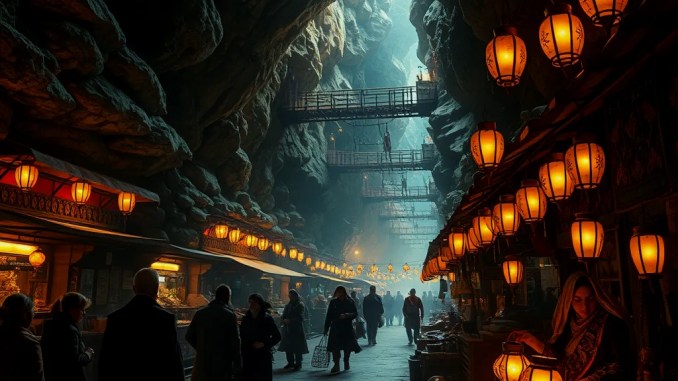
What is SubTropolis and how was it created?
SubTropolis occupies a converted limestone mine roughly 49 meters beneath Kansas City. Developers expanded the mined voids into column-and-beam caverns, then finished floors, lighting and roadways to turn raw excavation into usable commercial real estate. The conversion focused on retaining structural rock integrity while installing modern building systems so businesses can operate below ground just as they do on the surface.
How big is the complex and who works there?
The complex covers an area comparable to approximately 140 football fields and contains hundreds of separate spaces used by diverse tenants. More than 2,000 workers commute daily by car into the facility. Occupants include logistics firms, cold-storage operators, data-center providers and media archivists; the variety stems from the predictable environmental conditions and exceptional security the site provides.
What infrastructure supports transportation and logistics inside SubTropolis?
SubTropolis includes 17 kilometers of illuminated asphalt roads and integrated rail spurs that provide direct loading access to underground warehouses. Operators have installed over 500 truck-loading ramps to enable efficient inbound and outbound freight handling. This multimodal network reduces transfer time by allowing trucks and railcars to reach storage areas without repeated surface handling.
Why do companies choose to store assets underground here?
The mine’s rock mass maintains a steady interior temperature—typically between 18 and 20 degrees Celsius—creating a naturally cooled environment that lowers heating, ventilation and air-conditioning demands. Tenants exploit that stability for sensitive storage: large-scale cold storage for food, climate-controlled vaults for film and photographic archives, and purpose-built rooms for server racks and telecommunications gear. Security is enhanced by limited access points, controlled vehicle entry, and the geological barrier itself.
What specific examples illustrate how spaces are used?
Examples of tenant use include:
Data centers: Racks are mounted inside insulated rooms; fiber and power are routed through redundant conduits to minimize single points of failure.
Cold storage: Multi-temperature zones allow frozen, chilled and dry-goods storage within meters of distribution docks, simplifying cross-docking.
Media archiving: Original Hollywood film reels are kept in humidity- and temperature-stable vaults to slow chemical degradation, with controlled access and fire-suppression systems designed for archival materials.
How does SubTropolis manage environmental controls and safety?
Environmental control combines passive rock insulation with active HVAC where required. Fire protection relies on compartmentalization, automatic detection, and suppression systems engineered for the underground context—often inert-gas suppression in archival vaults and water-deluge systems in logistics bays. Ventilation systems maintain air quality while balancing energy use; emergency egress routes and regularly drilled evacuation plans keep worker safety procedures current.
What are the economic and practical advantages of operating underground?
Key advantages include:
Lower energy for temperature regulation: Natural thermal inertia reduces heating and cooling loads.
Enhanced security: Geological cover and limited access lower physical intrusion risk.
Efficient land use: Repurposes otherwise unusable subsurface volume without consuming surface land.
Proximity to transport: Direct road and rail access within the complex speeds logistics.
How is access controlled and what are the day-to-day operations like?
Access points use vehicle checkpoints, ID-controlled doors and monitored ramps. Day-to-day operations mirror a surface logistics park: scheduled truck arrivals, inventory staging, order-picking, and IT monitoring. Many tenants run shift operations to take advantage of continuous temperature stability and to stagger traffic into the facility.
What challenges do operators face and how are they mitigated?
Typical challenges include moisture management, rock movement monitoring, and integrating surface utilities into a subterranean environment. Operators address these through constant geotechnical monitoring, waterproofing membranes and drainage systems, redundant utility feeds, and preventative maintenance schedules for ventilation and fire-suppression equipment.
How does SubTropolis fit into broader trends in logistics and storage?
SubTropolis reflects a trend toward specialized, secure, climate-stable storage close to metropolitan centers. As e-commerce and high-value physical media persist, facilities that reduce handling, provide long-term preservation and lower operating costs will grow in appeal. Subsurface development offers a distinctive solution where surface land is constrained or expensive.






Be the first to comment