
Incident summary and immediate response
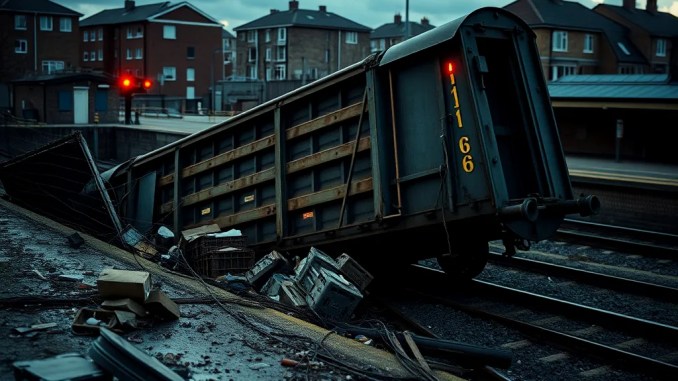
On 23 October 2026 a GB Railfreight intermodal freight train traveling from London Gateway to Hams Hall experienced a partial derailment south‑east of Barking station on the Up Tilbury Line. The train had two Class 99 bimode locomotives and 39 container wagons; the leading locomotive was powered while the rear was dead‑in‑tow. The 20th wagon was derailed at about 13:04 and its wheelsets ran on the rails and ballast for roughly 1.1 kilometers before the driver and signals coordinated an emergency stop approximately 170 meters north of Barking station. No injuries were reported but the derailment caused substantial damage to track, points, signaling equipment and adjacent infrastructure.
What happened second-by-second
Data from the leading locomotive’s event recorder shows the train braked to a stop at around 13 km/h, then restarted about two minutes later. Shortly after restarting, the 20th wagon left the rail. The derailed wagon continued to move forward while its wheel flanges traversed ballast and sleepers, passing platform 8 at Barking and crossing multiple sets of points. Track circuits at several switches showed loss of detection; the signals alerted the driver and the crew secured the train, preventing further movement. Engineers later confirmed the wagon traveled approximately 1.1 km in derailed condition before final containment.
Technical factors RAIB will examine
RAIB will conduct a systems‑level, evidence‑based investigation focused on these lines of enquiry: wagon condition and wheelset integrity, loading and stowage practices across the rake, locomotive braking performance and interactions when one unit is dead in tow, dynamic responses of the wagon‑train system at low speeds, and the real condition of track and turns where the derailment was initiated and propagated. Investigators will collect axlebox and bogie components, review maintenance and inspection records, analyze event recorder and CCTV footage, and simulate dynamic behavior using measured track geometry and vehicle parameters to reconstruct why the wagon left the rail.
Operational and human factors under review
The RAIB scope includes operational oversight and preparation procedures: marshalling practice, lashing and container distribution, pre‑departure inspections, in‑service defect reporting, and any communications between signals and driver before and during the event. The investigation will also evaluate whether management systems, resource pressures or local working arrangements might have contributed to latent conditions that allowed the defect or procedural lapse to remain undetected.
Damage assessment and repair works completed
Response teams repaired more than 1.2 km of damaged rail, replaced heavily damaged switch blades with specially fabricated turnouts, and renewed signaling equipment and cables that had been torn or crushed. Network Rail engineers used bespoke replacement components where standard parts could not be installed immediately because of the extent of deformation. Restoration included testing of track circuits and a sequence of trial movements to validate alignment and signaling interlocks before passenger services gradually resumed.
Service disruption, passenger alternatives and timetable recovery
The derailment forced suspension of c2c services to Dagenham Dock, Rainham and Purfleet and halted London Overground services on the South Tottenham–Barking Riverside section of the Gospel Oak–Barking route. Operators implemented targeted bus replacement and enhanced acceptance of c2c tickets on Greater Anglia trains and TfL buses across affected sections. Examples: Dagenham Dock customers were routed via Dagenham Heathway or Barking by local buses; Rainham saw dedicated rail‑replacement buses between Upminster and Grays; Purfleet used Upminster–Grays diversionary buses with c2c ticket acceptance. By 11 November operators had restored most scheduled services following phased testing and sign‑off.
Comparisons with the 2020 Wanstead Park derailment and lessons to test
RAIB will revisit parallels with the Wanstead Park derailment of 23 January 2020, where a heavily loaded train ran derailed for about 4.1 km and investigation identified rotten timber bridge bearers and abnormal wheelset wear as key contributors. For Barking, researchers will test whether degraded supporting structure, unusual wheel or axle wear patterns, or hidden environmental deterioration played comparable roles. The probe will explicitly compare inspection records, maintenance intervals and earlier defect reports across both sites to determine if systemic inspection failings persist.
What evidence investigators will gather and how they will use it
RAIB teams will recover mechanical components (axles, bogie frames, bearings, springs), retrieve train recorder data, secure CCTV and lineside camera footage, and map damage to sleepers, ballast and switches. They will undertake metallurgical analysis of failed items, wheel profile measurements, and track geometry surveys to feed into multibody dynamic simulations. Investigators will combine these physical examinations with documentary audits—maintenance logs, loading manifests and staff statements—to build a timeline and causal chain that supports robust, actionable findings.
Potential outcomes and safety recommendations
Expected outputs include a report identifying direct and contributory causes, safety‑critical recommendations to operators and infrastructure managers, and suggested changes to inspection regimes, loading rules or component design if defects are implicated. Where human or organizational factors contributed, RAIB often issues recommendations covering procedural changes, staff training, and governance improvements. Any recommendations will remain independent of potential regulatory or enforcement action by the Office of Rail and Road.
Practical advice for passengers and freight operators from this incident
Passengers affected by service disruption should check operator announcements for validated ticket acceptance zones and planned replacement buses. Freight operators should preemptively review wagon maintenance histories, ensure accurate container weight distribution, and verify that any dead‑in‑tow locomotives are accounted for in braking performance models. Local route owners should prioritise inspection of turnsouts and bridge support timbers on routes with heavy intermodal traffic, using both visual and non-destructive testing methods where history suggests deterioration.






Be the first to comment