
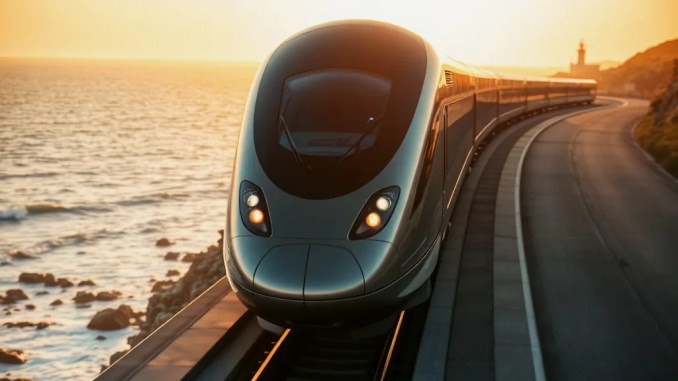
Alstom brings Avelia Stream tailored for Portugal’s new high-speed corridor
Alstom will offer its Avelia Stream train for Portugal’s planned Porto–Lisbon high-speed line, presenting a complete rolling-stock solution adapted to the country’s infrastructure, operational needs and long-term industrial ambitions. The Avelia Stream leverages 45 years of high‑speed experience and the Pendolino family’s proven tilting and distributed propulsion concepts, but is further optimized for 300 km/h running, passenger capacity, modular interiors and Portuguese track gauge specifics.
How Avelia Stream will meet the Porto–Lisbon 300 km/h requirement
The reference seven‑car Avelia Stream configuration spans 202 meters with distributed traction that frees interior space and lowers axle loads. For the Porto–Lisbon route Alstom configures traction, aerodynamics and braking systems to operate reliably at the line’s design speed of 300 km/h under Portuguese environmental and signaling conditions. Key technical steps Alstom will perform:
Assessment and adaptation: adapt bogie designs to Iberian gauge tolerances where needed; validate pantograph and catenary interaction at sustained 300 km/h speeds; and test dynamic behavior on representative track geometries.
Performance validation: conduct high-speed tests for acceleration, emergency braking distances and thermal load management; Calibrate active suspension and yaw damping to passenger comfort limits.
Operational integration: integrate train control and ATP systems compatible with Portugal’s signaling; tune regenerative braking and on-board energy management to local grid characteristics.
Passenger capacity, interior layouts and comfort features
Avelia Stream’s modular interior supports 2+2 or 2+1 seating across intermediate cars, enabling flexible capacity and service mixes. In the seven-car reference layout the train carries over 500 passengers, with design options to include: a quiet car, a family zone, an accessible coach with universal spaces and different catering modules (bistro, trolley service or full restaurant). Wider glazed areas and revised carbody architecture increase natural light and perceived space. Alstom emphasizes reduced life‑cycle costs by combining components designed for easy access, standardized replacement intervals and predictive maintenance capability through embedded diagnostics.
Long‑term industrial and maintenance commitments in Portugal
Alstom positions the Avelia Stream bid alongside a commitment to local production and support. The company proposes a new factory near Matosinhos to manufacture and maintain a significant share of the fleet, creating direct jobs in assembly and indirect employment across the supply chain. Building local manufacturing capacity enables shorter delivery timelines, trains adapted to regional maintenance practices, and faster spare parts provisioning. Practical steps include:
Local engineering ramp‑up: transfer detailed design know‑how to a Portuguese engineering team and run joint verification programs for bogies and traction equipment.
Workforce development: implement apprenticeship and certification programs aligned with the new plant’s skill requirements and Portuguese vocational standards.
Supply chain localization: qualify local suppliers for non-critical subsystems, lowering logistics cost and improving resilience.
Operational and economic benefits for operators and passengers
Avelia Stream’s distributed traction yields better axle load distribution and redundant tractive effort, which improves acceleration and reduces track wear. Faster acceleration and optimized dwell times translate into shorter end‑to‑end timetables on the Porto–Lisbon route. From an operator perspective, these features deliver:
Lower whole‑life costs: modular systems and accessible components reduce maintenance man‑hours; Predictive diagnostics minimizes unplanned service interruptions.
Service flexibility: interior modules allow operators to reconfigure trains for peak commuter flows, medium‑distance intercity services or premium long‑distance offerings.
Passenger experience: quieter cabins, improved air filtration, larger windows and ergonomic seating improve comfort and perceived value, raising ridership potential.
Testing, certification and timeline considerations
To certify the Avelia Stream in Portugal, Alstom will follow a staged program: design adaptation and static verification, dynamic testing on test rigs and representative track, interoperability and signaling integration, followed by series acceptance tests with the national infrastructure manager and operator Realistic timeline elements:
Phase 1 — adaptation and design freeze (6–12 months): finalize gauge adaptations, systems integration and local factory preparation.
Phase 2 — prototype production and testing (12–18 months): build pre-series units, perform high-speed runs and safety validation under Portuguese network conditions.
Phase 3 — series production and delivery (rolling): ramp up local production to meet staged deliveries tied to line opening and operational entry milestones.
Examples and precedent: Pendolino and Avelia deployments
Pendolino‑based platforms have operated in Portugal for more than 27 years under the Alfa Pendular brand, providing a direct knowledge base for Avelia Stream adaptation. International examples—Virgin in the UK and Italo in Italy—demonstrate how Alstom delivers differentiated interior concepts and local maintenance arrangements. Those implementations show tangible benefits: improved trip times, consistent availability above industry benchmarks and successful passenger uptake following service launches.
What operators and stakeholders should evaluate when selecting Avelia Stream
Procurement teams should focus on measurable criteria and exit risks. Key evaluation points:
Technical fit: how the train’s loading gauge, axle load, and signaling compatibility map to future infrastructure plans.
Total cost of ownership: compare energy consumption per seat‑kilometer, maintenance intervals, spare parts policy and warranty terms.
Industrial benefits: quantify local job creation, technology transfer, supplier development and the manufacturing footprint proposed.
Service performance guarantees: availability targets, mean time to repair, and penalties or incentives linked to punctuality and reliability.
Conclusion: a tailored high‑speed offering for Portugal’s needs
Alstom’s Avelia Stream proposal aligns high‑speed performance with local adaptation, local industry investment and service flexibility. By combining distributed traction, modular interiors and a commitment to Portuguese production and maintenance, the bid aims to deliver a reliable 300 km/h intercity service that supports ridership growth, operational resilience and local economic development.




Be the first to comment