
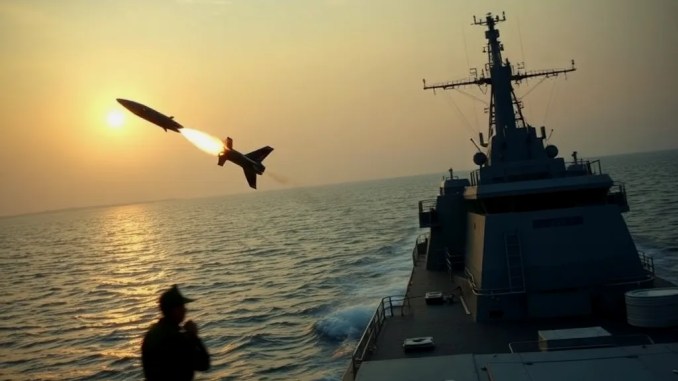
Malaysia selects ATMACA over NSM based on cost, schedule, and integration
Malaysia’s Ministry of Defense announced a decision to procure ROKETSAN’s ATMACA anti-ship missiles for its Littoral Combat Ship (LCS) fleet, after evaluating bids from Turkey, France and Italy Officials cite a combination of lower total acquisition cost, an accelerated delivery window tied to existing LMS commitments, and assurances of compatibility with the current Combat Management System (CMS) as the primary reasons for selecting ATMACA. Negotiations, systems integration engineering and technical verification are set to begin immediately.
How ATMACA can reach earlier delivery dates
Because Malaysia has already ordered ATMACA-compatible missiles for the Littoral Mission Ship Batch 2 (LMS B2) program, the Defense Ministry expects to shorten procurement lead time. Planners estimate that the commonality with LMS B2 could shave months off a fresh acquisition schedule, potentially allowing initial deliveries as early as 2029. Practically, this works by reassigning part of the existing missile production tranche and adjusting logistics planning to meet LCS-specific integration milestones rather than starting a separate manufacturing line.
What drives the project cost and the expected additional expenses
Procurement economists inside the ministry estimate a full, from-scratch missile buy for the LCS class could add roughly USD 200 million to the program. That figure assumes new missile production volumes, export licensing, transport, and separate test campaigns. By using LMS payments already made, the government expects to avoid charging the entire amount to the current budget at once. Still, the ministry will need to fund key incremental items: procurement of vertical/shipboard launchers, engineering for CMS-to-missile interfacing, hardware and software integration, test firings, and crew training and logistics support packages.
How integration between ATMACA and the LCS combat system will proceed
Integration will follow a phased technical verification process: requirements mapping; interface control document (ICD) development; laboratory bench testing of the missile’s guidance and data-link interfaces; hardware-in-the-loop (HIL) simulation with the LCS CMS; at-sea integration trials; and final operational acceptance tests. Each phase produces discrete milestones that must be cleared before proceeding. The ministry has already received preliminary assurances regarding CMS compatibility, but third-party verification and detailed ICD work will determine final engineering scope and costs.
Legal status of the NSM contract and dispute resolution steps
Malaysia acknowledges payments previously made under the NSM contract even though the NSM supply will not proceed. The two sides remain in legal dispute over contract termination and reimbursement. Initial bilateral negotiations failed to resolve the disagreement, so the ministry plans to convene a Dispute Resolution Committee. If that committee cannot broker a settlement, Kuala Lumpur may move to arbitration; The ministry has not ruled out holding arbitration proceedings in Malaysia. Arbitration would determine damages and contract rights but could extend timelines and add legal costs.
ATMACA’s technical profile and operational capabilities
ATMACA is a long-range, sea-skimming anti-ship missile designed for all-weather operations and resistant to countermeasures. Key capabilities include an active radar seeker for terminal homing, robust inertial navigation augmented by GNSS, barometric and radar altimeters for low-altitude flight, and a datalink for in-flight target updates, mission abort and salvo coordination. The missile supports 3D routing and re-attack profiles to engage fixed or maneuvering targets. Construction uses composite materials to reduce weight and increase structural strength.
Typical performance parameters the ministry highlighted: range on the order of 250+ km, warhead mass near 220 kg with both blast-fragmentation and penetration options, and overall missile length roughly 4.3–5.2 meters depending on variants. The seeker is active RF in the baseline; future seeker upgrades (IR or dual-mode) are planned by the manufacturer.
Examples of integration scenarios, risks and mitigations
Example scenario: an LCS receives a beyond-line-of-sight target cue from maritime patrol aircraft. The CMS transmits a target coordinate via datalink to the ATMACA launch sequencer, which uploads a mission plan including a 3D ingress corridor and terminal homing parameters. During flight the missile receives mid-course updates and executes sea-skimming profiles to minimize detection. Mitigations for common risks include incremental software versions to reduce CMS interface bugs, factory acceptance tests for launchers before shipboard installation, staged live-fire trials in progressively complex environments, and supply-chain audits to protect delivery windows.
Planned ROKETSAN developments and variant roadmap
ROKETSAN intends to expand ATMACA’s mission set with infrared and dual-mode seekers, submarine-launched variants, and vertical-launch system (VLS)-compatible versions for increased platform flexibility. The company also plans to increase domestic industrial content where customers request localization, which could shorten maintenance cycles for Malaysian forces and create opportunities for technology transfer in support and sustainment.
What to expect next and timeline milestones
Near-term milestones: start of contract negotiations and ICD work; completion of initial integration bench tests; award of launcher and CMS-integration subcontracts; commencement of hardware-in-the-loop and at-sea trials; and phased delivery of missile rounds and launch systems. If all phases proceed on schedule, the ministry’s optimistic projection remains first deliveries around 2029, followed by full operational capability once at-sea testing and crew certification completion.
Bottom line: trade-offs Malaysia weighed and practical implications
Malaysia’s choice balances faster access to a proven indigenous Turkish missile family, lower immediate fiscal exposure through prior LMS payments, and a manageable engineering integration program. The switch leaves outstanding commercial and legal issues with the NSM supplier that could impose additional costs or schedule risk, but the prioritized path emphasizes accelerating ship-level strike capability for the LCS fleet and leveraging existing procurement lines where possible.
Quick facts and specifications summary
Range: ~250+ km; Warhead: ~220 kg (blast-frag/penetration options); Length: ~4.3–5.2 m; Guidance: INS + GNSS + barometric & radar altimeters; Seeker: active RF (baseline); Key features: datalinked updates, mission abort, re-attack, 3D routing, composite structure.








Be the first to comment