
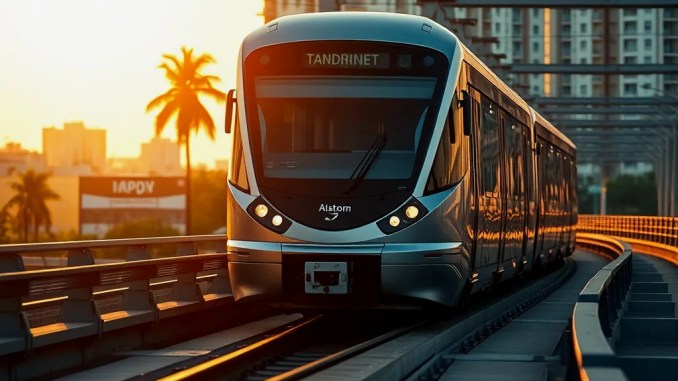
Alstom has started production of 96 Metropolis driverless metro cars for Chennai Metro Phase II at its Sri City facility in Andhra Pradesh, following a €135 million contract awarded by Chennai Metro Rail Limited (CMRL) in 2025. The Phase II project spans about 119 km across three main corridors and interconnections, with more than 76 km elevated and 43 km underground.
32 trainsets configured in three-car formations will be manufactured
Alstom will supply 32 three-car trainsets tailored for Chennai Metro’s operational profile and provide a 15-year post-warranty maintenance package. Engineering designs for these Metropolis vehicles were developed at Alstom’s Bengaluru engineering center under the “Make in India” initiative, while final manufacture and assembly take place at Sri City. Production follows earlier collaboration with CMRL that led to establishing the Sri City plant to build trains for Phase I.
Driverless GoA4 capability, systems and passenger amenities
The Metropolis trains are designed to operate at a maximum commercial speed of 80 km/h and support GoA4 unattended train operations (fully driverless). Key technical and passenger features include:
Technical systems: regenerative braking to reduce energy consumption and recover power, layered cybersecurity measures protecting train-to-infrastructure communications, and modular onboard diagnostics for quicker fault isolation and remote maintenance support.
Capacity and layout: each three-car set accommodates up to 900 passengers in crush-load conditions. Interiors include high-back seating, zoned standing areas, real-time passenger information displays and CCTV networks integrated into operations centers.
Accessibility and inclusions: dedicated spaces for women and passengers with reduced mobility, multi-door wide aisles for faster boarding, and air conditioning sized for tropical climates and high-occupancy peak loads.
How GoA4 driverless operation improves Chennai Metro performance
Deploying GoA4-capable rolling stock brings measurable operational benefits. Example impacts and the pathway to implementation:
1) Increased frequency and throughput: removing driver-change constraints lets operators reduce headways. A conservative estimate: if headways tighten from 5 minutes to 3.5 minutes on a corridor, line capacity increases roughly 43% without adding more cars.
2) Higher reliability through automation: consistent automated braking and door timing reduce station dwell-time variance, improving on-time performance. Modern diagnostic systems enable predictive maintenance that lowers in-service failures.
3) Energy and lifecycle savings: regenerative braking and optimized traction control can cut traction energy by 10–25%, depending on driving profiles and station spacing. Coupled with scheduled predictive maintenance, life-cycle costs decline.
Background: 4th corridor handover and prior deliveries
Series production followed delivery of 36 Metropolis trainsets (108 cars) for the Phase II 4th Corridor, which serves the 26-km Poonamallee Bypass–Light House alignment with 28 stations (18 elevated, 10 underground). That contract, awarded in 2023 for €102 million, covered design, manufacture, testing, commissioning and training; deliveries completed in October 2026.
Alstom’s expanding footprint across India’s metro networks
Alstom has steadily grown its presence in India’s urban rail sector: since the firm’s first Chennai contract in 2010 it delivered 208 cars for Chennai Metro Phase I and supplied rolling stock to cities including Delhi, Lucknow, Kochi, Mumbai, Pune, Agra-Kanpur, and Indore-Bhopal. The company also executed 86 km of track works in Chennai in partnership with Larsen & Toubro. According to company data, approximately one in three metro cars operating in India has an Alstom origin.
Operational rollout, testing and stakeholder coordination
Transitioning new driverless trains from factory to passenger service follows a multi-step process emphasizing safety and interoperability:
Step 1 — Factory acceptance testing (FAT): systems integration checks, onboard software validation and static safety tests at Sri City.
Step 2 — Depot integration and dynamic testing: rail compatibility checks, depot shunting procedures, and full-speed dynamic trials on dedicated test sections to validate brakes, traction, and signaling interfaces.
Step 3 — Signaling and CBTC integration: close coordination between Alstom and CMRL ensures Communications-Based Train Control (CBTC) or equivalent automation systems meet GoA4 requirements, including safe separation minima and fallback modes.
Step 4 — Trial operations and staff training: supervised passengerless operations, emergency scenario drills, and control-center simulator training for operations staff who monitor and manage automatic operations.
Each step produces formal test reports and regulatory submissions before moving to the next phase, ensuring transparent audit trails and traceable safety cases.
What this means for Chennai commuters and city planning
Adding 32 modern, driverless trainsets into Phase II fleet planning will increase service capacity, reduce crowding, and enable more frequent off-peak services that support modal shift from private vehicles. For urban planners, distributed high-capacity corridors paired with reliable automatic operation simplify timetable integration with feeder bus networks and first/last-mile services, enabling measured reductions in surface congestion and emissions.
Example outcome: on a 26-km corridor with 2.5-minute headways using three-car metro sets carrying up to 900 passengers each, a single direction hourly peak capacity can exceed 21,000 passengers — a material uplift versus typical four-minute headway operations.
Key data points and timelines
– Contract value for the 96-car order: €135 million (awarded). 2025).
– Manufacturing location: Sri City, Andhra Pradesh; design hub: Bengaluru engineering center.
– Train speed: up to 80 km/h; GoA4-capable driverless operation.
– Capacity: up to 900 passengers per three-car set.
– Related 4th Corridor delivery: 36 sets (108 cars) for the Poonamallee Bypass–Light House line; contract awarded 2023 and deliveries completed October 2026.
Risks, mitigation and performance monitoring
Primary risks include system integration delays, signaling interoperability issues, and regulatory certification timelines. Mitigation measures that Alstom and CMRL typically deploy:
– Parallel testing tracks that allow rolling stock certification without blocking corridor construction.
– Incremental software release and verification cycles to reduce regression and integration risk.
– Joint safety case development with independent auditors and staged rollouts under monitored trial operations.
Once in service, performance metrics such as mean distance between failures (MDBF), on-time performance, energy consumption per passenger-km, and passenger load factors will guide continuous improvements and contractual performance regimes.
Summary: The start of production at Sri City marks a significant step in equipping Chennai Metro Phase II with modern, GoA4-capable Metropolis trains that combine energy-saving systems, accessibility features and high passenger capacity. When commissioned, these trains will increase capacity, reliability and operational flexibility across the expanding Chennai metro network.



Be the first to comment