
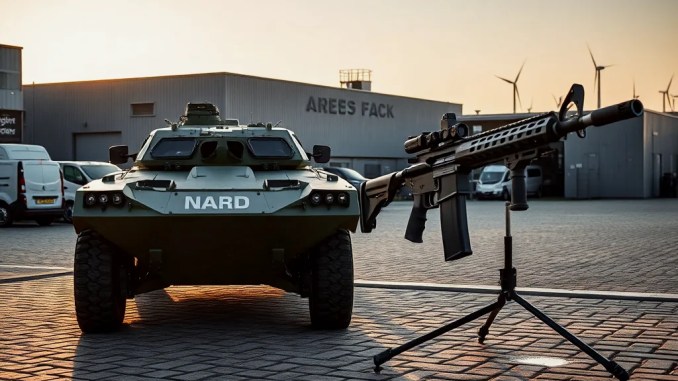
New Weapons Manufacturing Facility to be Established in the Netherlands
IWI and AIA will establish a new manufacturing facility in Tilburg to begin mass production of the ARAD 5 infantry rifle and the NEGEV UX machine gun in the Netherlands. AIA will establish the assembly lines, quality control, and logistics infrastructure; IWI will provide technology transfer, production processes, and technical training. The project is designed to bring not only parts assembly but also long-term maintenance and engineering capabilities to the country.
What Will the New Facility Deliver and How Will Production Work?
The facility will follow a phased production ramp-up: initial setup and pilot runs (months 0–6), low-rate initial production with full quality-assurance workflows (months 7–18), then full-rate production and lifecycle support (months 19+). AIA will handle fabrication of local components, final assembly and testing; IWI will transfer jigs, fixtures, test rigs and software for weapon zeroing and diagnostics. The plant will implement NATO-compatible acceptance testing, maintenance documentation, and a spares pipeline to minimize operational downtime for users.
ARAD 5: Design, Modularity and Operational Advantages
The ARAD 5 is a 5.56×45 mm, short-stroke gas piston rifle built for modularity and quick caliber-agnostic servicing. Key features include rapid barrel-change capability, compatibility with AR-pattern magazines and a hinged dust cover for ingress protection. In practical terms, units gain reduced mean-time-to-repair because barrels and gas systems can be swapped in the field; maintenance crews can replace wear items quickly using standardized fixtures transferred by IWI during training cycles.
NEGEV UX: Weight, Gas System and Deployment Use-Cases
NEGEV UX is a lighter iteration of the Negev family chambered in 7.62 mm, weighing about 6.8 kg. Its two-stage gas regulator allows operators to tune the weapon for adverse environments such as sand or mud: position 1 for standard operation, position 2 for high-dust/high-residue conditions. Half- and full-auto modes plus a reinforced feed ramp increase ammunition tolerance, improving reliability in sustained-fire roles like convoy overwatch, base defense and vehicle mounting.
Training, Maintenance and Local Industrial Benefits
AIA’s plan includes creating a training center adjacent to the factory for armorers and operators. Training covers: 1) field stripping and armorer-level repairs, 2) use of electronic boresighting and zeroing rigs, 3) diagnostics using transferred IWI test software, 4) preventive maintenance scheduling and parts-ordering workflow. Localizing these capabilities shortens supply chains, creates skilled jobs, and provides the Dutch Armed Forces and other customers faster turnaround on repairs and spares.
Quality Assurance, Standards and Export Controls
Production will adhere to ISO quality management systems and NATO interoperability standards for small arms. Acceptance testing will include proof firing, accuracy groups at multiple ranges, cyclic rate measurement, and environmental stress tests (salt spray, dust chamber, temperature extremes). Both partners will implement export-control screening to ensure compliance with Dutch and international regulations, enabling controlled exports to approved customers.
Strategic Context and Industrial Partnerships
For IWI, partnering with a longstanding Dutch state-armory descendant like AIA extends its European industrial footprint and creates a node for future upgrades and system variants. For AIA, the partnership brings contemporary small-arms designs, digital test procedures and aftermarket revenue streams from spare parts and upgrade kits. Together they can offer integrated packages—weapon, optics mounts, remote weapon station interfaces—that appeal to NATO and partner nations seeking on-continent supply.
Examples, Timelines and Deliverables
Concrete deliverables and timeline examples the companies have signaled: pilot production batches within 12 months of facility completion; first-generation training courses delivered within 3 months of pilot acceptance; full-rate production of both ARAD 5 and NEGEV UX within 18–24 months. Example outcome: a brigade-sized initial lot (several thousand rifles and hundreds of machine guns) can be produced and supported regionally without reliance on off-continent logistics.
Implications for Users and Procurement Officers
Procurement officers should expect lower lifecycle costs once local production stabilizes because spares supply and armorer training shorten repair cycles. Operators will benefit from weapons tuned for local operating environments and supported by nearby engineering teams. Contracting packages may bundle initial spares, training and sustainment contracts; procurement strategies that include phased acceptance tests and availability-based milestones will reduce operational risk.
How This Partnership Fits Broader Trends
Shifting small-arms production closer to end-users mirrors wider defense trends: resilience of supply chains, national industrial bases reconstituting key capabilities, and dual-use facilities that support both military and police customers. The AIA–IWI model—facility plus training plus transfer of diagnostics—serves as a replicable blueprint for other countries seeking sovereign capability in small arms without developing designs from scratch.






Be the first to comment