
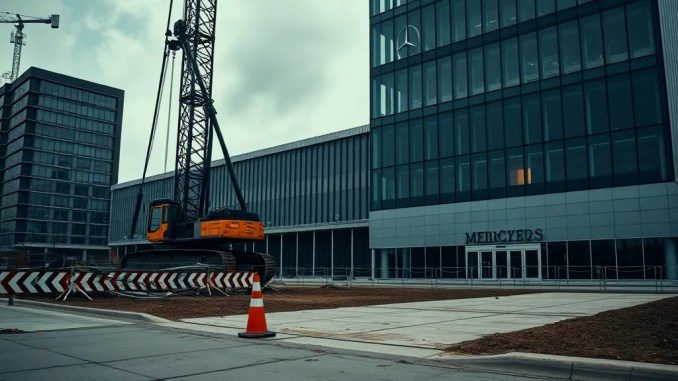
Mercedes-Benz pauses new German investments amid rising costs and stalled talks
Mercedes-Benz has stopped all new capital investments in its German plants while management re-evaluates which facilities remain viable. Management cited sharply higher production costs and unsuccessful negotiations with employee representatives as the immediate drivers. The pause does not mean an immediate shutdown of production lines; instead, leadership has launched a structured review of plant-level economics, capacity needs and the cost levers required to sustain operations in Germany.
Which plants could close and how will Mercedes decide?
Management is assessing each site against three clear criteria: unit labor cost competitiveness, future model allocation potential and required capital intensity for electrification and automation. Two plants have been flagged as candidates for closure if cost and productivity gaps remain unresolved. One candidate is focused on vehicle assembly, the other on powertrain and component production. The decision process will include timeline modeling, break-even analysis under multiple demand scenarios, and an assessment of redeployment or reskilling costs for affected employees.
What changes to working hours has Mercedes proposed?
To reduce hourly labor costs without immediate layoffs, Mercedes has proposed increasing weekly hours from 35 to 40 while keeping base wages flat. That change raises weekly output by roughly 14% per worker and lowers effective labor cost per produced unit when overtime and scheduling effects are managed. Management also proposed revising profit-sharing, holiday pay structures and selected allowances to capture additional savings. IG Metall and worker representatives reject reductions in accrued rights, creating a stalemate that has stalled implementation.
How big is the Germany–Eastern Europe labor cost gap?
Company analyzes indicate that hourly labor costs in some German plants can reach up to five times the levels paid in certain Eastern European sites. These differences depend on local wage rates, social security contributions and work-time regulations. When you combine higher wages with stricter shift rules and higher non-wage labor costs (benefits, pensions), the total employment cost delta can alter a model allocation decision by millions of euros per factory over a vehicle program lifetime.
Why is Mercedes shifting production choices outside Germany?
Beyond direct labor costs, Mercedes faces three external pressures: weakening demand in China, US tariff exposure and intensified competition from low-cost entrants — particularly Chinese EV makers expanding into Europe. These forces compress margins and make headroom for German-cost structures smaller. When the incremental margin on a new model narrows, manufacturers evaluate cheaper assembly locations or shared-platform production in lower-cost regions to preserve profitability.
What are realistic management and labor negotiation steps to avoid closures?
Both sides can pursue a structured, phased agreement to bridge the gap:
Phase 1 — Short-term contingency measures: implement suspended shift flexibility, temporary redeployment to other high-demand plants, and limited productivity-linked bonuses to protect base pay while improving output per hour.
Phase 2 — Medium-term contractual reforms: negotiate a time-limited hours increase combined with guaranteed job protection clauses, shared-investment commitments for automation projects and targeted retraining budgets for affected workers.
Phase 3 — Strategic repositioning: define which product lines will remain in Germany based on automation intensity and brand value, invest in advanced manufacturing where Germany retains a competitive edge (high-end EVs, software-intensive vehicles), and create explicit pathways for plant modernization co-funded by company and state incentives.
What are the likely outcomes and timelines?
If talks remain deadlocked, Mercedes may announce a phased reallocation of new model production to non-German facilities within 12–24 months—matching typical new-vehicle program timelines. A negotiated settlement could extend Germany’s role, but only if it meaningfully narrows the unit-cost gap. Plant closure decisions, if taken, would typically follow liberalization consultation periods and can take 18–36 months to implement from announcement to site wind-down, depending on redeployment options and legal requirements.
How will this affect regional suppliers and the broader German auto sector?
A program of plant reductions or model shifts would cascade to suppliers that specialize in stamped bodywork, transmissions or powertrain components tied to the affected lines. Suppliers facing reduced volumes often consolidate, relocate production, or diversify into new programs. The sector may see increased consolidation and accelerated automation investment as firms aim to protect margins against persistent cost pressure.
What data and examples illustrate similar industry moves?
Examples from recent industry activity show large OEMs relocating high-volume, low-margin production to lower-cost countries while keeping R&D and high-technology production at home. Automotive firms in Western Europe have in past decades moved commodity-rich production south or east to maintain competitiveness; At the same time, they retained flagship, capital-intensive programs—like premium EV platforms—domestically. Real-world program economics typically allocate production where lifetime contribution margin and capacity investment returns meet corporate thresholds.
Next steps for stakeholders
For employees and communities: prepare for extended consultations, seek clarity on retraining and severance options, and explore regional investment or job transition programs. For suppliers: map exposure to at-risk models, engage customers on volume forecasts, and develop contingency plans for production footprint adjustments. For policymakers: consider targeted support tied to modernization, conditional on firm commitments to maintain specific activities and employment levels.







Be the first to comment