
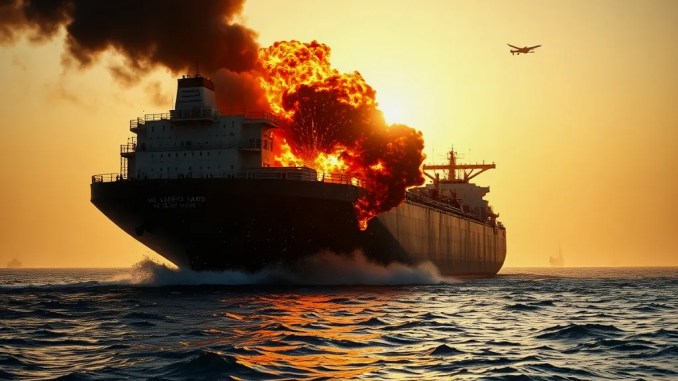
Iran’s Islamic Revolutionary Guard Corps naval unit reported that an LNG carrier east of the Strait of Hormuz struck a naval mine and suffered a large explosion. The unit’s statement said the incident occurred a few hours earlier, without providing casualty figures or detailed damage assessments. Iranian authorities highlighted the ship’s course through a “unauthorized and dangerous southern route” when the contact with the mine happened.
What the Reported Incident Involves
The statement indicates three concrete elements: the vessel was carrying liquefied natural gas (LNG); it contacted a sea mine; and a violent explosion followed. Those three facts, if confirmed, carry immediate operational and safety implications: LNG tankers carry cryogenic cargo under pressure and are built with double hulls or specialized containment systems, but they are vulnerable to external blast damage. A mine blast can breach cargo containment, ignite vapors or cause catastrophic structural failure.
Likely Sequence of Events After Mine Contact
Based on naval-incident patterns and LNG carrier design, a plausible sequence is:
1. Initial contact and local structural damage: The explosion likely created localized hull breaches near the point of contact; secondary systems (pumps, piping, insulation) can be damaged even if primary tanks remain intact.
2. Rapid loss of stability or progressive flooding: Water ingress in a cargo or ballast tank can change trim and stability quickly; crew must enact damage-control procedures to avoid capsize.
3. Fire or gas release: If insulation or pressurized tanks are compromised, cold gas vents or, in worst cases, hydrocarbon release and ignition can occur. LNG itself must vaporize before it becomes flammable in air; However, ignition sources from the blast can trigger fires.
4. Emergency response and towing or salvage: Nearby vessels and naval assets typically establish exclusion zones, provide firefighting, and if possible, tow the damaged ship to shallower water for salvage.
Immediate Safety and Environmental Concerns
An LNG carrier incident poses distinct hazards compared with crude oil spills:
– Rapid vapor dispersion: LNG releases evaporate and form cold, dense vapor clouds that can travel along the surface before dispersing; These clouds can create asphyxiation or flammability risks downwind.
– Marine and coastal impact: Freezing effects from evaporating LNG can harm marine organisms locally; Physical debris and firefighting runoff can also damage ecosystems.
– Navigation danger: A damaged vessel and floating debris become navigational hazards in the Strait of Hormuz, a choke point for global energy traffic.
Implications for Commercial Shipping and Route Choice
Shipmasters balance safety, cost and schedules when selecting routes. The Iranian statement’s reference to a “dangerous southern route” implies a route choice that may have tried to avoid heavily monitored lanes but placed the vessel in higher-risk waters with potential mines or other hazards. Commercial implications include raised insurance premiums, rerouting around perceived danger zones, and stricter vetting of convoy or naval escort options for high-value cargoes like LNG.
What Authorities and Operators Typically Do Next
Standard responses combine search-and-rescue, technical assessment and maritime security measures:
– Immediate search and rescue and medical triage: Prioritize crew safety, health checks for blast injuries, and account for all personnel.
– Damage and contamination assessment: Salvors and classification societies evaluate hull integrity, cargo containment, and pollution risk to determine whether to offload, vent, or tow.
– Mine countermeasure deployment: Naval forces will likely survey for additional mines and mark exclusion zones; if mines are confirmed, commercial traffic will be redirected and mine-clearing operations scheduled.
Historical Context and Precedents
Past incidents show that mined or contested waters near major chokepoints create outsized disruption. Examples include wartime minefields that rendered narrow passages temporarily unusable, spike insurance rates and prompted multi-national convoys. The strategic sensitivity of the Strait of Hormuz—through which a significant share of seaborne oil and LNG transits—means even a single incident can produce immediate market and security reverberations.
Questions to Watch and Next Steps for Verification
Key verification steps and questions for analysts and the public:
– Independent confirmation: Satellite imagery, AIS (automatic identification system) signal analysis, and third-party maritime monitoring groups can Corroborate a vessel’s position, damage and any blackout of signals.
– Identity and flag of the vessel: Knowing the ship’s name and flag state clarifies operator responsibilities and which authorities will lead salvage, investigation and compensation.
– Casualty and cargo status: Official manifests, company statements, or port authorities will eventually provide numbers for crew injuries and the exact state of cargo containment.
– Evidence of mining activity: Wreckage analysis, mine fragments and seabed surveys can determine whether the strike came from a military-style mine, an improvised device, or another cause (such as an onboard explosion).
Practical Advice for Mariners Transiting the Area
Shipmasters should follow maritime authority guidance and take concrete steps:
– Maintain AIS on and report deviations: Keeping AIS active helps authorities track vessels and provide timely warnings.
– Implement increased watch and damage-control drills: Rehearse rapid sealing of watertight doors, firefighting, and transfer-of-personnel procedures.
– Liaise with insurers and operators: Report incidents immediately to insurers and owners to activate response plans and salvage contracts.
Potential Market and Geopolitical Effects
Because the Strait of Hormuz is critical to global energy flows, even isolated maritime incidents near it can push short-term price spikes and trigger diplomatic responses. Governments with flagged vessels or energy dependencies may demand inspections, escorts or temporary routing changes. Insurance and freight markets typically react quickly, increasing costs for shippers until perceived risk falls.
What to Expect in the Coming 24–72 Hours
Expect an evolving picture: official statements from Iran, possible shipowner or classification updates, satellite and maritime society-monitoring corroboration, and regional naval patrol adjustments. Independent verification will determine whether the explosion resulted directly from an external mine or another cause; each scenario carries different legal, insurance and security consequences.







Be the first to comment