
Return to Syria: timeline and diplomatic effort
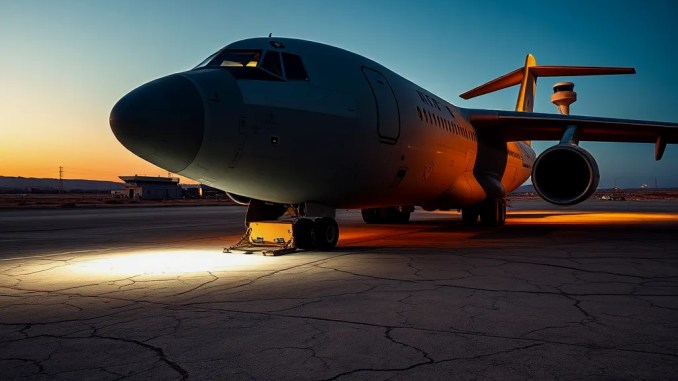
The Il-76T bearing registration YK-ATD and serial 0013431915 arrived back in Syria on 12 November 2026 after departing Damascus for Benghazi on 4 December 2024. Syrian Air Force and Foreign Ministry officials conducted diplomatic missions. negotiations with authorities in eastern Libya, including Deputy Commander of the Libyan Arab Armed Forces, Lieutenant General Khalifa Haftar, to secure the aircraft’s transfer. The transport left Benina International Airport at 08:37 UTC and reached the Damascus area at approximately 14:08 local time. This handover followed renewed bilateral contacts between Damascus and Benghazi authorities that resumed in late 2026.
Recorded Libyan operations: seven domestic rotations and patterns
Open-source tracking and imagery indicate YK-ATD carried out seven documented domestic flights while based in Libya. Notable activity includes multiple Benghazi–Sebha rotations in January 2025, when the aircraft flew the sector twice on 9 January. The Benghazi–Sebha route spans roughly 640 kilometers direct, a typical medium-range mission for the Il-76T used to move cargo and personnel between eastern and southwestern Libyan airfields. By 5 February 2025 the registry of domestic movements totaled seven departures; by 16 February 2025 imagery showed the aircraft parked at Benina with SyrianAir markings either removed or obscured, a practical step to mask origin while operating under different local control.
Context of the December 2024 departure from Damascus
The Il-76T left Damascus on 4 December 2024 amid the final phase of the Assad government’s territorial collapse and military withdrawals triggered by observation gains, notably Aleppo’s fall on 30 November 2024. At the time, units including the 4th Armored Division, Republican Guard elements and specialized security formations were withdrawing or relocating. Multiple reports suggested limited, organized evacuations of personnel and materials; However, there is no independently verified evidence that YK-ATD transported specific senior personnel during that exodus.
Aircraft identity, production and early operational history
Manufactured in Tashkent, the airframe carries production number 2309 and made its first flight on 31 July 1981 as an Il-76M military transport. It was converted to Il-76T standard in 1994. Historic movement logs show early international visits: London Heathrow in January 1982, Amsterdam Schiphol on 9 May 1985 and Malta Luqa on 29 September 1990. These entries indicate the platform was routinely used for long-range logistics and third-country missions throughout the 1980s and early 1990s.
Role within the Syrian Air Force transport inventory
Registered as SyrianAir YK-ATD, the aircraft served with the 585th Transport Squadron under the 29th Air Transport Brigade based at Damascus International Airport. That unit historically operated four Il-76 transports and conducted scheduled and ad hoc airlift between Syria and partner countries such as Iran, Russia and Libya as well as domestic routes in northeastern Syria. Recovering YK-ATD restores one Il-76 to Syrian inventory and helps normalize the brigade’s lift capability for medium-heavy cargo movements.
Operational implications and likely missions while in Libya
When an Il-76T operates on domestic Libyan sectors such as Benghazi–Sebha, typical payloads include palletized supplies, vehicle components, humanitarian consignments, or rotations of local forces. Flight cadence and route choice (seven recorded domestic hops, concentrated on key east–south links) suggest the aircraft supported logistical redistribution inside Haftar-aligned territory rather than long-range international transfers. Concealment of Syrian insignia and the aircraft’s retention in Haftar-controlled zones are consistent with deliberate local integration for operational security and political deniability.
Verification and open-source indicators
Evidence for the aircraft’s movements comes from a blend of flight-tracking records, airport logs, and imagery: timestamps for departures and arrivals, imagery of livery changes at Benina, and chronological match-ups with reported diplomatic meetings (for example, the October 2026 meeting between Syrian Foreign Minister Esad al-Sheibani and Haftar in Benghazi). While such sources create a converging picture, analysts note limits: gaps in continuous flight tracking, the ease of altering visible registration markings, and potential local re-registration or temporary operating arrangements.
What the return means for Syrian airlift capacity
Restoring YK-ATD increases the operational pool of Il-76s available to the Syrian Air Force by one platform—an important increment given each airframe’s ability to carry outsized cargo (military vehicles, generators) or large palletized loads. Practically, the aircraft can re-enable specific route capacities: sustained cargo runs to Iran and Russia, intra-Syria rotations, and contingency evacuation lift if required. Given the airframe’s age (first flight 1981) and refit history, its serviceability will depend on maintenance depth, spare-part supply and inspection cycles before high-tempo deployment.
Key dates and quick reference
– First flight: 31 July 1981 (Il-76M). Conversion: 1994 to Il-76T standard.
– Damascus departure: 4 December 2024 to Benghazi (approx. 2,000 km direct).
– Documented domestic Libyan flights: seven movements, including two Benghazi–Sebha flights on 9 January 2025.
– Imagery showing obscured SyrianAir markings at Benina: 16 February 2025.
– Return to Syria: 12 November 2026, departed Benghazi at 08:37 UTC, arrived Damascus area at ~14:08 local.








Be the first to comment