
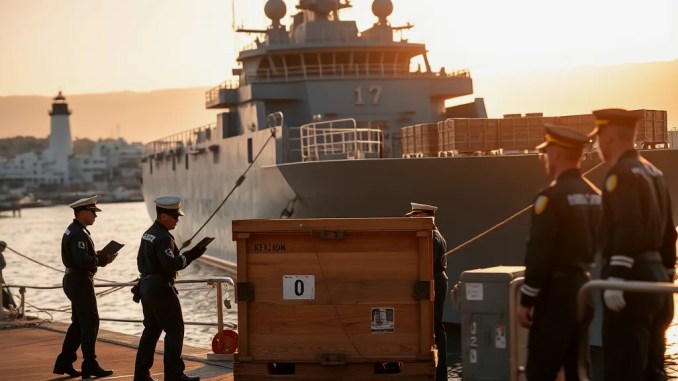
Nearchos departs for Brest to complete weapons and sensor integration
The Hellenic Navy’s second FDI (Frégate de Défense et d’Intervention) frigate, Nearchos, sailed towards the French naval base in Brest to undergo final weapons and sensor integration before joining Greek service. Naval yards in Brest will install and integrate Aster-30 area-defense missiles, MM40 Exocet anti-ship missiles, MU90 lightweight torpedoes, and the RAM close-in weapon system. Integration at Brest consolidates the ship’s combat systems, verifies end-to-end firing chains, and completes acceptance trials ahead of transfer to the Saronic Gulf.
Key timelines and operational handover steps
Nearchos is scheduled to remain at Brest into mid-week for the major integration activities and system checkouts. Typical steps being executed there will include: a) mechanical and electrical installation of missile canisters and launchers; b) integration of missile fire-control with the ship’s combat management system; c) end-to-end guided‑weapon tests using target simulators and telemetry links; d) live‑fire or instrumented firings if safety and bilateral agreements permit; and e) final crew training aboard the fully fitted platform. After those milestones are complete and acceptance certificates signed, the frigate will transit to Greek waters for formal commissioning into the Hellenic Fleet.
Nearchos technical profile and sensor suite
Nearchos displaces about 4,500 tons, measures roughly 122 meters in length, and reaches a top speed of approximately 27 knots. The ship operates with a crew complement near 120 and emphasizes advanced digital architecture. Core combat and sensor elements include an integrated PSIM mast that consolidates electro-optical and electronic sensors, the CAPTAS‑4 variable-depth sonar for anti‑submarine warfare, and the Sea Fire active electronically scanned array (AESA) radar providing 3D air picture and horizon surveillance. These systems enable layered anti-air, anti-surface and anti-submarine capabilities when combined with Aster family interceptors, Exocet anti-ship missiles and torpedo countermeasure suites.
Ceremony and transfer: political and naval context
The formal naming and flag-raising ceremony for Nearchos took place with Greek Defense Minister Nikos Dendias attending in France. The minister participated in official ceremonies in Lorient, met his French counterparts, and attended a blessing at Naval Group facilities. After ceremonies and the signature of the acceptance decree, the ship entered the Greek Navy inventory, with Greek naval insignia and command pennants raised prior to the voyage to Brest for final outfitting.
Strategic implications for the Hellenic Navy and regional posture
Integrating Nearchos brings the Hellenic Navy a modern multi-mission frigate optimized for area air defense, sea control and undersea warfare. Minister Dendias framed the delivery as part of a broader fleet modernization: the government expects Formion to follow before the end of 2026, with additional hulls (including Themistokles) fleet scheduled for later delivery and progressive upgrades to a “Standard 2+++” configuration by 2030. Practically, the upgrades will raise interception ranges, strike options and survivability—shifting tactics toward distributed air-defense screens, layered anti-ship strike , and more resilient command-and-control under contested conditions.
Fleet modernization plan: numbers, timelines and force structure changes
Dendias outlined a decade-long vision packages to achieve roughly ten modern or modernized frigates by the end of the ten‑year window. The plan blends full newbuild platforms, incremental modernization of existing hulls, and integration of unmanned surface and subsurface systems. Expected operational impacts include: • Improved area air-defense umbrella over key sea lanes; • Greater long-range anti-ship deterrence through Exocet and Tomahawk‑class equivalents where applicable; • Enhanced ASW coverage using CAPTAS‑4 and embarked helicopters; • Better distributed sensing via integrated masts and networked data links.
Operational readiness: crew training and systems acceptance
Bringing a high‑end frigate to operational readiness requires serial activities that the Brest phase addresses. Crew qualifications will be completed under a combined French‑Greek training syllabus covering weapons handling, missile engagement procedures, damage control under live conditions, and combined exercises with escort vessels and maritime patrol aircraft. Acceptance testing focuses on the combat management system’s ability to fuse sensor data, allocate weapons, and perform simultaneous engagements across air, surface and subsurface tracks—verified by synthetic and instrumented live events.
Examples and precedent: how the first ship’s route informed Nearchos’ schedule
The lead ship of the class followed an identical routing through French facilities before arriving at Salamis Naval Base; lessons learned from that program sped up integration sequencing, logistics staging, and crew familiarization. For instance, pre-positioning spares and having dedicated engineering teams reduced integration delays by measurable weeks on the first hull. Nearchos benefits from those process improvements, tightening the timeline to operational deployment.
What to expect next
Once weapon integration and verification complete in Brest, expect Nearchos to transit to the Saronic Gulf where Greek crews will continue operational workups and include the ship in national and NATO exercises. By the time Formion and subsequent hulls arrive, the Hellenic Navy will have rebalanced patrol patterns and fleet dispositions to take advantage of increased area-defense and anti-submarine reach—altering escort tasking for high-value transits and layered protection schemes for maritime chokepoints in the Aegean and Eastern Mediterranean.









Be the first to comment