
Project Overview and Route Details
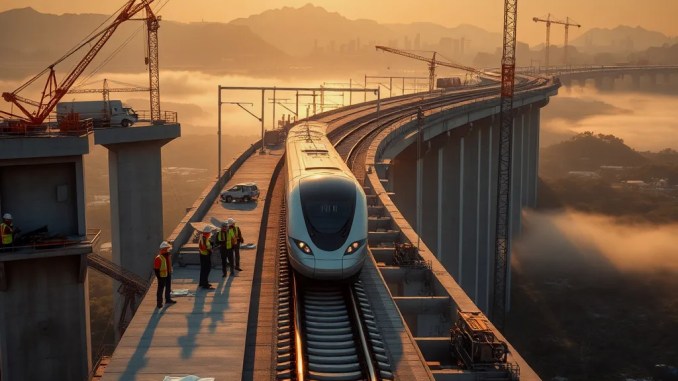
The Hanoi–Quang Ninh high-speed rail will run approximately 120 kilometers from Co Loa National Exhibition Center in Hanoi to the public park in Tuan Chau, Quang Ninh. Trains will operate on a 1,435 mm standard-gauge, electric, double-track system designed for up to 350 km/h on the mainline and 120 km/h within Hanoi city limits. The alignment serves Hanoi, Bac Ninh, Hai Phong and Quang Ninh, and includes five stations: Co Loa, Gia Binh, Ninh Xa, Yen Tu and Ha Long Xanh. A maintenance and stabling depot will be located at Ha Long Xanh station in Tuan Chau.
Investment, Financing and Cost Breakdown
The project budget totals about 147.37 trillion VND. That figure excludes roughly 10.27 trillion VND earmarked separately for compensation, support and resettlement costs that are expected to be covered from state budgets. Within Quang Ninh province, planners have allocated about 48.10 trillion VND for construction there, with land acquisition and clearance estimated at 3.579 trillion VND. The primary investor and developer for operations and project delivery is VinSpeed High-Speed Train Investment and Development JSC.
Current Construction Status: Bridges and Foundations
Contractors have concentrated on bridge piers and foundational works across the corridor. In the Quang Ninh section crews are working on 45 bridge piers with 237 driven piles completed so far. On the Ha Long–Hai Phong expressway crossing, teams finished construction of 84 piles across 18 pier positions in addition to ten footing foundations and four shaft footings. These structural elements form the backbone of the elevated and crossing structures required for a high-speed right-of-way and are on the critical path for sections that demand grade separations.
Land Clearance and Right-of-Way Progress
Land clearance teams have delivered 226.88 hectares across Quang Ninh, representing about 82% of the area required for the provincial section. Remaining undelivered parcels total 46.53 hectares. Mao Khe, Tuan Chau and Uong Bi have near-complete handovers; Hoang Que, Yen Tu and Ha An report roughly 80% completion; Dong Mai lags at about 43%. These delivery percentages directly affect the schedule for civil works because track-bed construction and utility relocation cannot proceed in undelivered stretches.
Technical and Utility Challenges Slowing Progress
Project managers report delays tied to relocation of technical infrastructure — notably high-voltage lines, telecom ducts and lighting systems. Utility diversion requires coordination with multiple agencies, phased de-energization and installation of temporary services for affected communities and businesses. Each diversion follows a step-by-step sequence: 1) survey and mapping of existing assets, 2) design of diversion routes minimizing service interruption, 3) procurement and civil execution, 4) testing and switchover, and 5) formal handover and record updates. Bottlenecks at any step push back excavation and embankment programs.
Resettlement, Compensation and Social Measures
Compensation programs target three main groups: private homeowners, aquaculture operators, and small commercial tenants displaced by the right-of-way. Effective resettlement requires transparent valuation, timely cash flows and practical relocation options that preserve livelihoods — for example, replacing lost aquaculture ponds with alternative ponds or offering training support to transition to nearby agricultural employment. Authorities estimate and resettlement expenditures at ~10.27 trillion VND, compensation handled separately from construction capital and subject to provincial approval cycles that can create scheduling risk if payments delay.
Coordination Steps to Meet the 2028 Completion Target
To maintain a 2028 construction completion and 2029 commercial start, stakeholders have focused on four operational levers: increasing machine and labor capacity, sequencing concurrent works across multiple fronts, Accelerating utility diversion plans and improving interagency coordination for land handovers. Practically, this means mobilizing additional piling rigs and track-laying teams, issuing overlapping contracts for civil, electrical and systems works where dependencies allow, and establishing a single-point coordination office to fast-track approvals and dispute resolution.
Operational and Economic Outcomes Expected
Once operational, the line will reduce journey times between Hanoi and key northern centers, facilitate commuter flows into the Hanoi metropolitan area, and strengthen connections to Quang Ninh’s tourism nodes such as Ha Long Bay. Faster freight-capable services and improved logistics connections at transfer nodes can generate regional economic multipliers: higher tourist arrivals, increased real estate activity near stations and improved labor market accessibility that boosts productivity across connected provinces.
Risks, Mitigations and Monitoring
Key risks include utility diversion delays, unresolved land claims, funding flow interruptions and environmental constraints during construction (eg, wetlands or coastal coastal near Ha Long). Mitigation measures include contingency budgets for targeted parcels, phased utility diversion contracts with performance bonds, dedicated rapid-response teams to settle land disputes, and ecological monitoring programs that adapt construction methods (such as using silt curtains and timing in-water works to low-impact seasons) to limit environmental harm.








Be the first to comment