
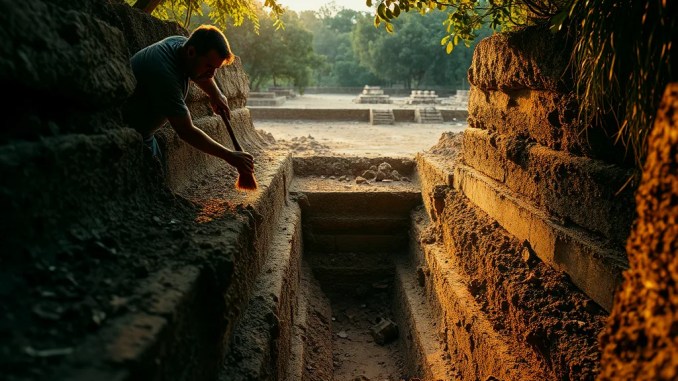
They Built New Houses on Destroyed Temples
Archaeological teams excavated 96 domestic structures built directly atop collapsed monumental platforms. Excavators documented light-frame houses with thatch roofs and wooden posts whose foundations reused dressed stone blocks from fallen temples and pyramids. The builders leveled rubble to create compacted floors, placed stone footings at post locations, and oriented living compounds along segments of the old 12-meter-wide causeways. Those technical choices reduced labor and material demands and illustrated an adaptive reuse strategy: sacred architecture structural supply for everyday housing.
Life Continued in Ake for Approximately 450 Years
Material dates and artifact assemblages place continuous occupation between roughly 1100 and 1550 CE. Radiocarbon and ceramic typologies cluster squarely within the Postclassic and early contact periods. Finds include grinding stones (metates), spindle whorls, utilitarian pottery, and faunal remains dominated by small mammals and deer—evidence for a mixed subsistence economy that combined household cultivation, hunting, and exchange. Burnt residue and traces of incense within collapsed ritual spaces indicate that religious practice persisted, repurposed into domestic contexts rather than disappearing entirely.
Ake’s Withdrawal from the Stage of History is Still Being Investigated
Historical silence after 1567 leaves the end of Ake unsettled; Multiple exit scenarios remain plausible. One scenario fits coerced relocation under early Spanish colonial policies—encomienda resettlements and missionization often forced dispersed indigenous populations into new nucleated towns. Another scenario envisions gradual depopulation from epidemic disease and economic marginalization, producing an attritional abandonment. Ake’s surviving 16th-century letter mention does not resolve which mechanism predominated; targeted paleoepidemiology, archival surveys, and landscape-level survey of contemporaneous settlements could discriminate among causes.
What the Evidence Shows: Daily Life, Ritual, and Organization
Combined archaeological evidence reveals households that integrated ritual spaces, craft production, and food processing within densely packed neighborhoods. Examples: (1) A courtyard house built over a collapsed shrine contained an adjacent hearth and a concentration of obsidian flakes—indicating domestic tool production; (2) clusters of metates and grain-processing residues within rear rooms suggest household-scale cultivation and storage; (3) funerary deposits under compacted floors—often with ceramic offerings—demonstrate continuity in ancestor veneration. These spatial patterns point to resilient household-level social structures that maintained cultural continuity despite political fragmentation.
How Reuse Practices Affected Social and Environmental Systems
Stone recycling and in-situ reuse reduced the need for new quarrying and redirected labor from monumental construction to household maintenance. That transition would alter local labor mobilization and craft specialization: fewer state-sponsored projects meant artisans and masons applied their skills to domestic repairs, fences, and new low-rise structures. Environmentally, leaving large carved blocks in place minimized landscape disturbance, while increased reliance on organic building materials required ongoing access to timber and thatch resources—shifting resource pressure rather than eliminating it.
Methods That Reconstructed Ake’s Postcollapse Narrative
Researchers combined stratigraphic excavation, ceramic seriation, radiocarbon dating, micromorphology, and GIS mapping of house-cluster patterns. Micromorphology of collapsed temple deposits revealed occupation surfaces above ritual floors. GIS density maps of domestic features produced a temporal sequence showing gradual infill of plaza edges and causeways. This multi-proxy approach allowed archaeologists to distinguish short-term reoccupation episodes from sustained household continuity spanning centuries.
Implications for Understanding Maya “Collapse” Elsewhere
Ake reframes collapse as a variable, long-term process that produced diverse adaptive responses. Instead of equating architectural decline with cultural extinction, the Ake case shows continuity of practice, adaptation of former ceremonial spaces, and the survival of localized economies. Other Classic-period centers may show similar postmonumental lifeways if examined with fine-grained settlement archaeology and household-focused analyses.
Key Data Points and Examples
Selected empirical highlights from the Ake excavations:
– 96 domestic compounds constructed among temple rubble, often aligned with surviving roadway segments.
– Date range: radiocarbon and ceramic evidence clustering roughly 1100–1550 CE.
– Artifact types: metates, spindle whorls, utilitarian ceramics, obsidian debitage, faunal remains dominated by deer and small mammals.
– Ritual persistence: incense residue, interments beneath occupation floors, and reused shrine stones incorporated into house platforms.
Next Research Steps and Practical Approaches
To refine the end-date and social processes at Ake, combine these actions:
1) Targeted AMS dating of human remains and short-lived botanical samples to tightenology around the late 16th century.
2) Archival cross-referencing to locate documentary traces of population movements or colonial-era relocations near Ake.
3) Paleopathological and aDNA analyzes to assess epidemic impacts and kinship patterns among late residents.
4) Regional settlement surveys to determine whether Ake’s adaptive pattern replicated across neighbors Maya towns.
Takeaway
Ake demonstrates that architectural decline did not equate to immediate social collapse: households repurposed monumental remains, sustained ritual and production activities, and persisted for centuries in a transformed urban landscape. This nuanced perspective encourages archaeologists to look beyond podiums and plazas to recover long-term everyday resilience in postclassic settings.







Be the first to comment