
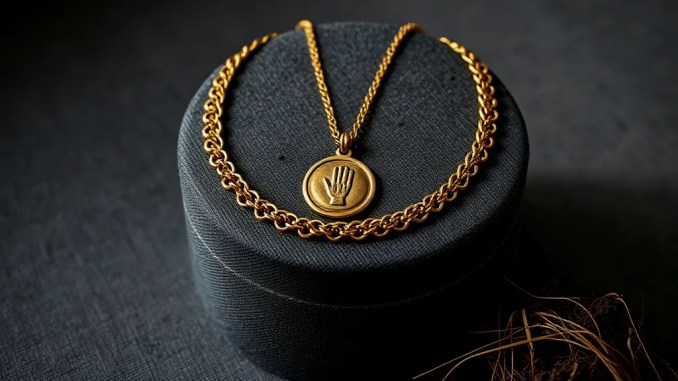
Rare 9th–10th Century Gold ‘Hand of God’ Pendant Found Near Highclere Castle
Archaeologists surveying farmland near Highclere Castle in Hampshire uncovered a near-intact, solid-gold pendant depicting the Christian “Hand of God” motif. A metal-detecting surveyor noticed a bright glint close to the surface and recovered the piece; early assessment dates the object to the late 9th or 10th century, placing it firmly in the Anglo-Saxon period.
How experts dated the pendant and what specific features point to the 9th–10th century
Scholars dated the pendant by comparing its metal composition, manufacturing marks, and decorative vocabulary with securely dated finds. Microscopic inspection reveals tool marks consistent with Anglo-Saxon chasing and punchwork; the gold alloy’s trace elements match regional metallurgical profiles known from contemporary treasure hoards. The pendant’s small perforations and recessed panels echo techniques found on church plate and high-status dress fittings from late Saxon and early Viking contexts, providing multiple independent lines of evidence for a 9th–10th century origin.
Why the “Hand of God” motif mattered in early medieval England
The Hand of God motif functions as a visual shorthand for divine agency and protection. In practical terms, owners displayed such symbols to signal religious affiliation and, importantly, social standing. On pendants and coinage, the hand often appears issuing from a cloud or border, aligning the wearer with ecclesiastical networks or patrons who controlled churches and land. In Anglo-Saxon society—where literacy was limited—portable images conveyed theology and status in a single emblem.
Materials, craftsmanship, and what the pendant reveals about Anglo-Saxon goldworking
The pendant’s solid-gold construction indicates access to high-value raw material and to goldsmith expertise. Close-up study shows deliberate hollowing in specific zones to reduce weight while retaining surface presence, a technique used by experienced smiths to balance opulence and wearability. Small decorative pits and chased lines reflect a repertoire shared with contemporary silverwork and gilded objects, suggesting workshops that produced for both elite seculars and ecclesiastical patrons. If chemical assays confirm locally sourced gold or recycled metal, that would illuminate trade and reuse practices in the period’s metal economy.
Context of discovery and legal process in England
Found in cultivated land near Ashmansworth, the pendant entered the legal framework for treasure finds. Local authorities reported the object to national heritage bodies, and curators at the British Museum undertook conservation and detailed recording. Under the Treasure Act, museums can acquire such finds at market value; A sale would generate a reward split between the landowner and the finder. That process protects the object while compensating stakeholders and ensures proper scientific recording before any public display.
What this pendant can teach scholars: research angles and testing plans
Curators outlined a phased research program: high-resolution photography and photogrammetry to produce a 3D model; X-ray fluorescence (XRF) and inductively coupled plasma–mass spectrometry (ICP-MS) for alloy composition and trace elements; computed tomography (CT) scanning to reveal internal construction and any concealed repairs; and comparisons with regional typologies to map likely production centers. Each method targets a specific question—composition for provenance and recycling, CT for manufacturing techniques, and typology for cultural connections.
Comparative examples and rarity
Gold pendants with devotional iconography are rare from this period; Comparable examples appear in hoards and grave goods but often in silver or gilt copper alloy. Where solid gold parallels exist, they typically associate with elite burial assemblages or ecclesiastical treasuries. This pendant’s combination of pure gold, a clear Hand of God motif, and find context in farmed land makes it an uncommon data point for understanding mobility of high-status objects beyond known burial or treasury sites.
Immediate conservation steps and museum handling
Conservators stabilized the pendant to prevent further surface loss, applying minimal, reversible measures and documenting condition with scale photography. The British Museum prioritizes environmental control—low light, stable humidity, and secure display mounts—before any public exhibition. Conservation records will accompany the object through research publication, ensuring transparent provenance and condition reporting for future scholars.
Potential public display, interpretation, and community benefits
If acquired by a public museum, interpreters can place the pendant in displays that combine digital 3D models, close-focus lighting to reveal punchwork, and contextual objects such as contemporary coinage and ecclesiastical fittings. Local communities and the finder stand to benefit financially and culturally when museums purchase finds; shared exhibitions and outreach events build public interest in local archeology and responsible metal-detecting practices.
Next steps for researchers, curators, and the public
Researchers will publish technical analyzes in peer-reviewed outlets and make 3D data available for teaching and study. Curators will decide acquisition based on significance and resources; if the British Museum offers to acquire the pendant, declared market valuation will determine rewards. Public programs—talks, site tours, and exhibit labels—will communicate the pendant’s story, from the moment of discovery to its broader significance for understanding power, belief, and craft in early medieval England.









Be the first to comment