
Crash Overview and Immediate Impact
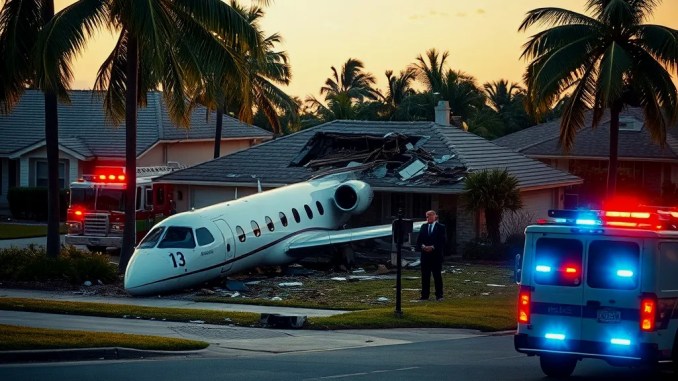
A Learjet 60 private jet crashed into a residential area in Palm Beach County, Florida, killing all 9 people on board and igniting a large fire that forced the evacuation of roughly 600 residents. The aircraft departed Austin-Bergstrom International Airport bound for North Eleuthera in the Bahamas. Local officials say the jet went down near the Cresthaven neighborhood at about 12:50 local time, producing a massive explosion on impact and creating a crater at the primary impact site.
Pilot Radio Calls and Sequence of Events Before Impact
Air traffic control recordings from the Miami Center indicate the pilot reported light icing and moderate turbulence before the aircraft’s sudden uncontrolled descent. The pilot requested a climb to avoid precipitation, then declared an emergency as the jet began to descend rapidly. Recorded transmissions captured escalating alarms: “We’re descending 8,000 feet per minute… 10,000 feet per minute… we’re overspeeding, descending 20,000 feet per minute, we are going to hit the ground.”
Weather Conditions and Possible Contributing Factors
At the time of the accident, southern Florida was experiencing thunderstorms with heavy showers gusts Meteorological radar shows the jet passed through a convective cell shortly before its rapid altitude loss. Investigators will examine whether icing, severe turbulence, wind shear, or microburst activity played a direct role. While pilot reports mentioned ice accumulation and turbulence, causation has not been established and will require analysis of flight data and wreckage.
Damage on the Ground and Evacuation Response
The aircraft impacted near Military Trail, scattering debris across a wide area, damaging power infrastructure and igniting fires in multiple structures. Governor Ron DeSantis described the scene as resembling a missile strike and confirmed a large crater at the impact point. Local emergency managers coordinated evacuation efforts; Palm Beach County District 3 Commissioner Joel Flores reported approximately 600 people required relocation to temporary shelters. The American Red Cross mobilized to provide shelter, meals, and support services for displaced residents.
Federal Investigation and Evidence Collection
The US National Transportation Safety Board (NTSB), supported by the Federal Aviation Administration, dispatched accident inspectors to the site. Their initial tasks include securing wreckage, recovering cockpit voice and flight data recorders if intact, documenting impact distribution, and cataloging evidence of pre-impact aircraft damage. Investigators will cross-check radar tracks, ATC transcripts, maintenance records, pilot training and medical history, and weather data to reconstruct the flight’s final minutes.
Why Investigators Focus on Multiple Hypotheses
Modern aviation investigations assess layered causes rather than single-point failures. For this crash, plausible hypotheses include:
1) Aerodynamic disruption from icing: Ice accumulation on critical surfaces can shift stall speeds or reduce controllability. Flight crews often request altitude changes to escape icing conditions—something the pilot did here.
2) Extreme vertical wind shear or microburst: Convective storms can produce rapid vertical accelerations that overwhelm small business jets.
3) Mechanical or flight-control failure: Sudden loss of control can also result from structural failure, engine anomalies, or flight-control system malfunctions.
4) Combined human–environment–mechanical factors: Investigators commonly find a cascade of events where weather, pilot decisions, and technical issues interact.
Local and Federal Officials’ Statements
US Transportation Secretary Sean Duffy called the accident “a horrific tragedy.” Officials have not released the identities of the victims or the passenger/crew manifest pending family notification. Governor DeSantis and local emergency managers prioritized containment of fires, restoration of utilities, and sheltering displaced residents while federal teams secure the scene for evidence collection.
Proximity to Presidential Flight and Public Concerns
The crash site sits about 6.4 kilometers (approximately 4 miles) from the West Palm Beach airport. President Donald Trump’s Air Force One left the area roughly an hour before the accident; Authorities report no evidence of a connection between the presidential flight and the private jet incident. Officials emphasize safety perimeter measures and are investigating whether airport operations reported any anomalies on radar prior to the crash.
What Comes Next: Timeline of the Investigation
Investigative milestones typically include:
Within 24–72 hours: Scene stabilization, debris mapping, initial witness interviews, and retrieval of accessible recorders.
Within days to weeks: Forensic examination of recovered components, metallurgical testing, and preliminary analysis of flight recorder data when available.
Within months to a year: Completion of the factual report, safety analyses, and final probable cause determination. If systemic issues are identified, the NTSB may issue safety recommendations for industry and regulators.
How Residents and Local Services Are Being Supported
Emergency management has set up temporary shelters and is coordinating with utility companies to repair damaged lines. The Red Cross and county social services are providing immediate needs—shelter, food, and counseling—and working to reunite families separated by evacuation. Health departments are monitoring air quality where fires burned structures to address potential smoke and particulate exposure.
Frequently Asked Questions People Also Ask
How do researchers determine the cause of a crash like this? They combine physical evidence (wreckage distribution, system components), recorded data (CVR/FDR), ATC communications, maintenance logs, and meteorological data to reconstruct events and identify causal chains.
Can icing cause a jet to descend uncontrollably? Yes. Severe or unexpected icing can alter aerodynamic properties and instrumentation, potentially inducing stall/spin or other loss-of-control scenarios if not mitigated.
Will residents be able to return home soon? That depends on fire suppression, structural damage assessments, and restoration of utilities. Authorities are prioritizing safety; tentative timelines emerge after engineering inspections.
Practical Steps for Residents and Witnesses
If you live in the affected area:
– Follow official evacuation orders: Leave only when directed and bring identification and essential medications.
– Document damage safely: Take photos for insurance after authorities clear the area; avoid entering unstable structures.
– Seek support: Register with local disaster assistance centers and the Red Cross for housing and recovery aid.
Concluding Details and Expected Communications
The NTSB will provide public updates as they recover recorders and analyze data. Officials will release victim identities after notifying next of kin. Residents and travelers should monitor official county and FAA channels for road closures, airspace advisories, and sheltering instructions. The final investigative report may take many months, but preliminary factual releases typically appear sooner as key data are validated.









Be the first to comment