
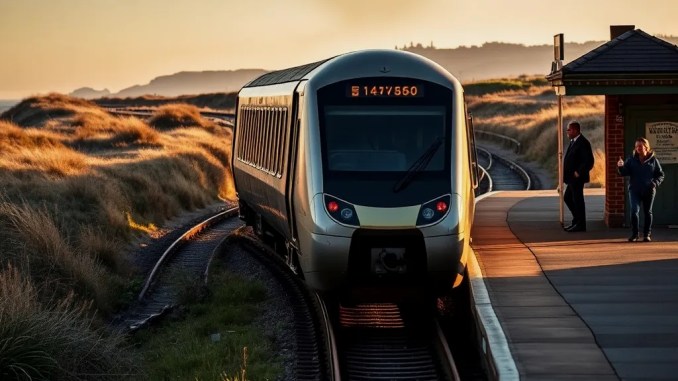
Grove Hill Tunnel concrete track replaced and supporting systems upgraded
Network Rail crews completed a focused renewal of the concrete track inside Grove Hill Tunnel, removing degraded track components and installing a reinforced concrete base that secures rails without traditional sleepers and ballast. Teams dismantled the old track bed, poured and cured a strengthened concrete slab, and fastened new rail fastenings designed for tunnel environments. The project also replaced adjacent drainage runs and inspected tunnel linings to remove water ingress risks that accelerated degradation.
The engineering sequence followed three clear steps: clear and assess (remove old material; scan the tunnel for defects), prepare and pour (installformwork, apply reinforcement, pour concrete and allow curing under controlled humidity), and install and commission (secure rail fastenings, align rails to design tolerances, test with measurement trains). This method reduces rework risk and delivers a stable, low-maintenance running surface tailored for confined tunnel geometry.
Comprehensive corridor works: what teams fixed beyond the tunnel
Beyond Grove Hill, engineers targeted five specific locations along the Tonbridge–Wadhurst corridor. At Wadhurst Tunnel they performed structural inspections and local repairs to brick and concrete lining. Near Stonegate crews renewed sections of ballast, improved drainage outfalls and carried out rail geometry checks using track recording vehicles. Etchingham received new power distribution equipment and station roof repairs; bridges nearby had drainage refurbished to prevent saturation under heavy rainfall.
Robertsbridge and Mountfield works replaced worn rail lengths, conducted ultrasonic rail flaw testing, and mapped the route for future maintenance windows. The combined program improved resilience by addressing both immediate defects and the environmental factors—drainage, vegetation control and cable protection—that cause repeat failures.
Temporary speed limits removed after alignment and settlement checks
Three temporary speed restrictions (TSRs) that had reduced maximum speeds at two locations were lifted after engineers confirmed track alignment, stiffness and settlement met safety thresholds. Two TSRs lay between Crowhurst and Battle and one between Etchingham and Robertsbridge. Teams used track recording trains and tamping data to validate both horizontal alignment and cross-level tolerances; where minor adjustments were needed, tamping and rail grinding restored the safe running profile.
Seasonal soil contraction following a hot, dry summer had caused the original restrictions. Subsequent rainfall rehydrated the subgrade and combined with the renewal works, restored the track to design performance, allowing Southeastern to reinstate normal speeds and timetable recovery.
Passenger services resumed on 2 November with mitigation during closure
Southeastern reopened the Tonbridge–Wadhurst route to passenger services on the morning of 2 November, running to the published timetable. During the nine-day shutdown the operator provided rail replacement buses; a particular overnight diversion ran between Wadhurst and Hastings from 22:30 on 31 October until 07:00 on 1 November to preserve connections.
Operational adjustments included retiming some services on the first two days after reopening to allow drivers and signallers to confirm platform interfaces and revised timetables. This pragmatic, phased reintroduction reduced start-up risk and improved punctuality as passenger services returned to normal.
Context and history: past renewals and investment on the Hastings line
The Hastings route has undergone multiple targeted interventions over the past two decades. In 2007 Network Rail replaced about 130 meters of concrete track bed at Grove Hill as part of a £2m project that also refurbished drainage and switches. April 2023 works at Mountfield dealt with legacy track panels dating from the 1970s. More recently, an October 2025 nine-day closure delivered 25 discrete projects across five sites between Tunbridge Wells and Hastings with a combined budget near £9m, addressing tunnels such as Bo Peep and Hastings and broad corridor resilience.
Those earlier projects established a template: concentrate on tunnel sections with bespoke concrete track solutions, bundle station repairs and drainage works into single possessions, and schedule night or multi-day possessions to minimize peak passenger disruption.
What this renewal means for reliability, speed and future maintenance
Replacing the concrete track in Grove Hill increases long-term reliability by removing known failure modes related to degraded trackbed and poor drainage. Benefits include fewer emergency repairs, more stable track geometry that reduces rail grinding frequency, and predictable maintenance cycles for the reinforced concrete slab. For passengers, the immediate gain is the removal of speed restrictions that had extended journey times; For operators, the renewal reduces delay risk caused by tunnel-related geometry defects.
Practically, the route will now rely on planned condition monitoring and targeted interventions: scheduled ultrasonic rail checks, annual drainage inspections before wet seasons, and periodic track measurement trains to detect early movement. Mapping completed during the closure also gives engineers a baseline to prioritize future interventions on the line.
Questions passengers commonly ask (and clear answers)
Were train services replaced during the closure? Yes — rail replacement buses served affected stations throughout the possession; a dedicated overnight bus linked Wadhurst and Hastings for a short window to maintain connections.
Why use concrete track inside tunnels? Concrete trackbeds eliminate ballast and timber sleepers, offering enhanced stiffness, reduced maintenance in constrained tunnel environments, and better long-term dimensional stability when correctly installed and drained.
Will disruptions recur? Routine maintenance and monitoring remain necessary, but the scale of this renewal reduces the probability of similar closures in the near term. Localized possessions for periodic work will still happen but should be shorter and better targeted.
Key data points and practical takeaways
– Closure length: nine days; reopening: 2 November.
– Major works: Grove Hill Tunnel concrete track renewal; drainage, power, roof and bridge repairs across corridor.
– Cost context: similar past programs ranged from ~£2m (2007 Grove Hill) to ~£9m (October 2025 multi-site program).
– Safety verification: track recording trains, tamping adjustments and ultrasonic rail testing confirmed removal of temporary speed limits.







Be the first to comment