
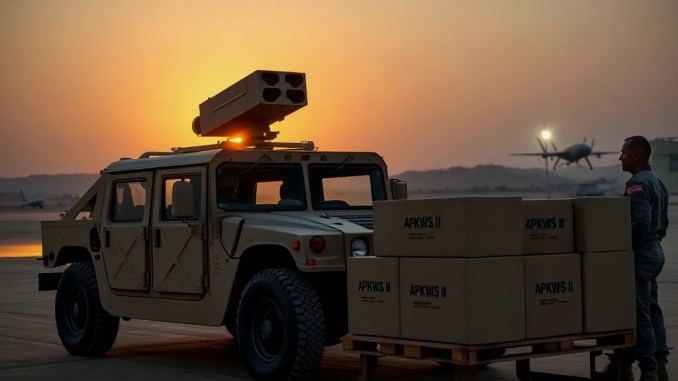
US Approval and Purpose of the Sale
The United States approved a defense package to strengthen Jordan’s air-defense capability, centered on the APKWS II laser-guided rocket system. The package includes laser guidance kits that retrofit 70 mm Hydra rockets into precision munitions, rocket launchers, MK-152 high-explosive warheads, MK66 rocket motors, and proximity fuzes. The sale also covers training munitions, technical documentation, spare parts, and comprehensive logistics and engineering support. The primary goals are to increase deterrence against current and emerging threats and to enhance protection for US forces stationed at bases in Jordan.
What APKWS II Brings: Technical and Tactical Advantages
APKWS II converts existing unguided rockets into low-cost precision weapons using an insertable, fin-equipped laser guidance kit. Placed between the engine and warhead, the guidance section uses semi-active laser homing to steer the warhead toward laser-designated points on small, moving, or fleeting targets. Key advantages include:
Cost-efficiency: Each guided 70 mm round costs a fraction of guided missiles, enabling more engagements per budget.
Platform flexibility: APKWS II integrates with air-to-ground, air-to-air and surface-fired launcher configurations, allowing rotary- and fixed-wing aircraft and some ground launchers to employ precision 70 mm effects.
Precision against small targets: The system achieves sufficient accuracy to neutralize small unmanned aerial systems (UAS), light vehicles, and selected personnel or material targets while reducing collateral damage.
How Proximity Fuzes Change Engagement Outcomes
Proximity fuzes (approach fuzes) detonate the warhead when the munition passes near the target instead of requiring a direct hit. For small, agile, high-speed threats—such as kamikaze or loitering munitions—the ability to detonate within meters of the target increases kill probability dramatically. Operational effects include:
Expanded effective kill zone: A single proximity-detonated warhead can disable or destroy a drone without perfect trajectory alignment.
Reduced need for multiple interceptors: Each round has a higher single-shot effectiveness, lowering the number of rounds required per engagement.
Training, Sustainment, and Logistics Included
The package’s logistical and training components are designed to deliver ready-to-use capability quickly and sustainably. That includes live and training rounds, detailed technical manuals, spare parts kits, and engineering assistance during initial fielding. Practical steps in initial deployment typically follow this sequence:
1. Arrival and inventory of hardware and spares.
2. Technical workshops for maintenance teams on rocket engine care, fuze handling, and launcher integration.
3. Flight- and ground-based familiarization sorties to validate weapon/aircraft/interface behavior.
4. Live-fire qualification events that establish local rules of engagement and employment tactics.
Operational Use Cases and Examples
APKWS II is especially suited to the contemporary threat environment where small, inexpensive UAS pose asymmetric risks. Example scenarios where the system delivers value:
Counter-drone perimeter defense: Rotary-wing aircraft or forward firing ground launchers engage inbound small drones detected near installations, using a minimal number of guided rockets to neutralize each threat.
Dispersed force protection: Units with limited air-defense assets can use APKWS-equipped aircraft to patrol and quickly defeat small aerial threats or lightly armored ground targets that would otherwise require more expensive missiles.
Urban-locale precision strike: High-accuracy warheads with proximity fuzes allow disabling drones or small vehicles with a lower blast footprint than larger guided air-to-ground missiles, reducing collateral effects in populated areas.
Counter-UAS Tactics: How Forces Would Employ the Kit
Effective employment combines detection, designation, and rapid launch—with APKWS II providing the terminal precision. A typical engagement flow:
1. Detect and track: Ground radar or electro-optical sensors classify and track the UAS.
2. Designate: A laser designator—mounted on a manned aircraft, unmanned aircraft, or ground team—paints the target to provide the APKWS seeker a reference.
3. Intercept launch: A launcher or aircraft fires guided rockets, which home to the laser spot; Proximity fuzes ensure detonation near fast-moving, small-profile targets.
4. Battle damage assessment and re-engage as needed: Sensors confirm kill or damage; follow-on rounds are fired if residual threats remain.
Regional and Strategic Implications
Beyond immediate tactical utility, the sale supports broader regional deterrence and interoperability goals. Upgrading Jordanian air-defense layers helps stabilize local deterrence postures, enables combined exercises with US forces, and demonstrates the viability of affordable precision upgrades across partner inventories. By equipping a partner with low-cost, scalable precision, the US increases allied capacity without introducing high-end, sensitive missile technologies.
Limitations and Considerations
APKWS II and associated munitions fill a specific niche but are not a universal solution. They perform poorly against heavily armored targets or against threats that cannot be reliably laser-designated (eg, in heavy smoke or obscurants). Commanders must integrate APKWS into a layered air-defense architecture that includes sensors, hard-kill missile systems for larger threats, and electronic-warfare measures where applicable.
Key Takeaways for Operators and Planners
APKWS II offers a cost-effective, flexible precision option for countering small aerial threats and supporting force-protection missions. Combined with proximity fuzes, it raises single-shot effectiveness against kamikaze and loitering munitions, and its inclusion in a logistics-backed foreign military sale ensures rapid, maintainable fielding. Planners should focus on sensor-to-shooter timelines, reliable laser designation training, and integration with existing command-and-control to maximize the system’s value in real operations.









Be the first to comment