
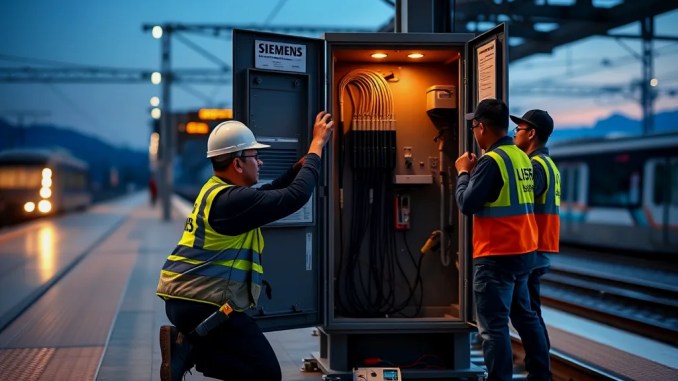
Siemens wins signaling contracts for Taoyuan Metro extensions
Siemens secured turnkey signaling contracts for two Taoyuan Metro extension projects awarded by ST Engineering’s Urban Solutions unit. The scope covers roughly 11 kilometers of new track: the Brown Line extension and the Green Line branch reaching Zhongli (A23). The Brown Line will include eight stations across underground and elevated alignments, while the Green Line extension will connect a major multilevel transport hub. Siemens will deploy its Signaling X platform and full GoA4 automatic train operation with an Automatic Train Supervision (ATS) layer to deliver fully automated, driverless service and modern digital signaling.
What Signaling This enables operators to run applications on commercial off-the-shelf (COTS) hardware rather than proprietary boxes. The immediate operational benefits include reduced vendor lock-in, faster feature roll-outs, and simplified lifecycle management. For Taoyuan Metro, that means phased upgrades without wholesale trackside replacement and easier scaling as ridership grows or new lines connect.
How GoA4 automatic train operation will work in practice
GoA4 delivers unattended train operation with centralized supervision. In Taoyuan, Siemens will integrate:
Automated train protection (ATP): enforces movement authorities and speed profiles in real time.
Automatic Train Control (ATC) and ATS: manage timetables, headways, and platform dwell times to keep service regular.
Condition-based maintenance data feeds: allow predictive interventions on rolling stock and trackside equipment, lowering unexpected outages.
Operational example: during peak hours, ATS will tighten headways dynamically from nominal spacing to optimized spacing using real-time dwell-time prediction, increasing peak throughput without adding trains.
DS3 safety platform: meeting SIL4 and redundancy needs
Signaling X incorporates DS3 (Distributed Smart Safety System) to host safety-critical functions with high availability. DS3 uses redundant processing lanes, independent watchdogs, and cross-check protocols to achieve CENELEC SIL4-level integrity where required. For Taoyuan, DS3 will protect interlocking, movement authority issue, and critical axle/counting functions. The practical effect: if a processing node fails, the voting and redundancy logic maintain safe operation while maintenance crews replace the faulty element with minimal service disruption.
Migration strategy: moving from hardware-centric to virtualized signaling
Siemens proposes staged migration to minimize operational risk:
1) Interface harmonization: map existing train control and wayside interfaces and implement gateway adapters that translate legacy protocols to Signaling X services.
2) Parallel validation: run Signaling
This approach reduces one-time outage risk, spreads commissioning costs, and creates learning cycles for staff and maintainers.
Maintenance and lifecycle benefits that reduce total cost of ownership
By using COTS hardware and virtualization, maintenance becomes software-driven. Benefits include standardized spare pools, remote patching, and containerized service updates. For an operator like Taoyuan Metro, expected advantages are:
Lower spare-part diversity: common server platforms reduce parts inventory.
Faster corrective maintenance: hot-swappable COTS nodes cut mean time to repair.
Continuous delivery: software updates enable incremental feature improvements and security hotfixes without lengthy hardware replacement.
Examples and data points to set expectations
Real-world rollouts of software-defined signaling show measurable gains:
Example 1 — Reduced commissioning time: modular software deployments shortened subsystem verification from months to weeks on comparable projects.
Example 2 — Spare-part cost reductions: operators reporting 20–40% lower inventory costs after standardizing on COTS compute platforms.
Example 3 — Availability improvements: redundant safety platforms with predictive maintenance saw operational availability rise by several percentage points, translating into fewer services cancellations.
Key technical and operational risks—and mitigations
Adopting Signaling X requires addressing cyber, integration, and organizational risks. Recommended mitigations:
Cybersecurity: apply zero-trust segmentation between critical and non-critical domains, encrypt key interfaces, and run continuous intrusion detection.
Integration complexity: use phased gateways and end-to-end testing with shadow deployments to verify timing and interlocking behavior.
Workforce readiness: train maintainers on virtualized operations and automated diagnostics to reduce human error during fault resolution.
What passengers will notice: service-level improvements
Passengers will experience more consistent headways, shorter average wait times during peaks, and fewer sudden cancellations thanks to redundant safety logic and predictive maintenance. The Green Line link to the multilevel transport hub will improve multimodal connectivity and reduce transfer times for commuters and airport-bound travelers.
How Taoyuan can measure success after go-live
Define a compact set of KPIs to track early success: on-time performance, mean time to repair (MTTR) for signal faults, headway adherence during peak windows, and passenger-reported satisfaction. Tie incentive milestones in contractor agreements to these KPIs to align delivery focus on measurable outcomes.
Why Signaling X is a strategic choice for future expansion
Signaling That flexibility makes future line additions, interchanges, and fleet growth easier and less costly to implement.
Summary: What Taoyuan gains
Taoyuan Metro gains a modern, upgradeable signaling backbone: GoA4 driverless operation, SIL4-capable DS3 safety, and software-defined architecture that reduces vendor lock-in and lifecycle cost. The staged migration plan preserves current operations while delivering measurable availability, maintenance, and passenger-service improvements.








Be the first to comment