
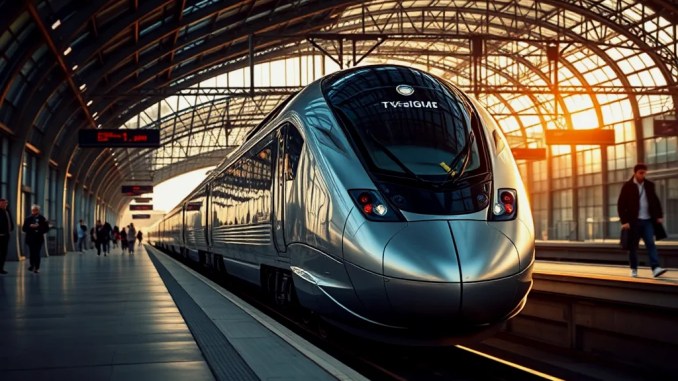
Avelia Horizon enters commercial service as a new high-speed benchmark
Alstom launched the TGV M into commercial operation in France on the Avelia Horizon platform. SNCF began passenger services on the new model, marking the first commercial deployment built on Alstom’s Avelia Horizon very-high-speed architecture. The program draws on 45 years of TGV engineering and operational lessons to deliver a train designed to increase capacity, reduce energy per passenger-kilometer, and lower life-cycle coach maintenance costs.
How Avelia Horizon increases capacity without changing train footprint
Avelia Horizon achieves higher capacity through shorter traction modules and reconfigured carbody layouts that free up space for an additional passenger within the same overall train length. That redesign yields up to a 20% increase in seating compared with the previous generation while preserving passenger comfort — the platform can accommodate up to 740 passengers in high-density configurations. Practical examples include converting space previously taken by large underfloor systems into additional seating or accessible circulation, and redistributing HVAC and auxiliary equipment into compact modular units beneath the shorter power cars.
Why energy consumption falls by up to 20% and what that means per passenger
Alstom reduced energy use through three combined factors: improved aerodynamics, lighter structures, and more efficient traction systems. Together these changes cut train-level energy consumption roughly 20% versus the last generation. When capacity gains are included, energy per passenger-kilometer can fall about 32%, meaning each seat consumes materially less energy over a typical intercity journey. For operators, this translates to lower traction energy bills and reduced carbon intensity per transported passenger — a concrete metric for sustainability planning and timetable optimization.
Which maintenance innovations cut life-cycle costs by over 30%
The platform applies predictive maintenance, component count rationalization, and design-for-access to reduce scheduled downtime and simplify repairs. Predictive monitoring uses sensors and analytics to move from calendar-based checks to condition-based interventions, reducing unnecessary part replacements. Fewer distinct components and standardized modular assemblies lower spare-part complexity and inventory cost. Design-for-access places common wear items behind service hatches and along a technician’s logical workflow, speeding routine servicing. Alstom estimates combined effects exceed a 30% cut in maintenance costs compared with the previous generation.
What the 400+ patented innovations deliver in practice
More than 400 innovations underpin the Avelia Horizon platform; key examples show practical operator benefits:
Modular traction pods: Shorter, swappable power modules simplify fleet scaling and reduce vehicle weight.
Integrated digital architecture: A scalable software backbone enables over-the-air feature upgrades, consistent diagnostics across fleets, and integration of passenger services like real-time seat maps or dynamic information systems.
Advanced aerodynamics: Refined nose sections, optimized inter-car gaps, and underfloor fairings reduce drag at high speed, improve stability and energy use on open lines.
How Alstom’s 45-year TGV heritage informs the new design
Alstom incorporated operational lessons from more than 2,200 vehicles across 25 countries and over 10 billion kilometers. That empirical foundation guided decisions on axle configurations, door placements, passenger flows in stations, cross-border signaling compatibility, and long-term maintainability. For example, interior arrangements reflect boarding and alighting data from busy hub stations, placing doors and vestibules to minimize dwell time and maintain tight schedules on congested corridors.
Adaptability: tailoring Avelia Horizon for international markets
The platform’s modular, scalable architecture enables technical and regulatory adaptation without full redesign. Operators can customize coach count, interior layout, and service equipment to match gauge, platform height, power supply, loading gauge, and accessibility regulations. Because the platform supports double-deck configurations while keeping standard train width and length, it offers a practical capacity boost in regions where infrastructure expansion would be costly or constrained by station geometry.
Operational examples and deployment potential
Early SNCF services demonstrate how the platform serves domestic high-density corridors and cross-border links. Operators planning to relieve congested corridors can deploy Horizon trains to increase daily capacity avoiding using existing platforms and signaling, expensive civil works. For international operators, the platform eases interoperability challenges: modular power units and configurable onboard systems streamline certification across multiple national safety regimes.
Step-by-step considerations for operators evaluating Avelia Horizon
1. Define capacity targets and service patterns (regional express vs. long-distance high-speed). 2. Map infrastructure constraints: platform lengths, power systems, and route speed profiles. 3. Select modular configuration: number of coaches, single- or double-deck balance, seating classes, and accessibility features. 4. Plan predictive maintenance rollout with digital diagnostics and spare-part rationalization. 5. Model lifecycle costs including energy, maintenance, and potential ridership gains from higher capacity. 6. Conduct staged certification and test runs to validate interoperability on cross-border corridors.
What operators gain beyond seats and savings
Beyond higher capacity and lower per-seat energy, Avelia Horizon delivers faster fleet modernization cycles through software-enabled feature upgrades, improved passenger amenities that can increase ridership conversion, and a reduced operational carbon footprint per passenger-kilometer. Those benefits support network planners seeking modal shift from air or road to rail in dense corridors, with a measurable impact on station throughput and timetable robustness.
Summary: who benefits and why Avelia Horizon matters
Passenger operators that need to increase capacity without altering platform geometry, networks aiming to cut energy and maintenance costs, and cross-border services that require configurable, certifiable fleets all gain from Avelia Horizon. The platform turns decades of TGV operational knowledge into a modular, energy-efficient, and maintainable package that addresses contemporary demand challenges on busy rail corridors.






Be the first to comment