
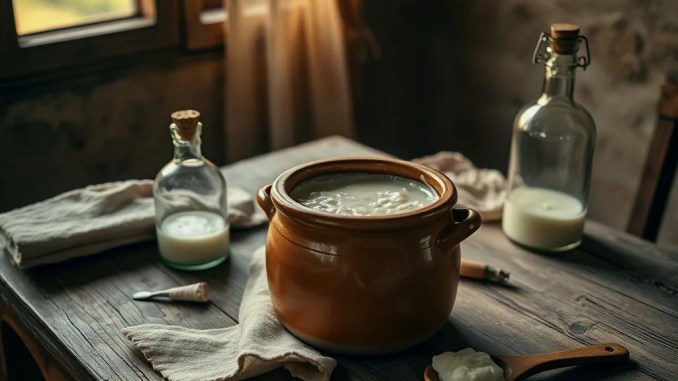
The Karachay people guarded kefir grains for generations as a living heritage. In the early 1900s a diplomatic incident and a bargaining demand — ten pounds of live kefir culture — transferred that heritage out of the Caucasus, setting the stage for industrial kefir production in Russia.
Kefir’s origin and why Karachay communities protected the grains
The Karachay of the North Caucasus considered kefir grains sacred because the culture produced a stable, nutrient-dense fermented milk that reliably preserved milk in mountainous. conditions. They stored and passed grains household-to-household using precise feeding routines and seasonal care: fresh milk replacement every 12–24 hours, cool storage when ambient temperatures rose, and division of excess grains only to trusted kin. That stewardship created microbial communities adapted to local milk, climate and practices — a biological patrimony the community equated with identity, health and survival.
Why outsiders wanted the grains: 1900s medical and commercial interest
By the turn of the 20th century, physicians and agriculturalists in Russia had recorded anecdotal links between kefir consumption and lower incidences of gastrointestinal disease and respiratory complaints. Russian medical societies began to trial kefir in clinic settings, seeking a practical, dietary adjunct for tuberculosis and convalescence. Industrial actors recognized two commercial opportunities: a shelf-stable cultured beverage and a therapeutic product for hospitals. Those converging interests drove targeted efforts to acquire authentic kefir cultures from the Caucasus.
The Irina Saharova episode: mission, kidnapping and legal leverage
Milkman Blandov of Russia dispatched a young assistant, Irina Saharova, to the Karachay region specifically to obtain genuine kefir grains. She met with Beka Mirza Bayçorov, a prominent Karachay bey who refused to hand over the culture. As she prepared to return empty-handed, local tensions escalated and she was detained by men loyal to the bey — an act that transformed a private negotiation into a diplomatic incident. Russian authorities intervened, freeing Saharova and initiating legal proceedings against Baychorov. Facing prosecution and potential exile, the bey sought a way to settle the case without enduring the harshest penalties.
The bargaining chip: requesting 10 pounds of live kefir culture
Instead of accepting money or land as compensation, Saharova insisted on a single, non-monetary demand: the transfer of ten pounds (about 4.5 kilograms) of live kefir grains. That demand served multiple purposes: it guaranteed Blandov and his patrons access to an authentic microbial inoculum; it resolved the diplomatic standoff without a large cash settlement; and it allowed Russian scientists and producers to begin propagation under controlled conditions. The bey conceded and delivered the culture, which then traveled to laboratories and apartments in St. Petersburg and Moscow.
How the transferred grains were adapted and scaled for industry
Industrializing a household culture required deliberate steps to preserve viability and to scale production. Practitioners in Russian dairy followed a sequence: (1) acclimatize the grains in filtered, pasteurized milk to remove competing wild microbes; (2) establish sterile passaging schedules to maintain microbial balance; (3) document temperature and incubation times — typically 18–24°C for long fermentations or 20–25°C for short batches depending on desired acidity; (4) progressively increase batch size using back-slopping methods while monitoring sensory and acidity markers; (5) transition to starter production where preserved, concentrated inocula seeded large vats. These steps converted fragile, household-kept grains into reproducible starters fit for factory workflows.
1908 and the emergence of commercial kefir in Russia
Historical records indicate that by 1908 organized production began in major Russian cities. Factories standardized milk treatment, fermentation times and packaging; they also supplied hospitals with kefir as part of dietary regimens. The availability of a stable starter culture derived from the Karachay grains allowed manufacturers to reproduce flavor and texture at scale, accelerating consumer adoption and associating kefir with Russian dietary practice despite its Caucasian roots.
Cultural and microbiological consequences of removing heritage cultures
Removing the Karachay grains extinguished a portion of locally adapted microbial diversity from its original context. When cultures move, selective pressures change — milk source, ambient microbes, and handling protocols differ — and that shifts the microbial composition over subsequent passages. Culturally, the transfer reallocated a community resource into commercial and scientific spheres, raising questions about ownership of traditional foods and the ethics of biocultural appropriation. On the other hand, wider production spread kefir’s health and nutritional benefits to populations who otherwise would not have had access.
How this episode answers common questions people ask
Was kefir invented in Russia? No — traditional kefir originated among peoples of the North Caucasus, including the Karachay and other Turkic groups. The story of Saharova and the ten pounds explains how an authentic inoculum left the region and facilitated Russian industrial production.
Could the original Karachay grains still exist? Possibly, but original household lineages often disappear through social disruption, migration, or assimilation into commercial starters. Some contemporary researchers have sought traditional grains in remote families and found unique microbial signatures consistent with long-term local stewardship.
Is modern kefir the same as the traditional product? Not exactly. Modern production prioritizes reproducibility, safety and shelf life, so microbial diversity and flavor nuance can differ from small-scale, locally managed fermentations.
Practical steps for anyone seeking authentic kefir grains today
1) Source from trusted producers who culture grains rather than rely on freeze-dried starters. 2) Request provenance information — origin region and maintenance practices — to evaluate how closely the grains follow traditional care. 3) When adopting a culture, replicate traditional feeding rhythms: frequent milk refreshment, avoid overheating, and avoid metal contact where possible to preserve grain structure. 4) If your goal is microbiological study, collaborate with accredited labs that can sequence community composition and compare it to published datasets from Caucasian isolates.
Why the 10-pound demand matters historically and scientifically
The demand distilled the stakes in one concrete act: transfer of a living culture that embodied centuries of adaptive knowledge. Historically it marks the point where kefir began to leave its insular, clan-based custodianship and enter institutional production. Scientifically it created a lineage that researchers could propagate, analyze and standardize — shaping the kefir we encounter today. The episode thus sits at the crossroads of culture, commerce and microbiology.
Understanding this incident clarifies why kefir’s modern identity ties both to the Karachay cultural landscape and to Russian-scale production — a dual legacy encoded in ten pounds of living grains.






Be the first to comment