
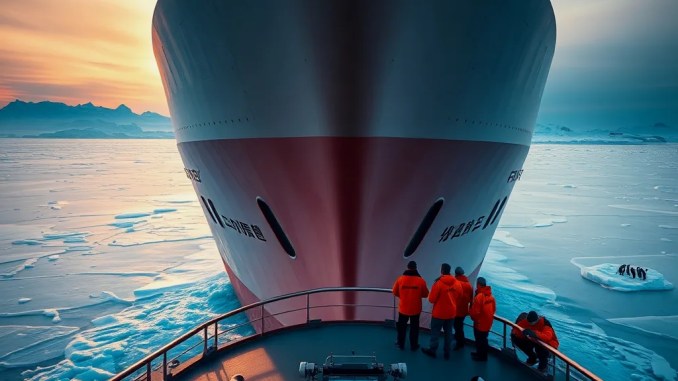
China sets sail for a six-month Antarctic research campaign
Two icebreakers, Xuelong and Xuelong-2, departed Sanya Port on Hainan Island to begin China’s 43rd Antarctic expedition. The mission will run through April 2027 and focuses on scientific fieldwork, logistics upgrades and multinational cooperation. The fleet’s departure initiated a tightly scheduled program of research voyages, equipment trials and base maintenance that will operate across multiple Antarctic regions.
Who is on the expedition and which institutions participate
More than 600 researchers and operational staff from over 100 Chinese institutions will join the voyage. Participants include marine scientists, glaciologists, atmospheric researchers, engineers, logistics coordinators and technicians. Teams were assembled to cover laboratory analysis at sea, field sampling onshore, instrument deployment and station refurbishment tasks. Each ship hosts specialized laboratories and containers for cold-environment experiments, enabling continuous data collection while en route.
Primary objectives: science, infrastructure and technology testing
The expedition concentrates on three interlinked objectives: (1) sustain and upgrade China’s Antarctic research infrastructure, (2) carry out multidisciplinary scientific studies, and (3) test and validate domestically developed polar technologies under operational conditions. Planned projects include long-term ice-core sampling plans, marine biodiversity surveys using remotely operated vehicles (ROVs), atmospheric composition monitoring for greenhouse gas baselines, and geophysical surveys to map sub-ice topography.
Where China’s Antarctic bases are and how they will be serviced
China operates three year-round research stations and several seasonal inland camps. Key sites and their roles are:
China Station (Fildes Peninsula): logistics hub for the western peninsula, supports coastal biology and glaciology teams.
Sun Yat-sen Station (near Prydz Bay): primary base for East Antarctic coastal oceanography and sea-ice studies.
Zhongshan Station (Ross Sea region): supports marine ecosystem research and southern logistics operations.
Seasonal inland field stations such as Kunlun and Taishan open during the austral summer for high-altitude ice-core drilling and inland geophysics. The current expedition will deliver personnel rotation, resupply scientific consumables, upgrade station infrastructure and install new observational platforms.
Notable scientific tasks and sample methodologies
Field teams will follow step-by-step protocols to ensure reproducible, high-quality results. Examples:
Ice-core programs — Establish drill sites, extract cores in continuous sections, log stratigraphy and temperature on retrieval, seal and transport cores in insulated containers to cold storage facilities for isotope and gas analysis.
Marine biodiversity surveys — Deploy ROV transects at predetermined depth intervals, record video and environmental metadata, collect voucher specimens with minimal habitat disturbance, and return samples to shipboard wet labs for genetic and morphological analyses.
Atmospheric monitoring — Calibrate in-situ sensors before deployment, operate continuous greenhouse gas analyzers aboard ship and at fixed stations, compare shipboard and station baselines to identify local versus transported signals.
How China will test polar technologies during the voyage
Domestic equipment slated for field validation includes cold-hardened communications gear, autonomous surface and underwater vehicles, and power systems optimized for polar microgrids. Engineers will run acceptance trials: pre-deployment bench tests, constrained short-duration deployments to assess failure modes, and extended operational runs to measure endurance and maintenance needs. Real-time telemetry from prototypes will feed shipboard diagnostic teams who will iterate firmware and mechanical adjustments at sea.
International cooperation and knowledge exchange
The expedition includes joint research planning with bilateral and multilateral partners, data-sharing commitments for agreed projects, and invitations for international scientists to participate in selected field campaigns. Collaborative efforts aim to align observational protocols, so datasets integrate with global networks (for example, the Global Ocean Observing System and Antarctic atmospheric monitoring networks), improving comparative analyzes across nations.
Logistics, timeline and expected outputs
The mission timeline spans mobilization, transit to target areas, concentrated field campaigns, station work, and return transit. Expected outputs by the expedition’s end include:
Scientific outputs: peer-review manuscripts on oceanographic and cryospheric findings, open-access datasets (eg, CTD casts, ice-core chronologies), and baseline environmental indicators for long-term monitoring.
Operational outputs: refurbished station modules, installed or upgraded observational sensors, validated prototype systems and updated logistics plans that reduce turnaround times for future campaigns.
Environmental safeguards and operational constraints
All activities will follow Antarctic Treaty System rules and environmental impact protocols to minimize disturbance. Teams will implement waste management plans, wildlife avoidance procedures and emergency response drills tailored to polar conditions. Operational constraints include sea-ice variability, extreme weather windows, and limited daylight in some regions—factors that the mission schedule buffers with contingency periods.
What success looks like and how the results will be used
Success will be measured by delivered infrastructure improvements, validated technologies that reduce future mission risk, and high-quality scientific outputs that feed climate models and conservation planning. Shared datasets and publications will inform international assessments of Antarctic change, support marine protection discussions and guide subsequent research expedition planning.
How to follow expedition results and releases
Progress reports, selected data releases and scientific highlights are typically published through official research institute channels and international data repositories. Expect milestone briefings when major field campaigns conclude and peer-reviewed papers in the year following the expedition as laboratory analyzes and data synthesis complete.






Be the first to comment