
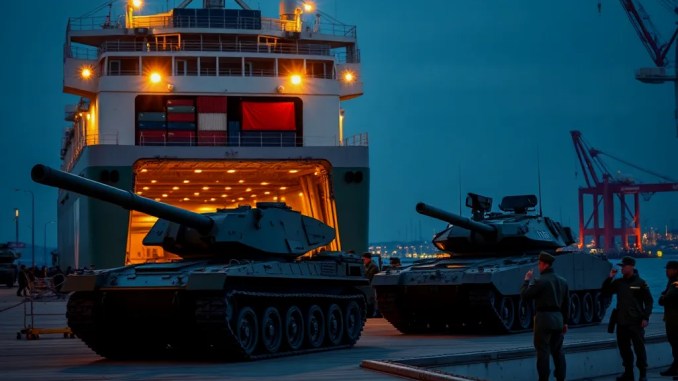
Poland Receives Final Batch of K9 Thunder Howitzers and K2 Black Panther Tanks in 2026
Poland completed delivery acceptance in 2026 for dozens of K9 Thunder self-propelled howitzers and K2 Black Panther main battle tanks supplied by South Korea. Unloading and handover operations took place at Polish ports and logistics hubs; Technical acceptance and functional checks concluded before units moved to forward storage and staging areas. Ministry and procurement authorities reported that within days the systems will join units stationed on Poland’s eastern flank.
Where these systems will be deployed and why it matters
The 16th Mechanized Division, based in northeastern Poland near the Suwałki Gap and the border with Kaliningrad Oblast, will receive many of the new platforms. That sector forms a narrow land corridor linking Poland to the Baltic states and is considered strategically sensitive. Adding modern K9 howitzers and K2 tanks increases local deterrence and enables faster, more lethal responses to cross-border threats. Operational planners highlighted improved combined-arms synergy: K2s provide protected direct fire and maneuver, while K9s deliver long-range, high-volume indirect fires that can shift positions rapidly after shooting.
Contract details and procurement timeline
Poland’s procurement program consists of two key contracts with South Korean industry partners: a December 1, 2023 contract for K9 howitzers and an August 1, 2025 contract for K2 tanks The K9 contract, valued at roughly $2.6 billion, covers 152 tracked 155 mm K9 Thunder howitzers. The K2 program, valued at approximately $6.5 billion, covers 180 tanks in several build batches with a K2PL variant tailored to Polish requirements.
How the K9 Thunder increases artillery effectiveness
The K9 combines a 155 mm, long-range cannon with a high level of shoot-and-scoot mobility. Key operational advantages include rapid hull-to-hull firing sequences, automated loading systems that sustain high rates of fire, and a chassis engineered for cross-country mobility. Practical benefits observed during trials include: improved circular error probable (CEP) at extended ranges when matched with modern artillery ammunition; lower logistics footprint per delivered round due to integrated ammunition handling; and faster displacement after firing, reducing counter-battery vulnerability. Field crews reported typical procedures: prepare fire mission from tactical net, receive fire control solution, execute a rapid salvo, and withdraw within minutes to prepared rally points.
Poland’s plan to localize K2 production and technology transfer
Poland’s K2 agreement includes industrial cooperation beyond finished-vehicle deliveries. Of the K2PL-configured tanks, 61 units will undergo final assembly at Poland’s Bumar-Łabędy facilities. The program aims to transfer manufacturing know-how, establish supply-chain nodes in Polish defense industry, and create maintenance and upgrade capabilities domestically. This staged approach (initial imports, followed by local assembly, then deeper manufacturing integration) reduces dependence on foreign repair lines and shortens turnaround for depot-level maintenance.
Force structure impact and numerical context
Under the broader modernization framework signed since 2022, Poland plans to field up to 1,000 K2 tanks, 672 K9 howitzers, and 288 Chunmoo multiple rocket launcher systems. If fully realized, these acquisitions would reshape Poland’s armored and long-range fires posture, replacing many Soviet-era platforms in Polish inventories and standardizing systems with NATO-caliber logistics. Example outcome at brigade level: a mechanized brigade augmented with K2s gains higher direct-fire punch and better protection, while artillery battalions equipped with K9s extend brigade suppression zones and high-angle fires beyond previous ranges.
Operational considerations: deployment, sustainment, and training
Deploying modern armored and artillery systems requires synchronized logistics, maintenance, and training crew. Poland has taken a multi-track approach: 1) Forward-deploy initial units to eastern garrisons to build deterrent presence; 2) Establish local assembly and sustainment depots for K2PL units to shorten repair cycles; 3) Conduct integrated live-fire training focusing on combined-arms coordination, counter-battery drills, and remote logistics resupply. Practical examples include rotating artillery battery live-fires with aerial reconnaissance assets to refine sensor-to-shooter times and joint tank-artillery exercises that practice suppression-then-maneuver sequences.
How this procurement affects regional security and NATO interoperability
Introducing South Korean-designed K2 and K9 platforms enhances Poland’s interoperability with NATO through common 155 mm ammunition standards, digital fire-control interfaces, and compatibility with NATO communications protocols when integrated. Regionally, the buildup increases conventional deterrence in the Baltic theater. Allies can more easily plan coalition-level logistics and exercises because the K9’s ammunition and the K2’s command systems fit allied patterns; Poland’s investment in local production further strengthens collective sustainment options during protracted operations.
Risks, mitigation, and next steps for Poland
Risks include supply-chain bottlenecks for specialized components, technician training gaps, and the time needed to scale Polish production lines. Poland plans mitigations: phased deliveries to smooth training curves, dedicated maintenance training courses with South Korean partners, and investment in domestic suppliers for subsystems. Next steps involve completing final acceptance of the delivered vehicles, integrating them into battalion organizational charts, and running combined live-fire and maneuver exercises to achieve operational readiness in the coming months.






Be the first to comment