
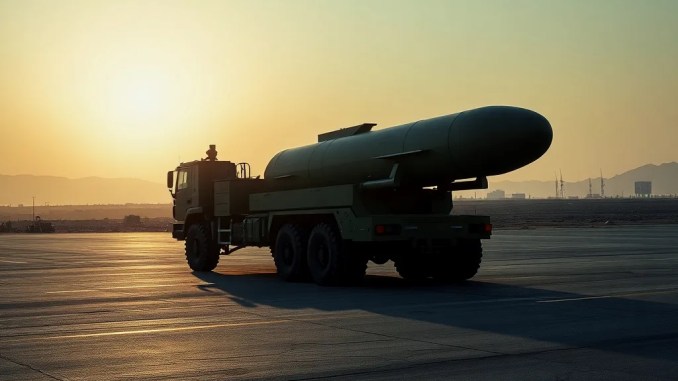
IRGC Announces End of 2,000 km Voluntary Range Limit
The Islamic Revolutionary Guard Corps (IRGC) publicly declared that the voluntary 2,000-kilometer restriction on its ballistic missile operations is no longer in effect. IRGC spokesperson Brig. Gene. Hossein Mohebbi stated this change in Tehran and said the corps will demonstrate its capabilities through operational use rather than policy statements. The announcement did not confirm whether Iran already fields operational missiles that exceed 2,000 km; instead it framed the decision as a removal of a self-imposed constraint.
Supreme Leader Signals No Geographic Limits on Retaliation
Supreme Leader Muqtada Khamenei clarified that responses to threats from the United States or Israel will not be limited by geography. He emphasized that threats of any scale should not go unanswered and called for an end to the “neither war nor peace” status with the US. This political direction supplies the strategic rationale behind the IRGC’s policy shift and signals willingness to respond beyond previous geographic taboos.
Which Countries Were Already in Range at 2,000 km?
A 2,000 km range from central Iranian launch sites already covers a wide swath of territory. From those launch points, missiles can reach the entire Arabian Peninsula, most Eastern Mediterranean countries, large portions of Egypt, and parts of southeastern Europe — including areas of Greece, Bulgaria, Romania, Albania, North Macedonia and Serbia. That means Gulf states and many regional actors were already within reach, so the immediate threat profile for those countries does not materially change on paper.
What Changes If Iran Deploys >2,000 km Missiles?
Removing the ceiling voluntary enables Iran to deploy or operate systems that can strike more distant targets, expanding options against targets in deeper Europe, North Africa and possibly US facilities located farther away. If Iran fields or deploys missiles with ranges of roughly 3,000–4,000 km from existing launch belts, that extends reach to much larger parts of southern and central Europe and broad swathes of North Africa. However, publicly available open-source intelligence has not independently verified Iran’s operational deployment of missiles with reliable ranges beyond 2,000 km.
Could US Bases in Europe Become Targets?
Concerns about American facilities in Europe grew after prosecution — disputed by Tehran — that Iran attempted or aided a strike toward Diego Garcia, roughly 4,000 km away. US officials have warned that technologies used in Iran’s space and rocket programs could be repurposed to build intercontinental systems over time. Still, Iran currently has no publicly confirmed intercontinental ballistic missile (ICBM) in its inventory. Short- and medium-range ballistic missiles pose greater near-term risk to regional allies and forward-deployed US infrastructure inside the 2,000 km footprint.
Technical and Operational Hurdles to Extending Range
Range increase requires more than raw political intent. It demands reliable propulsion improvements, guidance accuracy over long distances, warhead re-entry solutions and operational command-and-control adaptations. Iran has demonstrated progressive advances in propulsion and space-launch capability, which are technically relevant to extended-range ballistic development. Even so, weaponizing such advances for operationally reliable systems requires testing, logistics, integration with launch infrastructure, and survivable basing — steps that take time and leave observable signatures.
Strategic Effects on NATO and Regional Posture
Removal of the voluntary limit changes deterrence signaling and forces NATO and regional militaries to reassess risk envelopes. Practical responses can include shifting air and naval assets, hardening key facilities, dispersing or relocating sensitive platforms, and updating missile defense postures. Some measures are routine (temporary relocation, increased patrols); others — such as new interceptors or hardened shelters — take years to implement and significant investment.
Recent Indicators and Examples
Examples that inform assessment:
1) Deployments and Posturing: Intelligence and media reports describe temporary relocations of US aircraft in the UK and additional patrols in NATO airspace following threat alerts — immediate operational mitigations that do not imply permanent vulnerability changes.
2) Technology Overlap: Iran’s space-launch vehicles share propulsive and staging technologies with longer-range missiles. The existence of space-launch capability raises technical plausibility but not automatic operational capability.
3) Diplomatic Signaling: Tehran has issued diplomatic notes and public warnings to countries hosting US assets in Europe (eg, Bulgaria), indicating those installations feature in Iranian strategic calculations — a messaging move meant to raise political cost for partners hosting US forces.
What Will Change on the Ground — Step-by-Step Likely Outcomes
1) Short term (days–weeks): increased intelligence collection, temporary force posture adjustments, and public warnings by affected states.
2) Medium term (weeks–months): NATO and bilateral consultations, possible temporary relocations, and accelerated passive defenses at vulnerable sites.
3) Long term (months–years): investment in missile defenses, dispersal and hardening programs, and potential development of new basing agreements or asset rotations to reduce exposure.
How Analysts Should Evaluate Claims of >2,000 km Operational Missiles
Use layered verification: cross-check satellite imagery for new launch emplacements or missile movements; monitor telemetry and signals intelligence for unique signatures; evaluate open-source photos and footage for design features consistent with longer-range systems; and assess logistical footprints (transporters, fuel infrastructure). Independent corroboration across sources reduces risk of misattribution and false positives.
Implications for Diplomacy and Negotiation
Politically, Iran may use the removal of the voluntary limit as a bargaining chip in future talks, offering to reapply limits in exchange for concessions. Conversely, adversaries might use the announcement to justify accelerated security cooperation and arms posture changes. Either path will shape diplomatic channels, arms-control dialogue and sanctions dynamics depending on verification and reciprocal measures.
Bottom Line
The IRGC’s removal of the 2,000 km voluntary constraint raises strategic uncertainty more than it creates an immediate, verifiable new capability. The announcement expands Iran’s political and operational options, signals readiness to strike farther if necessary, and pressures NATO and regional partners to reassess defenses and posture. Confirming actual longer-range operational missiles requires independent technical verification, and absent that, policy and military responses will focus on preparedness and deterrence rather than acceptance of a newly proven ballistic capability.
Note: This article synthesizes open-source reporting, public statements and common weapons-development indicators to assess likely impacts rather than assert unverified technical capabilities.









Be the first to comment