
Background and why the tender was relaunched
Správa železnic restarted the procurement on 5 November 2026 after canceling the first tender in March 2026. The authority found that original qualification rules excluded capable suppliers, especially foreign manufacturers who deliver similar vehicles under multiple smaller long‑term framework orders rather than single large contracts. The relaunch widens who can apply while keeping technical and ETCS requirements that ensure interoperability.
Who can apply and what changed in qualification rules
The revised notice relaxes several documentary requirements that had blocked otherwise qualified bidders. Key changes:
Reference period extended: from the last 5 years to the last 8 years, enabling older but relevant projects to count.
Contract value aggregation: the previous requirement for two separate contracts each worth at least CZK 200 million is replaced by a single contract of equivalent total value. Ongoing contracts that have completed the relevant section by the qualification deadline now count as references.
ETCS and operational scope: firms must still show at least one contract covering design, supply and installation of an onboard ETCS Level 2 system whose prototype installation gained approval for regular operation under ETCS supervision in the EU/EEA or Switzerland. Other business strength conditions remain: at least CZK 500 million revenue in each of the last three financial years (or equivalent for younger firms) and an ECM certification that covers maintenance of special vehicles and tracked machines.
What technical features the vehicles must have
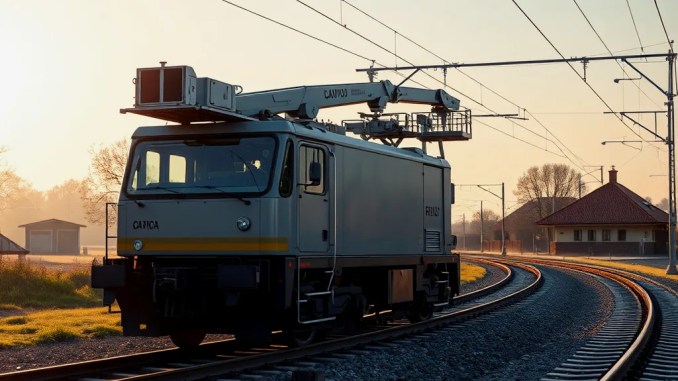
The tender specifies 15 self-propelled catenary maintenance vehicles with the following technical essentials:
Performance and traction: minimum service speed of 100 km/h under their own traction, and an electric power transmission system.
Propulsion and emissions: at least 500 kW total installed power from one or more water-cooled diesel engines meeting EU Stage V emissions.
Working envelope: equipment must enable safe work on contact wires between 4.95 m and 6.30 m above rail level.
Crane and vehicle layout: vehicles remain two-bogie, four-axle units with cranes; the prior 20 ton-meter minimum lifting moment requirement has been removed. Five of the 15 units will carry an additional snow‑throwing machine.
Onboard signaling: ETCS systems must support Baseline 3/Level 2 (referred to in tender as “Basic Version 4 Version 1”); if that exact release cannot be supplied, the bidder may provide Basic Version 3 Release 2 provided EU interoperability compliance is guaranteed. Systems must include the Czech national train protection STM LS module. ETCS software update obligations during the warranty period are included in the vehicle price.
Procurement evaluation and price rules
Evaluation uses the lowest-price criterion on the total price excluding VAT; the lowest offer wins. If bids tie, the earlier submitted bid receives a higher ranking. The tender documents offer no published estimated contract price, but Správa železnic’s spokesperson told Zdopravy.cz on 30 September that the investment is expected to be about CZK 2.5 billion.
Delivery, prototyping and warranty schedule
Contractual deadlines focus on rapid prototyping followed by staged fleet entry:
Prototype readiness: one prototype must be ready for trial operation within 36 months after the contract takes effect.
Prototype in service: with vehicle type authorization or market release, the prototype must enter regular service within 48 months.
Fleet milestones: at least eight vehicles (including the prototype) delivered by month 48 and all 15 vehicles delivered by month 60.
Warranties: vehicles: 48 months; onboard ETCS systems: 24 months. ETCS updates during warranty are included in the price.
Why the tender’s ETCS and qualification specifics matter
Requiring an ETCS Level 2 onboard installation with proof of operational approval narrows bidders to suppliers experienced with live ETCS rollouts and type authorization processes, which reduces later integration risk. Extending the reference window to 8 years and allowing aggregation into a single qualifying contract recognizes the contracting patterns of manufacturers that deliver through framework orders. Together these changes balance competition, interoperability and practical supply‑chain realities.
How this affects the existing Správa železnic fleet and long‑term renewal plans
Správa železnic operated around 85 catenary maintenance vehicles in 2025, many built in the 1980s and 1990s. The new vehicles will phase out the oldest non-ETCS units. In 2024 market research the agency aimed to buy roughly 50 new catenary maintenance vehicles up to 2040, targeting about 10 by 2030 and then four per year from 2031 onwards. That study used a 2025 indicator, VAT‑excluded cost of around CZK 100 million per vehicle; the 2026 procurement documents do not publicly update that figure.
Key dates, application and next steps for bidders
Suppliers must submit qualification requests by 7 December 2026 at 10:00. The contract will fund deliveries through the Czech State Transport Infrastructure Fund (SFDI). Bidders should:
1) compile contract references within the last 8 years, including ongoing contracts if the relevant work section is complete by the qualification deadline;
2) prepare evidence of an ETCS Level 2 (or accepted equivalent) onboard installation with authorization for regular operation in the EU/EEA or Switzerland;
3) ensure financial statements show at least CZK 500 million revenue in each of the last three financial years (or equivalent for newly formed companies);
4) include ECM certification covering maintenance of special vehicles and tracked machines;
5) plan delivery and prototype testing schedules that meet the 36/48/60 month milestones and include ETCS software update and warranty coverage in the price.
What winning suppliers should expect contractually
Expect strict oversight during prototype tests, ETCS integration trials and authorization steps, with contractual acceptance gates tied to authorization milestones. Payment schedules will likely link to prototype readiness, type approval, tranche deliveries and final acceptance. The contracting authority will expect documentation for maintenance, spare parts (initial spare set included), training, and warranty support for both the vehicles and onboard ETCS equipment.
Practical example: how a bidder can structure a compliant reference submission
Step‑by‑step approach:
Step 1: assemble a single contract dossier showing delivery of similar self-propelled maintenance vehicles worth at least CZK 200 million in the last 8 years, or combine related framework deliveries into a single demonstrable total where permitted.
Step 2: provide technical dossiers proving the onboard ETCS Level 2 design, installation and prototype approval for regular operation in the EU/EEA/Switzerland (test certificates, authorization letters, field trial reports).
Step 3: include audited accounts showing CZK 500 million+ revenue in each of the three most recent financial years, or pro‑rated evidence for companies created during that period.
Step 4: supply ECM certificate(s), maintenance plans, initial spare parts list and a draft delivery schedule meeting the contractual milestones.
Step 5: describe ETCS software maintenance and upgrade procedures during warranty and a plan for national STM LS integration and verification tests.
Conclusion — what this tender means for the market
The revised tender opens the field to more suppliers by recognizing longer reference periods and allowing aggregated contract value, while keeping high technical and ETCS standards to protect operational safety and interoperability. Suppliers with proven ETCS deliveries and robust delivery programs stand to compete successfully; smaller manufacturers relying solely on fragmented framework deliveries may still need to demonstrate equivalent consolidated experience to qualify.









Be the first to comment