
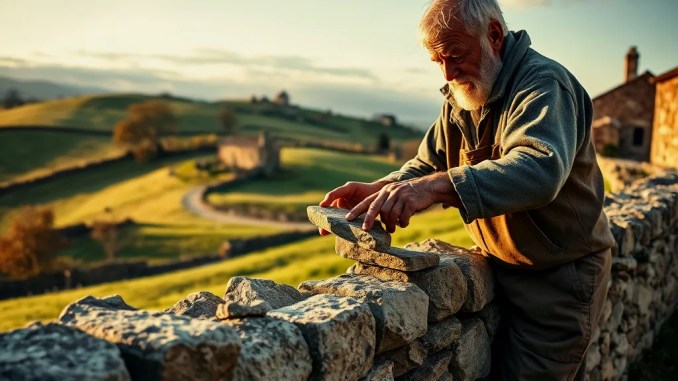
UNESCO Recognition Sparked Renewed Interest in Dry Stone Construction
UNESCO’s 2018 inclusion of dry stone building on the Representative List of the Intangible Cultural Heritage of Humanity raised the technique’s profile across Europe. Conservation programs and local governments started allocating funds specifically for dry stone restoration projects. Examples include restoration grants for dry stone terraces and farm structures in Catalonia and the Balearic Islands, and targeted budgets in Aragon, Murcia, Valencia and Andalusia to repair centuries-old walls and agricultural infrastructure.
How Dry Stone Walls Protect Landscapes and Reduce Risk
Dry stone walls, built without mortar, perform multiple ecological and risk-reduction functions. Their porous structure allows natural drainage, lowering surface runoff that causes erosion and floods. In steep agricultural terraces, properly graded dry stone buttresses dissipate slope energy and reduce landslide likelihood. They also create microclimates: the thermal mass of stone moderates nightly temperature drops, which can reduce frost damage for adjacent crops. Field data from Mediterranean terraced vineyards show measurable improvements in soil moisture retention and reduced topsoil loss where well-maintained dry stone systems remain.
Rising Demand Meets a Critical Skills Shortage
Regional conservation initiatives and rural-tourism development have driven a sharp increase in restoration work, revealing a shortage of trained practitioners. Where restorations require certified mastery to meet heritage standards, project backlogs form and costs rise because only a handful of specialists can guarantee authenticity. Interviews with local heritage offices in Spain report waiting lists for trained masons, with many regions estimating fewer than a dozen master dry stone builders available for large-scale programs.
Training Pathways: How to Develop New Masters Step by Step
Creating a pipeline of skilled dry stone builders requires structured, practical programs. Recommended steps for vocational programs and municipalities:
1. Survey and Documentation: Record existing dry stone assets and identify typical construction patterns and stone types used locally. Detailed drawings and photo records serve as training material.
2. Short Intensive Workshops: Offer 2–4 week hands-on workshops focusing on core techniques: selecting and shaping stones, building stable foundations, creating batter and bonding patterns, and rebuilding coping stones.
3. Apprenticeships: Pair trainees with master builders on real restoration sites for 6–18 months, combining repetitive skill practice with heritage conservation principles.
4. Certification and Micro-Credits: Develop simple certification levels (basic, intermediate, master) recognized by regional heritage bodies; provide micro-grants or wage subsidies to support apprentices.
5. Knowledge Transfer and Innovation: Encourage documentation of variants and incorporation of modern safety practices where appropriate—eg, discreet geogrid reinforcement behind walls for high-risk slopes—without compromising traditional appearance.
Examples of Successful Local Programs
Several European regions combine heritage funding with workforce development. In parts of southern France, NGOs run seasonal training projects that restore trails and terraces while teaching students. In central Spain, a cooperative funded by rural development funds hires apprentices to restore dry stone barns and walls, selling the restored sites as heritage tourism stops. These models show that coupling restoration budgets with training contracts shortens project timelines and reduces unit costs per meter of restored wall.
Practical Considerations for Project Planners
To deliver efficient dry stone restoration projects, planners should:
Assess material availability: Local stone types determine wall geometry and required tooling; transporting stone long distances multiplies costs.
Sequence work by skill level: Assign preparatory tasks (clearing, foundation trenching) to trainees and reserve critical battering, coursing and coping to certified masons.
Document as you build: Maintain incremental photo logs and short technique notes to create reusable training modules and to meet heritage reporting requirements.
Economic and Social Benefits of Investing in Craft Training
Investing in training yields multiple returns: reduced long-term maintenance costs for restored structures, creation of rural employment, and enhanced tourism revenue linked to well-preserved cultural landscapes. Small-scale pilot projects show that each certified apprentice can maintain or restore several hundred meters of walls per year, turning a backlog into steady maintenance cycles rather than one-off emergency fixes.
What Landowners and Communities Can Do Now
Landowners and community groups can act immediately to preserve dry stone heritage. Start by mapping existing dry stone features on properties, applying for small restoration grants that sponsor apprentices, and partnering with local vocational schools to host workshops on-site. Community-led maintenance days under the guidance of a single master mason can keep structures stable while training newcomers.









Be the first to comment