
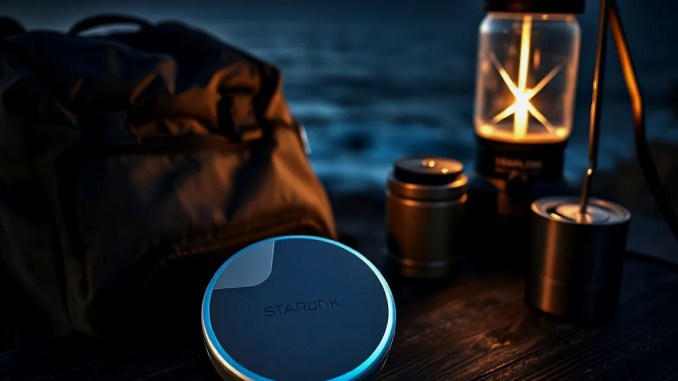
What Starlink Mini 2 is and which innovations it brings
Starlink Mini 2 is a second‑generation portable satellite terminal built to deliver independent, on‑the‑move internet with fewer setup constraints. The most visible upgrade is a removable 71 Wh battery that weighs roughly 490 g and extends untethered runtime to around 4.5 hours under typical mixed‑use loads. The terminal accepts 60 W USB‑C charging, simplifying power logistics by allowing common laptop and phone chargers to replenish the internal battery.
Key specs: durability, connectivity and physical design
The Mini 2 carries an IP67 ingress rating, meaning it resists dust and short submersions or heavy rain, which makes field deployment more dependable. The battery is designed for fast removal and replacement; the unit also provides a standard tripod mount and foldable kickstand for stable placement. Wireless hardware upgrades to Wi‑Fi 6 improve latency and concurrent device handling compared with the original Mini. Early US preorders launched at $999 and include one year of Roam Unlimited (invite required) in the initial offer.
How it performs in real world use: camping, mobile offices and emergencies
On a multi-day camping trip, Mini 2 replaces the need to run a generator or heavy power pack for low-to-medium network loads. Example: with one smartphone streaming audio, a tablet checking maps, and a laptop on video calls modestly, a single 71 Wh battery commonly approaches the advertised ~4.5 hours; Higher bitrate streams or heavy uploading will shorten that. For mobile professionals, the device reduces connection contention during small team video calls thanks to Wi‑Fi 6. In emergency response, IP67 protection plus a hot‑swappable battery supports rapid setup in poor weather and the ability to rotate charged batteries between teams without relying on fixed infrastructure.
Step‑by‑step battery management and swapping procedure
Follow these steps for safe, efficient battery use:
1) Power down and remove: Turn the terminal off, open the battery bay, slide the battery out using the indexed latch and lock it for transport.
2) Charge: Use a 60 W USB-C PD charger. Charge times vary by charger capability and battery state; a full recharge typically takes longer with lower‑power adapters.
3) Rotate for long deployments: Plan 2–3 battery cycles for full-day fieldwork; keep one battery in the device, one charging, and one cool‑stored as reserve.
4) Monitor thermals and safety: If the unit detects excessive temperature it will throttle charging/discharging. Allow batteries to cool to ambient before re‑installing.
Performance comparison: Mini vs Mini 2
Direct differences that affect choice and planning:
• Power: Original Mini required external power; Mini 2 includes a 71 Wh removable battery (~490 g).
• Runtime: Original depended on external supply; Mini 2 typically delivers ~4.5 hours on one battery for light‑to‑moderate use.
• Wi‑Fi: Mini used Wi‑Fi 5; Mini 2 upgrades to Wi‑Fi 6 for better multi‑device performance and lower latency.
• Durability: Mini had weather resistance; Mini 2 raises that to IP67 for improved field reliability.
Buying, preorder details and practical limits
Initial US preorders listed at $999 included Roam Unlimited for one year under the introductory package. Availability, pricing and roaming terms will vary by country and regulatory approvals. Consider recurring roaming fees, regional certification restrictions, and additional battery costs when budgeting. Battery lifespan will also decline with cycle count; plan reserve replacement batteries for long‑term, heavy use.
Who should choose Mini 2
Mini 2 fits users who need internet where grid power is limited or non‑existent: outdoor enthusiasts, RV and camper owners, field engineers, emergency teams and reporters. If you primarily need a stationary residential connection and cost efficiency, fixed Starlink terminals typically offer better long‑term value and continuous uptime.
Practical setup tips to maximize connectivity and battery life
1) Pick an open site: Place the antenna where the sky view is unobstructed by trees or buildings; Even small obstructions raise latency and packet loss.
2) Use a tripod: A few feet of elevation clears low obstacles and reduces multipath interference; use the built‑in tripod mount.
3) Rotate batteries proactively: Schedule battery swaps during low-traffic periods and store spares at ambient temperatures.
4) Keep firmware current: Allow occasional cloud access for updates—these improve stability and may add power‑management improvements.
Common questions answered concisely
How long does one battery last? Expect up to ~4.5 hours for mixed light‑use scenarios; heavy streaming or large uploads shorten runtime.
Can you hot‑swap the battery while the device serves users? Best practice is to power down before swapping. Some manufacturers provide supervised hot‑swap workflows—follow the official manual if attempting any live exchange.
What does Wi‑Fi 6 provide? Wi‑Fi 6 increases capacity for concurrent clients, lowers latency under load, and yields better spectral efficiency for denser device use during conferences or multi‑device streaming.
Where Mini 2 makes the biggest difference
Mini 2’s combination of removable battery, IP67 rating and Wi‑Fi 6 turns portable satellite internet from a niche backup into a practical day‑to‑day tool for people who move frequently or operate in locations without reliable power. That practical advantage shows up in multi‑day fieldwork, rapid emergency deployments, and RV travel where mains power is inconsistent.








Be the first to comment