
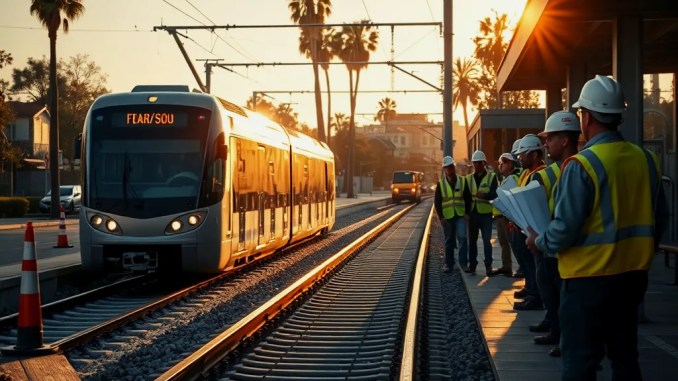
California allocates $66.58 million to nine rail projects, including Agnew Siding
California has awarded up to $66.58 million from the Flexible State Rail Assistance program to nine projects that improve capacity, reliability and day-to-day operations across the state’s passenger rail network. The awards prioritize near-term operating continuity for commuter systems, targeted infrastructure upgrades that remove chokepoints, and storage or siding capacity that reduces delays during high-demand events such as games and concerts at Levi’s Stadium.
Agnew Siding receives up to $3 million to reduce congestion near Levi’s Stadium
The Capitol Corridor Joint Powers Authority (CCJPA) will receive up to $3 million to build the Agnew Siding just south of Santa Clara–Great America station. That new track will provide trainset storage and enable service increases on Altamont Corridor Express (ACE) and other intercity services by reducing conflicts between passenger and freight movements. Increased storage capacity will let agencies run extra trains during events without pulling equipment off regular schedules.
How the Agnew Siding project will be built and contracted
Agnew Siding already holds multiple prior awards and design work. The California Transportation Commission (CTC) approved nearly $6.95 million in October 2025 for construction—$5 million from TIRCP and $1.95 million from Proposition 1A. The intended siding is roughly 2,600 feet long between mileposts 40.9 and 41.5 and sits on Union Pacific Railroad (UPRR) property, requiring coordination with freight-owner terms for construction and maintenance.
Because UPRR-required contract amendments can be complex, the CTC extended the window for CCJPA to award construction from April 30, 2026 to December 31, 2027. UPRR estimated in February 2026 that negotiating the needed changes could take approximately 18 months, a timeline that drove CCJPA to rebaseline construction costs. By September 2026 CCJPA revised the construction budget to about $15.068 million, with total project cost estimated at $16.51 million.
Funding history and current requests for Agnew Siding
Agnew Siding’s funding stream shows phased support across multiple state programs rather than a single consolidated grant. Key funding milestones include:
• March 2019: $1,441,969 from State Rail Assistance for preliminary design and pre-construction work.
• October 2024: A portion of a $14 million RAPID/TIRCP package that included Agnew Siding among several corridor projects.
• October 2025: $6.95 million for construction from TIRCP and Proposition 1A.
• September 2026: Budget rebaseline to $15.068 million construction estimate due to UPRR-driven cost increases.
• November 2026: Up to $3 million from the Flexible State Rail Assistance second-round awards.
These funding elements combine to cover design, construction administration, UPRR-required adjustments and contingency, although they are not simply additive because some awards fund broader programs or shared RAPID initiatives.
Which other agencies received operating or capital support and why it matters
The second-round Flexible State Rail awards emphasize two outcomes: keep commuter services running through the 2028 Olympics and complete targeted capital projects that unlock capacity.
Operating support: Metrolink won up to $20 million for two years of operating support to maintain current service levels through the 2028 Los Angeles Olympics and Paralympics. CalSTA highlighted that without this funding, Metrolink would likely reduce weekday and weekend frequency, degrading transit connections across the region. North County Transit District (NCTD) qualified for up to $7.316 million to retain 2028-level service through its fiscal year.
Capital and safety investments: Caltrans will receive up to $19.260 million to design and install Positive Train Control (PTC) between Gilroy and Salinas on the UPRR Coast Line — a prerequisite for reliable Salinas passenger operations and a key enabler for any future San Luis Obispo service extensions. CCJPA gained up to $4 million to replace aging signal equipment controlling the Davis grade crossings to reduce systemwide manual-mode failures that currently cause 30–45 minute delays when the system trips.
Caltrain, LOSSAN and SMART projects: practical examples of targeted improvements
Caltrain earned funding for two projects that demonstrate different approaches to capacity and technology testing. Up to $6 million will fund signal and track work to improve reliability along the Peninsula corridor; up to $4 million will subsidize a pilot battery-electric multiple unit (BEMU) service that aims to extend battery-assisted operations toward Gilroy and run demonstration trips to Salinas. BEMU pilots offer a low-emission way to trial off-wire service extensions without full electrification of the corridor.
LOSSAN will receive up to $1 million to complete a corridor optimization study—mapping operational constraints and short, medium and long-term investments that would yield measurable reductions in delay and capacity wins across a mixed passenger-freight corridor. SMART received up to $2 million to build a pedestrian grade crossing on Ward Street in Healdsburg, a final local element required to enable the Healdsburg extension to open by late 2028.
Nine awarded projects and their maximum awards
Below is a concise list of the nine award recipients and their maximum allocations. These figures summarize CalSTA’s announced upper limits; actual invoiced amounts will reflect contracts and eligible expenses.
• Metrolink — Operating support to 2028 Olympics: $20,000,000
• Caltrans — Gilroy–Salinas PTC design and construction: $19,260,408
• NCTD — Operating support through FY2028: $7,316,000
• Caltrain — Signaling and track work: $6,000,000
• Caltrain — BEMU pilot service: $4,000,000
• CCJPA — Davis crossings and signal upgrades: $4,000,000
• CCJPA — Agnew Siding: $3,000,000
• SMART — Ward Street pedestrian crossing: $2,000,000
• LOSSAN — Corridor optimization study: $1,000,000
How the Flexible State Rail Assistance program allocates funds
The Flexible State Rail Assistance program stems from 2017 Senate Bill 1, which dedicates a portion of diesel sales tax revenue to rail. The statute divides funds so that half supports commuter rail agencies and half supports intercity services. Within the intercity allocation, three corridors that operate scheduled intercity service each receive at least 25% of that share; CalSTA retains discretion over the remaining 25% to respond to state priorities and emergent needs—such as operating continuity ahead of a major event or funding short, high-impact capital projects.
CalSTA’s November 2026 awards represent the program’s second round of discretionary allocations. Since 2018, the program has distributed roughly $245.1 million across 11 agencies, with the new approvals adding another tranche targeted at both operations and capital readiness.
Quick implementation steps agencies must follow to use awarded funds
State and local agencies receiving Flexible State Rail Assistance typically proceed through these steps to convert awards into completed work:
1. Contracting and right-of-way agreements: Negotiate terms when projects use freight-owned property (UPRR), clarify maintenance responsibilities and finalize construction agreements.
2. Environmental and design approvals: Complete any remaining CEQA/NEPA tasks and finalize 30–100% design packages tied to grant milestones.
3. Procurement and bid packaging: Release construction or equipment procurements timed to funding windows; align staged payments with invoice schedules.
4. Construction mitigation and coordination: For mixed-traffic corridors, schedule work to minimize service disruption and coordinate single-track windows with passenger operators.
5. Commissioning and testing: For systems like PTC or signal upgrades, perform end-to-end verification, failover testing and operational training before revenue service.
What to watch next and tangible impacts for riders
Agencies will submit implementation schedules and funding drawdown requests following CA Transportation Commission and CalSTA milestones. Short-term impacts that riders should notice include fewer event-related delays near Santa Clara when Agnew Siding enters service, more reliable Davis station operations once the signal work completes, and preserved service frequencies on Metrolink and NCTD through the late 2020s. Mid-term benefits include a clearer path to extend passenger service toward Salinas and improved corridor-level planning from the LOSSAN optimization study.
For stakeholders tracking project progress, watch for final contract awards, UPRR agreement filings, and invoice milestones recorded by CalSTA and CTC; those documents will convert the announced maximums into actual funded scopes and schedules.








Be the first to comment