
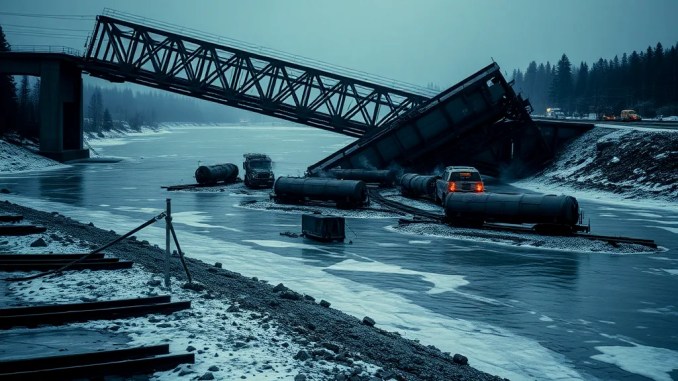
The Viled River rail bridge in Arkhangelsk region collapsed at 05:10 Moscow time on 10 November, causing a freight train derailment and stopping rail traffic on the Cheremukha–Viled section. Rescue trains were dispatched immediately, authorities cordoned the scene, and regional agencies began coordinating passenger movement by road while investigating the cause.
What happened at the bridge and how the derailment unfolded
Steel girders on the bridge failed under a freight consist, and several tanker wagons left the rails and came to rest near the collapsed span inside a snow-covered forest. Officials report no injuries. Track damage concentrated at the bridge approaches and the span itself, leaving rails misaligned and sleepers crushed where the structure fell. Emergency crews prioritized stabilizing the derailed wagons, securing hazardous-material risks from tankers, and establishing safe access for inspection teams.
Which passenger services were affected and immediate passenger solutions
Ten passenger trains experienced delays. Four trains were held at Solvychegodsk and Kotlas-Yuzhny stations (Adler–Vorkuta no. 310, St. Petersburg–Syktyvkar no. 98, Moscow–Labytnangi no. 22, Moscow–Vorkuta no. 376). Four more (Vorkuta–Novorossiysk no. 311, Vorkuta–Moscow no. 41, Labytnangi–Moscow no. 21, Vorkuta–Moscow no. 375) waited at Viled. Transport planners immediately contingency steps: (1) shuttle buses to carry passengers for the closed Cheremukha–Viled section; (2) standby trainsets prepared to resume services where tracks were intact; (3) on-site passenger welfare measures including heated tents at Viled station and food provisions for journeys delayed beyond four hours.
How authorities phased trains back into service
Regional officials reported that affected trains were returned to service in stages. One train reached its destination, two departed on time, and seven continued with delays up to six hours. Reintroduction followed this operational sequence: first, clear and inspect contiguous track segments; second, deploy replacement rolling stock where possible; third, arrange road links for passengers between isolated stations; fourth, prioritize time-sensitive freight and scheduled long-distance sleeper services. This stepped approach reduced total disruption while repair planning continued.
Why the region declared an emergency and what it covers
The Arkhangelsk governor activated a regional emergency regime citing the bridge collapse, associated cargo-wagon accident, and lingering infrastructure risks in the Vilegodsky district. The decree assigns a regional operations center to coordinate response and names the regional transport minister as incident lead. The emergency zone covers Vilegodsky, Velsky, Konoshsky, Kotlassky, Lensky, and Ustyansky districts plus the cities of Koryazhma and Kotlas. Declaring the emergency unlocked additional resources, accelerated permits for repair works, and established single-point command for interagency decisions.
How the repair operation is organized and expected steps to restore service
Authorities set up an operations center to coordinate North Railway (Kuzey Demiryollari) crews and the regional transport ministry. Key tasks and a likely repair sequence include: (1) site stabilization and environmental containment around derailed tankers; (2) structural assessment of the remaining bridge elements by engineers; (3) debris removal and salvage of derailed wagons; (4) temporary track reinstatement (shoofly or bypass) if terrain allows; (5) fabrication and installation of a replacement span or long‑term reconstruction. Timelines remain provisional because winter conditions and the need for heavy lifting equipment in a forested, snowbound area complicate mobilization. The operation center will also manage passenger flow alternatives and freight rerouting to minimize economic impact.
Risks, data points, and resource needs for a remote winter repair
Repairing a collapsed steel‑girder bridge in remote northern forest requires specialized resources and risk mitigation: heavy cranes and modular bridge segments transported over winter roads or via rail up to the closure point; qualified bridge engineers for integrity assessments; hazardous-material teams if tanker contents present a spill risk; thermal shelters and rotation schedules for crews working in subzero temperatures; Temporary signaling and power feed workarounds. Typical timelines for similar incidents range from several weeks for temporary restoration to months for full reconstruction depending on procurement, weather, and environmental remediation demands.
Practical effects on travelers and freight shippers now and in the short term
Passengers traveling on affected routes faced bus substitutions, longer journey times, and denied or delayed connections. Operators prioritized continuity for long‑distance services by using reserve sets and coordinating bus links. Freight operators must consider immediate rerouting, transshipment at unaffected hubs, or storage pending track restoration. Businesses dependent on predictable deliveries should expect scheduling variability for several weeks and plan contingencies such as inventory buffers or alternate transport corridors through southern routes.
What investigators will examine to determine cause
Investigators will analyze structural fatigue of girders, load distribution from the freight consist, track subgrade conditions, maintenance and inspection records for the bridge, and environmental factors (freeze–thaw cycles, permafrost effects, scour from the river). They will also review operational data (axle loads of the freight train, speed, braking patterns) and any recent works near the bridge. A thorough forensic timeline combining physical evidence and maintenance logs will guide corrective measures and liability determinations.
How regional authorities will keep passengers and stakeholders informed
The regional operation center coordinates public bulletins, updates to train timetables, and notifications to freight customers. Practical communication steps include: regular press releases with train status, station-level advisories for substituted transport, a dedicated hotline or web page for affected passengers, and liaison officers for major shippers. On-site measures such as heated waiting areas and meal provision improve passenger welfare while information channels reduce uncertainty and enable travelers to make alternate plans.
Meta note: This account synthesizes reported operational actions and typical rail recovery practices to present a comprehensive situation overview for travelers, transport managers, and local stakeholders.






Be the first to comment