
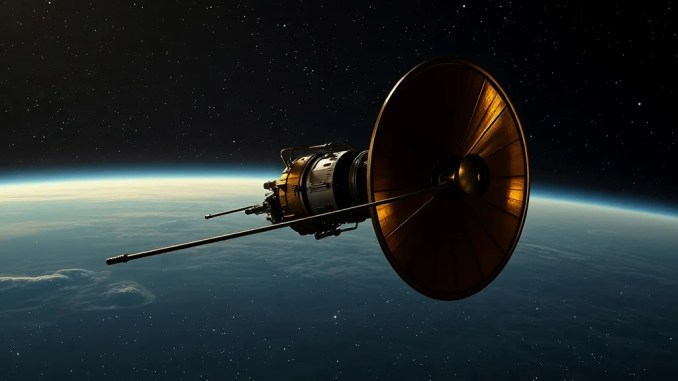
Voyager 1 launch purpose and initial trajectory
NASA launched Voyager 1 on September 5, 1977 to exploit a rare planetary alignment and perform close flybys of the outer planets. Engineers selected a faster, more direct trajectory than Voyager 2 so Voyager 1 could reach Jupiter and Saturn sooner and use gravity-assist maneuvers to extend mission reach. The spacecraft carried a compact suite of instruments designed to measure magnetic fields, charged particles, plasma, and take high-resolution imagery; mission planners prioritized long-life design and redundancy because the craft would travel far beyond the near-Earth environment.
Key discoveries at Jupiter and Saturn with concrete data
During the March 1979 Jupiter encounter, Voyager 1 directly recorded:
• Active volcanism on Io: thermal and visual data confirmed geyser-like plumes and supplied eruption energy estimates that estimated models of tidal heating.
• Detailed ring and atmosphere structure: imaging and spectrometry mapped cloud banding, wind shear, and thin ringlets, enabling quantitative atmospheric profile fits and particle size distributions.
At Saturn in November 1980, Voyager 1 produced:
• Titan atmosphere constraints: radio occultation and spectrometer data measured atmospheric pressure and composition profiles that informed later mission designs by establishing surface obscuration and entry challenges.
These measurements yielded calibrated datasets — magnetic-field vectors, charged-particle flux histograms, plasma density profiles, and multispectral images — that researchers still reference when validating simulation codes and interpreting later probe results.
How Voyager 1 crossed into interstellar space and why its measurements changed
On August 25, 2012 Voyager 1 moved beyond the heliopause, the boundary where the boundary solar wind’s influence gives way to the interstellar medium. Instruments recorded abrupt, sustained shifts in cosmic-ray intensity and plasma wave signatures, and a change in local plasma density consistent with entering a different medium.
Concrete measurement highlights include:
• Plasma density and wave spectra: plasma wave instrument detections of low-frequency oscillations allowed scientists to infer electron densities; inferred densities increased relative to heliospheric levels, revealing a denser surrounding medium than some pre-mission models predicted.
• Magnetic field behavior: magnetometer time-series showed shifts in field variability and local topology, clarifying how the heliospheric boundary reconnects or tangles with interstellar magnetic fields.
• Cosmic ray flux: particle detectors measured increased galactic cosmic ray intensities and decreased energetic particles originating from the Sun; these time-series enabled models of how the heliosphere attenuates or modulates incoming galactic radiation.
What Voyager 1 still measures today and why those data matter
Voyager 1 currently transmits magnetic-field vectors, plasma-related parameters inferred from plasma wave observations, and counts of high-energy cosmic rays. Those continuous streams matter because:
• Long-term trend analysis: decades-long records let scientists quantify secular changes and transient events in cosmic-ray flux and field fluctuations, isolating effects of solar-cycle modulation from spatial structure in the interstellar medium.
• Spatial comparison with Voyager 2: Voyager 2 crossed the heliopause in 2018 at a different heliospheric longitude; comparing both datasets reveals asymmetries and local irregularities in the heliopause shape and properties.
The Golden Record: design, contents, and cultural engineering choices
The 30 cm Golden Record carries 115 images, encoded sounds, and greetings in 55 languages, plus a curated music selection. Engineers and anthropologists balanced analog storage limits and cross-cultural representation: they included spoken greetings, natural sounds that define our planet acoustically (thunder, bird song, surf), and music ranging from classical pieces to folk and contemporary recordings. The record’s cover includes symbolic instructions intended to allow an intelligent finder to decode the analog engravings and locate the Solar System.
Operational limits: energy, communications delay, and planned instrument management
Voyager 1’s radioisotope thermoelectric generators (RTGs) produce steadily decreasing power as plutonium-238 decays. NASA logs show multi-watt annual declines; mission teams prioritize instruments and schedule staggered shutdowns to preserve power for critical systems. Communications lag increases as distance grows: by November 18, 2026 the one-way light time will approach ~24 hours (two-way ~48 hours). That delay forces command automation and pre-planned command sequences rather than real-time control.
Why November 18, 2026 is operationally significant
On that date Voyager 1 will reach a distance close to one light-day from Earth (roughly 25.9 billion kilometers). Technically this milestone changes how mission control operates because:
• Delayed telemetry responsiveness: troubleshooting cycles stretch over days; anomaly detection must trigger robust on-board fault protection and autonomy.
• Command sequencing becomes critical: mission planners will send multi-day command sets with embedded conditional logic and energy-aware timing to maximize scientific returns while avoiding inadvertent power drains.
NASA has announced operational changes focused on increased automation, tightened data-priority rules, and refined energy budgets timed to this growing delay.
Engineering techniques used to extend Voyager 1’s lifetime
Engineers applied and continue to apply specific methods to prolong operations:
1) Staggered instrument shutdown: teams maintain high-priority sensors (magnetometer, plasma wave instrument, cosmic ray detectors) longer while turning off lower-yield payloads.
2) Software and communications optimization: data compression, reduced telemetry cadence, and command bundling reduce energy consumed by transmitters and processors.
3) Thermal and power management: scheduled heater cycles and selective electronics power gating prevent cold-induced failures and balance available RTG output against essential loads.
Examples of research advances directly tied to Voyager 1 data
Researchers have used Voyager 1 measurements to recalibrate heliosphere boundary models and to improve estimates of galactic cosmic ray propagation near the Sun. Specific outcomes include:
• Updated input parameters for magnetohydrodynamic simulations that now better match electron-density inferences from plasma-wave detections.
• Improved radiation environment predictions used to size shielding for crewed and robotic missions beyond the inner heliosphere.
How Voyager 1 data shape designs for future interstellar missions
Concrete lessons from Voyager 1 have driven changes in spacecraft design and mission planning:
• Energy budgeting: RTG sizing and redundancy scenarios now factor in longer mission durations and slower decay-related margins observed ten Voyagers.
• Autonomy and comms architecture: mission designs emphasize fault-tolerant onboard decision trees, larger onboard data buffers, and communication protocols that tolerate multi-day round trips.
Concise operational outlook and legacy
Voyager 1 continues to provide unique, in-situ measurements from interstellar space while mission teams adapt to shrinking power and growing communication delays. The November 18, 2026 milestone marks a practical inflection point in operations: command sequences must be more autonomous and data priorities stricter. Beyond immediate operations, Voyager 1’s long-term datasets and engineering lessons continue to refine our models of the heliosphere and inform the architecture of future missions destined for the local interstellar medium.







Be the first to comment